
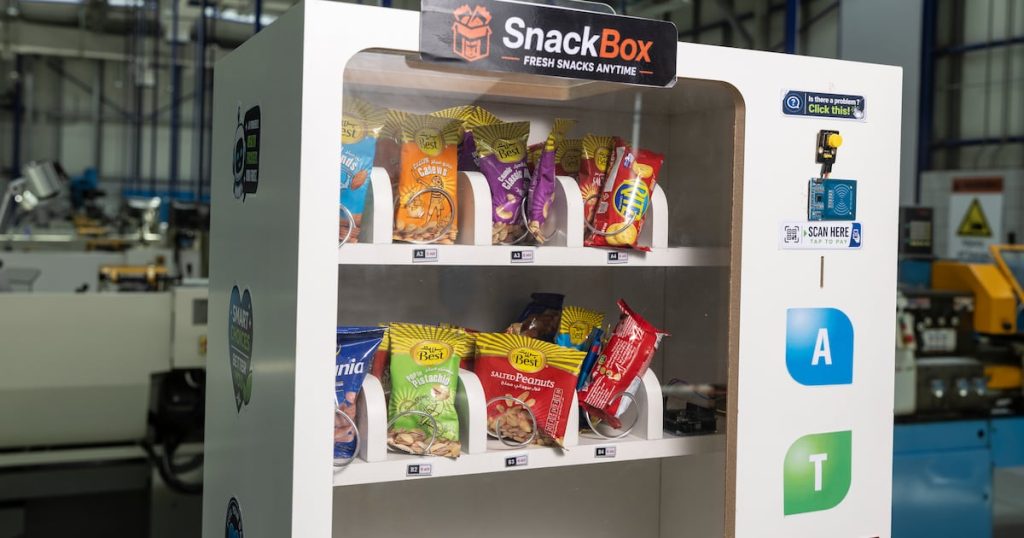
A UAE school is in line for global acclaim after developing a vending machine that uses facial recognition technology to prevent children from being served less healthy food.
The advanced device was developed by Emirati pupils at Applied Technology Schools – Sharjah in collaboration with the canteen staff. It refuses certain selections if the user has an allergy or is obese.
The project has been shortlisted for the Supporting Healthy Lives award in the World’s Best School Prizes, with hopes high that global recognition could help it to be rolled out more widely.
The idea was conceived following recognition at the boys’ school that traditional healthy eating campaigns had failed to achieve their aims.
Facing up to health challenges
Dr Wael Seitan, the school principal, said he was “very excited” that the invention had been shortlisted for the award.
“Some students have health concerns – allergies for some types of ingredients,” he told The National.
“Our students started investigating this idea. They started thinking about how they can come up with a solution. It allows students only to purchase [food] compatible with their health care.”
The Intelligent Health Food Dispensing Solution used artificial intelligence and was developed by pupils in grades 10 to 12 along with teachers, nurses, canteen staff, IT staff and parents. Prototypes were developed during workshop sessions.
It uses facial recognition technology in conjunction with a database holding information about allergies, illnesses and dietary restrictions affecting pupils.
If a pupil chooses food that conflicts with their health needs the system, which has access to pupils’ medical records and can see who is classified as obese, blocks the selection and the child’s parents are alerted.
Food for thought
Dr Seitan said that when the pupils were developing the vending machine, they learnt not just technical skills, but also how to create prototypes, improve them through workshops, understand and use data, and market their invention.
Some young people who worked on the project have gone on to study for degrees in science and technical subjects.
“We try to facilitate learning by pushing them to connect their projects to real-life scenarios. The next step is to create more than one [of the systems] and to distribute [them] across ATS campuses,” said Dr Seitan.
The Sharjah campus, which has 486 pupils, all Emirati, in grades nine to 12, is one of more than a dozen ATS campuses across the country.
The original vending machine has been tried out at an ATS campus in Dubai. Recognition from the World’s Best School Prizes will help roll the invention out beyond the ATS network, Dr Seitan said. The hope is that other schools and even hospitals might use the system.
Initiative reaps rewards
No food-related allergic incidents were recorded among 60 pupils with food allergies after the launch of the system, which has blocked more than 200 attempted selections of allergen-risk foods, said a statement from T4 Education, the founder of the World’s Best School Prizes.
Among 25 overweight or obese pupils, 70 per cent had reductions in their body mass index over two academic terms, according to the statement. In the first three months of the system’s use, healthy food selections went up from 45 per cent of items purchased to 68 per cent.
T4 Education is an online professional development and networking platform for teachers that aims, the organisation says, to share best practice between schools.
Global partnerships
Another UAE school, Nord Anglia International School Dubai has been shortlisted this year in the Community Collaboration category of the World’s Best School Prizes.
The school has forged links with organisations including Unicef, the Massachusetts Institute of Technology and New Yorks Juilliard music school, to allow pupils to develop projects in areas such as children’s rights and technology.
The other categories in the World’s Best School Prizes are Environmental Action, Innovation and Overcoming Adversity, and 10 schools are shortlisted in each.
A judging panel will apply “rigorous criteria” to choose the top three schools and winner in each category, which will be announced in November, T4 Education said.
One of the 50 shortlisted schools will be chosen by a public vote that opened on Thursday for a sixth prize, the Community Choice award.
Winning and shortlisted schools will be invited to share their ideas at the World Schools Summit in London on January 16 and 17.
In a statement, Vikas Pota, founder of T4 Education and the World’s Best School Prizes, congratulated the two shortlisted UAE schools.
“They have shown that the UAE’s schools truly stand among the best in the world,” he said.
He said each shortlisted school was helping to “prepare young people for a world that has never seemed so uncertain”.
“It is more important than ever that our schools grow the leaders we’ll need to face massive challenges from rising conflict and inequality to populism and climate breakdown,” he said.
“In their classrooms, every day, these institutions show what works. And governments and schools across the world should learn from their shining examples.”
In last year’s World’s Best School Prizes, Dubai British Schools Jumeirah Park, Arbor School in Dubai and Applied Technology Schools – Umm Al Quwain were shortlisted in the Community Collaboration, Environmental Action and Innovation categories respectively.
Arbor School triumphed in its category thanks to its environment-focused curriculum, making it the first UAE school to win in the contest.