
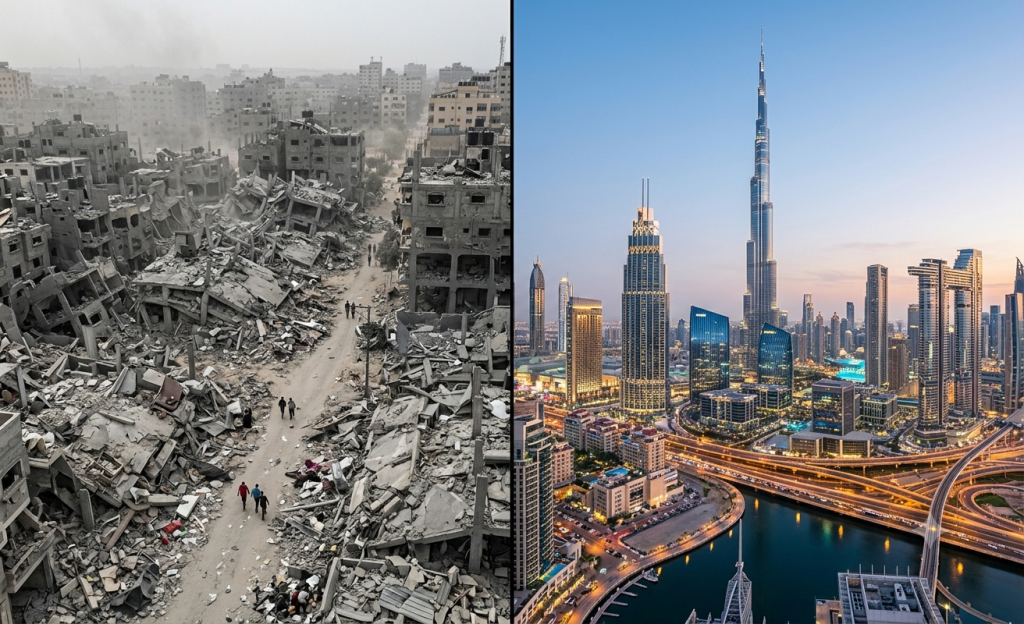
For the last six years, a particular narrative has circulated through the pro‑Israel media ecosystem: that the future of Middle Eastern stability lies not in resolving the Palestinian question, but in deepening ties with the United Arab Emirates. In this telling, the UAE is the leading Arab actor, the responsible regional stakeholder, the state most committed to dialogue and modernization. Gaza is treated as a humanitarian footnote. However, in the Israel-UAE dialogue, Palestinian political legitimacy is not just minimized; it is erased. And the states that actually hold the keys to Gaza diplomacy – Qatar, Egypt, Turkey, and Saudi Arabia – are pushed entirely out of the frame.
This narrative was always analytically flawed. But the events of the past year have revealed just how strategically dangerous it is for Israel itself. By acting as if Gaza were marginal and the UAE were central, Israel has misread the structure of the region, misjudged the sources of Arab legitimacy, and miscalculated the diplomatic environment in which it must operate. The result is an unprecedented level of international isolation and strategic exposure.
Gaza as the Regional Strategic Center of Gravity
Gaza is not simply a battlefield or a humanitarian crisis. It has become the regional strategic center of gravity – the place where even inaction produces international strategic effects. Gaza determines the legitimacy architecture of the Arab and Muslim worlds. It shapes the political bandwidth of the United States. It defines the diplomatic maneuver space of Saudi Arabia. It anchors the mediation authority of Qatar and Egypt. It influences Turkey and Pakistan’s political positioning. And it provides Iran with narrative leverage that no amount of military pressure can erase.
Every major regional file – Lebanon, Yemen, the Red Sea corridor, normalization, even Iran – ultimately routes back through Gaza. This was true long before the current war, and it remains true today. The idea that Israel could build a new regional order by elevating the UAE while sidelining Gaza was always a fantasy. The region does not work that way. Legitimacy does not work that way.
Saudi Arabia: The Central Arab Actor Israel Cannot Bypass
If there is a single Arab state whose position determines the trajectory of regional diplomacy, it is Saudi Arabia. Riyadh is the Custodian of Islam’s two holiest sites, the anchor of the Arab League, and the state whose decisions shape the political space for every other Arab government. Saudi Arabia – not the UAE – holds the core Arab legitimacy card on the Palestinian issue.
Riyadh cannot normalize with Israel without a credible Palestinian track. It cannot claim regional leadership while Palestinian political legitimacy is visibly denied. It cannot align publicly with Israel while Gaza remains the symbol of Arab and Muslim grievance. The very fact that Saudi Arabia has been unable to move forward on normalization is itself proof that Gaza, not the UAE, is the true hinge upon which Israel’s regional diplomacy swings.
Any regional order that ignores Saudi Arabia’s centrality is analytically unserious. Any narrative that elevates the UAE while sidelining Riyadh is strategically misleading. And any Israeli strategy that treats Saudi normalization as achievable without a Gaza‑centered diplomatic process is destined to fail.
The UAE cannot deliver what Israel needs
The pro‑Israel media narrative that elevates the UAE as the leading Arab actor is not just incorrect—it is strategically misleading. The UAE is wealthy, influential, and deeply integrated into Western security and economic networks. But it does not represent the Arab or Muslim world on the Palestinian issue. It does not possess legitimacy on the Gaza file. And it does not have the political or social authority to deliver the regional acceptance Israel seeks.
Across the Arab and Muslim worlds, the UAE is widely perceived as having traded Palestinian rights for economic and security benefits. It is seen as aligned with Israel, detached from Arab public sentiment, and fundamentally out of step with the region’s moral and political expectations. This perception is not fringe; it is mainstream. The UAE’s normalization with Israel was elite‑driven, not legitimacy‑driven. It cannot anchor a regional consensus on Gaza because it does not possess the legitimacy required to speak for anyone beyond itself.
By contrast, Saudi Arabia, Qatar, and Egypt—the three Arab states consistently erased from the pro‑Israel narrative—are the indispensable actors in Gaza diplomacy.
Qatar and Egypt: The indispensable mediators
Qatar holds the only meaningful leverage over Hamas and maintains channels with both Washington and Tehran. It is the only state trusted by all sides enough to mediate hostage negotiations, ceasefire frameworks, and political arrangements. Egypt controls Rafah, the Suez Canal, and the security architecture of the Red Sea. Its intelligence services are embedded in every Gaza negotiation. Any Gaza governance model, any ceasefire, any reconstruction plan—none of it is possible without Doha and Cairo.
Ignoring Qatar and Egypt is not just an oversight; it is a category error. They are not peripheral actors. They are system nodes.
The Strategic Backfire: Israel’s Isolation
The attempt to erase Palestinians from the political equation and elevate the UAE as the Arab voice has not strengthened Israel’s position. It has weakened it. Israel is now even more isolated in global public opinion than it was following the1982 Sabra and Shatila massacre in Beirut. It faces unprecedented diplomatic pressure in Europe, Africa, and Latin America. It has lost narrative ground in the Global South. And even in the United States, political support has become more conditional, more contested, and more confined to a shrinking Evangelical substrate.
This isolation is not the result of battlefield outcomes. It is the result of a legitimacy collapse centered on Gaza. By acting as if Gaza were marginal, Israel misread the structure of the regional system. It misread the limits of the UAE’s representational authority. It misread the centrality of Palestinian political legitimacy. And it misread the diplomatic environment in which it must operate.
The Iran war and its aftermath have exposed the gap between narrative and reality. Gaza is not peripheral. It is central. And Israel’s strategic exposure is the direct consequence of trying to bypass that reality.
Diplomacy as Strategic Necessity
Israel cannot control how Palestinians or Iranians respond to diplomacy. It cannot guarantee that negotiations will succeed. But it can control whether it is perceived as the advocate of diplomacy or its saboteur. And perception matters.
This is not about moral posturing. It is about strategic necessity. The international system will not accept a regional order built on Palestinian erasure. Saudi Arabia cannot normalize without a credible Palestinian track. Qatar and Egypt cannot mediate without Israeli buy‑in. And Israel cannot regain strategic security without restoring diplomatic legitimacy. Diplomacy is not a concession. It is a strategic asset.
The Path Forward Runs Through Gaza
The path to Israeli security does not run through Abu Dhabi. It runs through Gaza. It runs through a diplomatic process that acknowledges Palestinian political agency, engages Saudi Arabia, Qatar, Egypt and Turkey as indispensable actors, and aligns Israel with the international expectation that diplomacy—not force—is the preferred method to shape the region’s future.
Israel does not need to guarantee success. It needs to guarantee effort. Because the alternative is clear: continued isolation, strategic exposure, and a regional environment increasingly shaped by actors who understand the centrality of Gaza better than Israel’s own narrative architects.
Israel’s strategic security hinges primarily on Gaza and the West Bank. It always has.