
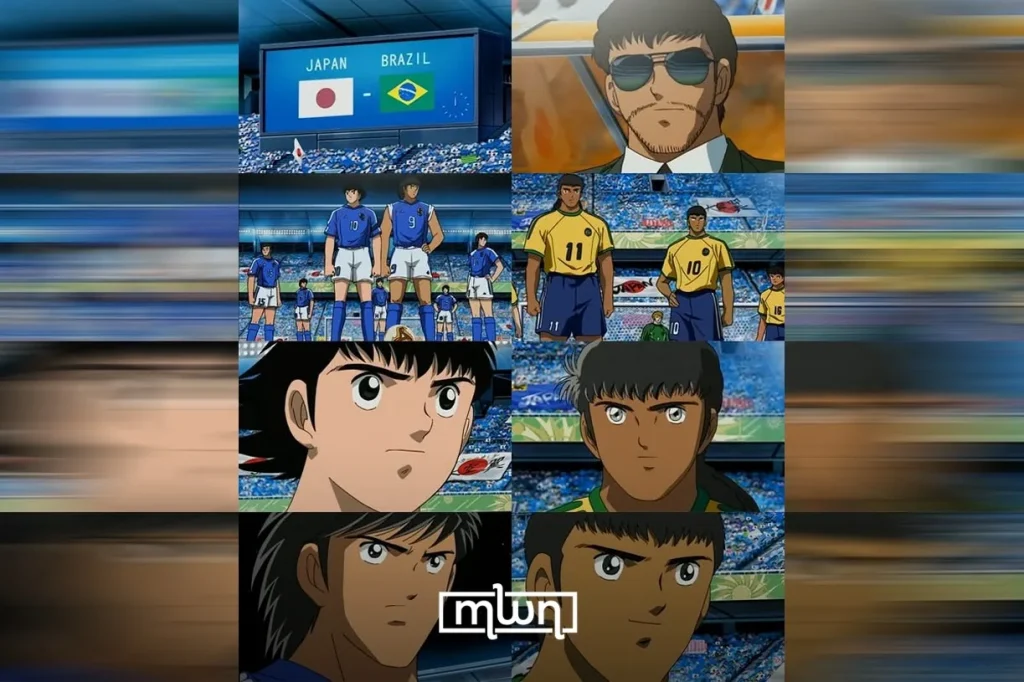
Rabat – Japan’s World Cup knockout match against Brazil will feel familiar to millions of football fans who grew up watching Captain Tsubasa, known across the Arab world as Captain Majid.
The two countries will meet in the round of 32 in Houston on Monday, turning one of the manga’s most famous football stories into a real match on the sport’s biggest stage.
The comparison is not exact. The fictional game was a youth tournament final, while the upcoming encounter involves the senior national teams in the first knockout round.
Brazil was always central to Tsubasa Ozora’s dream. It represented the highest level of football and the final challenge Japan needed to overcome to prove it belonged among the world’s strongest teams.
More than 40 years later, the real Japanese national team now has that opportunity.
A dream inspired by the World Cup
Creator Yoichi Takahashi became interested in football after watching the 1978 World Cup in Argentina while he was still in high school.
At the time, baseball was far more popular in Japan, and football received limited attention. Takahashi later recalled that many Japanese readers were not even familiar with the World Cup when his series began.
He published Captain Tsubasa in 1981, with the first television adaptation arriving two years later.
The story followed Tsubasa Ozora, a gifted young player whose main ambition was to become a professional and win the World Cup with Japan.
That dream appeared unrealistic when the manga began. Japan had never qualified for the men’s World Cup and did not yet have a professional national league.
Takahashi nevertheless created a world in which Japanese players could compete against the strongest football nations without fear.
Why Brazil was at the heart of the story
Brazil was not treated as an ordinary opponent in Captain Tsubasa. It was presented as the home of beautiful football and the destination where Tsubasa could complete his development.
One of the main characters in his journey was Roberto Hongo, a former Brazilian player who became Tsubasa’s coach and mentor.
Roberto taught him about Brazilian football and encouraged him to travel abroad. ‘
Tsubasa later moved to Brazil and played for a club based on São Paulo before returning to represent Japan at the World Youth Championship.
The series also introduced major Brazilian rivals, including Carlos Santana and Natureza.
Santana was shown as an exceptional forward with the talent to challenge Tsubasa, while Natureza represented another level of Brazilian creativity and unpredictability.
The World Youth storyline eventually ended with Japan facing Brazil in the final.
In the canonical manga story, Japan won 3-2 after extra time, with Tsubasa scoring all three goals, including the decisive winner.
The result represented more than a trophy. It completed Takahashi’s vision of a Japan capable of standing level with the country that had inspired so much of the story.
Captain Tsubasa became far more than an entertainment series.
Its popularity encouraged generations of Japanese children to play football and helped the sport gain attention during the years before the creation of the J.League in 1993.
The FIFA Museum has recognized the manga’s cultural influence, describing it as a work that helped generate interest in football in Japan and around the world.
Several professional players have also spoken about growing up with the series.
The distance between fiction and reality gradually became smaller. Japan qualified for its first men’s World Cup in 1998 and has appeared at every edition since.
Japanese players also began joining leading European clubs, following a path similar to the international careers imagined for Tsubasa and his teammates.
Japan has already defeated Brazil
The World Cup meeting will not be Japan’s first chance to test themselves against Brazil.
The countries previously met at the 2006 World Cup, when Brazil won 4-1 during the group stage.
However, Japan produced a historic result in October 2025 by defeating Brazil for the first time.
Brazil led the friendly 2-0 at halftime in Tokyo, but Japan completed a remarkable comeback to win 3-2.
Takumi Minamino began the recovery before a Brazilian own goal brought Japan level. Ayase Ueda then scored the winner with a powerful header.
The final score was the same as Japan’s fictional victory over Brazil in the Captain Tsubasa: World Youth storyline.
That friendly was not a World Cup knockout match, but it showed that Japan no longer view Brazil as an unbeatable opponent.
From fiction to the World Cup
Brazil reached the round of 32 after finishing first in Group C, while Japan advanced as the runners-up in Group F.
The five-time champions remain favorites, but Japan coach Hajime Moriyasu believes his team’s recent progress gives it a genuine chance.
For longtime fans, the match will carry an emotional meaning beyond qualification.
There will be no Tsubasa Ozora, Carlos Santana or Natureza on the field in Houston. The real players will write their own story.
Captain Tsubasa did not predict the exact date, city or stage of this match.
What it imagined was a future in which Japan would enter a major game against Brazil believing it could win.
That future has now arrived.