
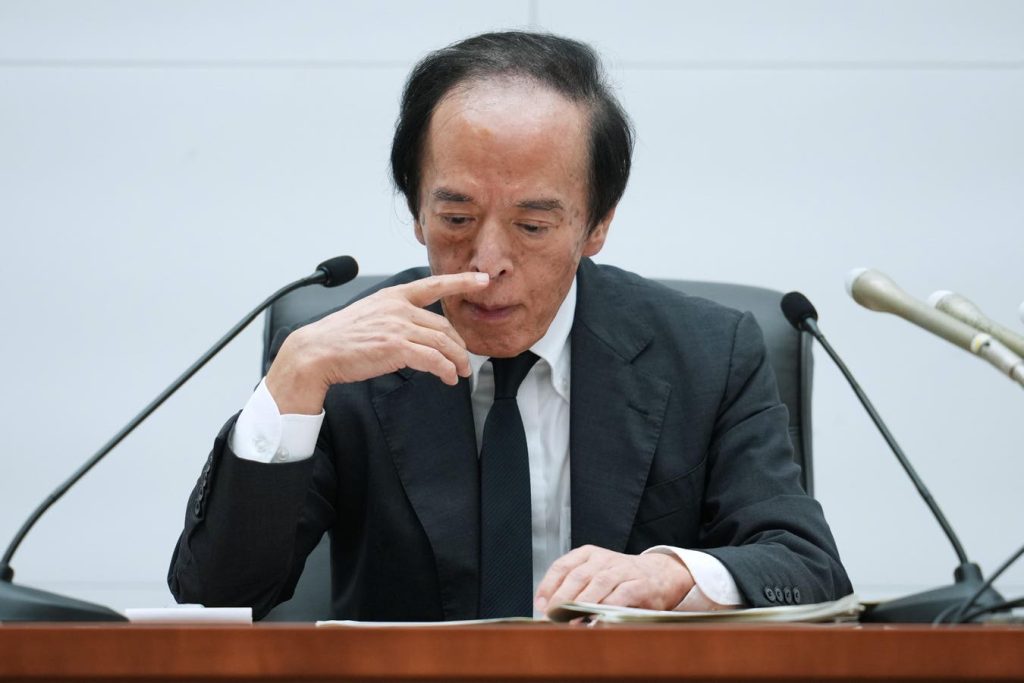
Kazuo Ueda, governor of the Bank of Japan (BOJ), during a news conference at the central bank’s headquarters in Tokyo, Japan, on Friday, July 31, 2026.
Hanai/Bloomberg
Bank of Japan Governor Kazuo Ueda’s carefully laid plans for 2026 are unraveling in real time.
First came the U.S.-led conflict with Iran. Then fresh tariffs from the Trump administration. Now the so-called “bond vigilantes” are circling, constraining Ueda’s ability to keep raising rates.
The 2026 plan was straightforward: push short-term rates up toward the 1% mark. In June, the BOJ hiked its benchmark to 1%, a 31-year high. Since then, a string of forces has conspired to stall a tightening campaign markets had treated as a foregone conclusion. None looms larger than the activist bond traders who periodically take matters into their own hands.
As the year unfolds, the bond market is becoming a growing headache for Ueda — largely because of Prime Minister Sanae Takaichi’s fiscal agenda. Details remain fluid, but Takaichi’s Liberal Democratic Party is pushing to boost economic support, including budget-busting tax cuts.
This has been Takaichi’s priority since taking office in October. A disciple of former Prime Minister Shinzo Abe, she favors government spending and monetary easing over supply-side reform. That approach, however, risks colliding with the bond market.
The dynamic is becoming a global concern. Japan carries the heaviest debt burden in the developed world, drawing scrutiny from Washington, where Treasury Secretary Scott Bessent has been pressing the BOJ to tighten.
Over the past two weeks, Bessent’s team has made headlines by leaning on the BOJ with an intensity unseen since 1998 — and intervening with Tokyo to boost the yen.
“The decision to launch intervention on July 30 should reflect a strong determination by the authorities to support the yen,” says Bank of America strategist Shusuke Yamada. “Moreover, the fact that the operation was coordinated suggests that extensive currency diplomacy took place beforehand.”
The push has less to do with Japan’s interests than with Washington’s desire for a weaker dollar.
Since January 2025, President Trump has tried unsuccessfully to prod the Federal Reserve into cutting rates. If the Fed won’t budge, nudging the BOJ to tighten offers another route to help U.S. manufacturers. But the calculus is complicated: Japan is by far the largest foreign holder of U.S. Treasuries, with holdings approaching $1.2 trillion.
Bessent’s real fear is that turbulence in Japan’s bond market will spill over into the $31 trillion Treasury market — better to defuse that risk early. It’s a lesson he learned firsthand during his hedge fund days: trouble in Japan tends to go global fast.
The “yen-carry trade” has been known to sink hedge funds over the past 25 years. It works like this: investors borrow cheaply in Tokyo to chase higher-yielding assets elsewhere. When the yen moves sharply, those bets can unwind violently, rattling markets far beyond Japan.
That’s only part of Ueda’s problem. Takaichi’s fiscal ambitions are the more pressing concern. With a debt-to-GDP ratio of 260% and a shrinking population, this is hardly the moment to open the fiscal floodgates. Yet Takaichi has shown no appetite for anything but more stimulus — paired with pressure on the BOJ to stand down.
In 2024, she called it “stupid” for the BOJ to even consider hiking. So it’s a safe bet her administration will pull out all the stops to keep the central bank from tightening further — a campaign likely to rival Trump’s own pressure campaign against the Fed.
Expectations that the Fed will hold rates steady while the BOJ pauses help explain why the yen has surrendered roughly half its post-intervention rally. So do growing doubts that the bond market will let the BOJ keep normalizing rates at all. The bottom line is that whether Japanese rates go up is less Ueda’s call than the bond market’s.