
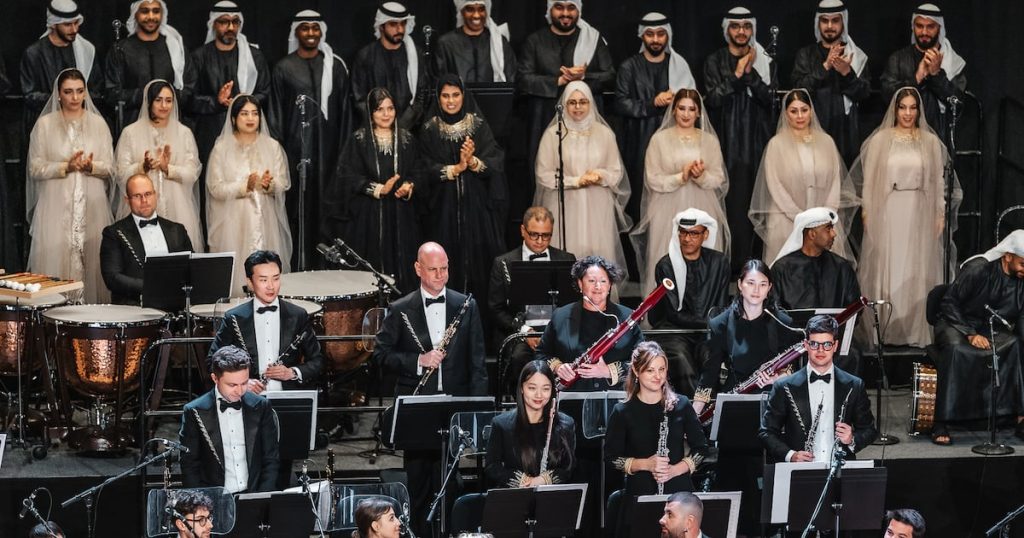
The five-decade history of Emirati film and television will be revisited on stage by the UAE National Orchestra.
On Thursday, the ensemble will return to public programming with From Screen to Stage at Abu Dhabi’s Cultural Foundation, in a concert designed to remind audiences of that legacy.
The programme features nearly 30 pieces of film scores and television theme songs, from pioneering Emirati productions to the familiar advertising jingle of the still-running Arabic children’s magazine Majid.
But artistic planner Fatima Al Hashemi says the concert is doing more than stirring nostalgia; it also reflects one of the orchestra’s central aims since its formal launch last year.
“One of the pillars of the orchestra is to help build a national library of concerts and programmes that we are going to commission or arrange,” she tells The National. “So it’s not only about performances, but also about recording them in order for us to build that archive of Emirati music to keep and to transmit for the next generation.”
The programme also highlights the role the country’s fledgling creative industries played in the UAE’s formative years.
Al Hashemi recalls her school years in the 1990s through the Wednesday ritual of buying the latest edition of Majid, first published in 1979 and now released monthly.
In the days before each issue appeared, its advertising jingle would announce its arrival. It begins with the crowing of a rooster before moving into a theme song in which a child singer lists the characters featured in the latest edition.
“That jingle is the sound that says Wednesday is coming and you hope you get the money to go to the grocery and get the magazine after school. I feel many people will feel goosebumps because it is a reminder of the simple life many of us used to lead.”
That also extends to renditions of classic 1999 Emirati Ramadan comedies Hayer Tayer and Khalil Fi Mahab Al Reeh, both starring pioneering Emirati actor Jaber Naghmoush.
More than light entertainment after sunset, the shows used separate storylines to touch on the local friction between tradition and modernity, and how the UAE’s growth could also be traced in the everyday life of an Emirati “freej” or neighbourhood.
Al Hashemi, who is a trained soprano and pianist, says the experience offers a chance to trace how Emirati musical scores evolved.
“That was so interesting because at the beginning from around the 1970s, you can hear that composers used the Emirati identity more, through the use of percussion and folk melodies. Over the years, the compositions became more expansive, cinematic and very contemporary, while still maintaining local elements.”
That shift is especially clear in the television scores, many of which are vocally driven. Therefore, the concert serves as a showcase for the orchestra’s 30-piece choir performing throughout the evening.
“Part of the value of the show comes from the orchestral and choral arrangements,” Emirati member Faisal Al Jassim says. “Many people think they know these songs well, but I think they will be surprised when they hear them reworked for a large ensemble.
“Some may be surprised by the depth of these works that we are able to highlight in this format, and I think people will realise how these seemingly simple songs are more complex and beautiful than they thought.”
Al Jassim also sees the programme as reflecting what the UAE National Orchestra is trying to represent more broadly.
Since making its public debut in January with the commissioned piece The Beginning at the sold-out Emirates Palace Auditorium, the orchestra has gone on to perform across the UAE with an eclectic programme featuring works by Vivaldi played on Arabic instruments, alongside compositions inspired by Rumi’s poetry in Faces of Love.
“Music itself, and the way it is played, is really the voice of the UAE. It is varied and evolving, but still rooted and carries an authentic core,” he says. “And the choir is an essential part of that because for Arab audiences, it is the words that often carry the memory as strongly as the melody.”
Al Hashemi says the format will be used again to explore other eras and regions.
“We hope the show will cement the blueprint, in that we start with the Emirati version and then next we could go in different directions, from Khaleeji, Egyptian and so on,” she says. “The most important thing is how to showcase and highlight the development of cinema, television and music in the region, and how that is always evolving.”
From Screen to Stage by the UAE National Orchestra is on April 16 at Culture Foundation Abu Dhabi. Show starts 8.30pm; tickets from Dh100