
Published on
May 30, 2026

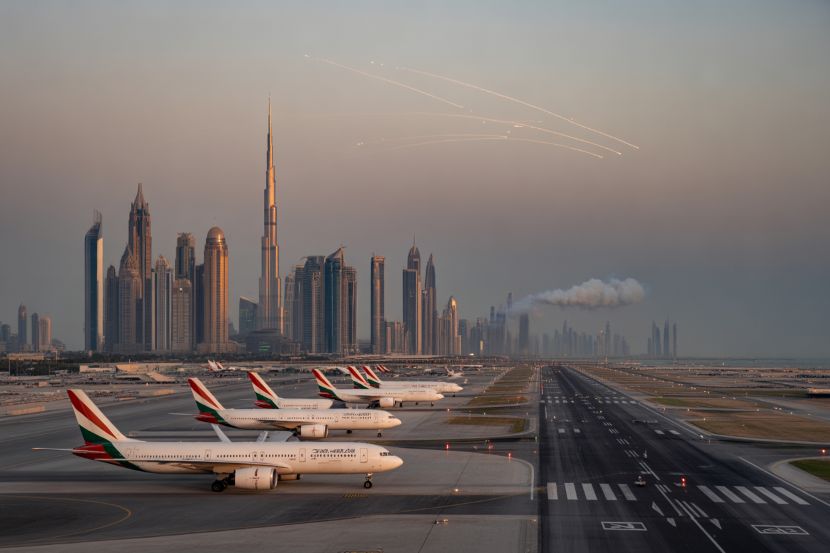
Image generated with Ai
The United Arab Emirates has found itself at the center of a rapidly expanding regional security crisis after a drone attack near Dubai International Airport left four people injured, including an Indian national, while Iran intensified pressure across the Persian Gulf through maritime seizures, threats against economic infrastructure, and actions targeting strategic transport corridors. The incident has amplified concerns across the aviation, tourism, logistics and energy sectors, particularly as Dubai remains one of the world’s most important international transit hubs.
The latest developments have unfolded against the backdrop of a broader Iran Gulf conflict that is now affecting commercial shipping, airline operations, business travel and global oil markets. While UAE authorities have maintained that critical infrastructure remains operational, the attacks have triggered heightened security measures, remote-working arrangements at several multinational firms, and growing uncertainty among travelers using Gulf airports as connecting gateways between Europe, Asia and Africa. The ripple effects are being felt far beyond the Middle East, with airlines, energy traders and international tourism stakeholders closely monitoring every new escalation.
How Dubai and Abu Dhabi Became the Latest Flashpoints in a Wider Regional Conflict
The security situation deteriorated significantly after drones were reported near Dubai International Airport, one of the busiest international passenger hubs on the planet. Authorities confirmed that four people suffered injuries during the incident, while separate interception operations were conducted in Abu Dhabi, where a fire reportedly broke out near the old airport following defensive action against an incoming aerial threat.
The attack represents a notable shift in regional risk calculations. Traditionally viewed as secure gateways for international tourism and business travel, Dubai and Abu Dhabi now find themselves increasingly exposed to the spillover effects of military escalation across the Gulf.
Advertisement
Advertisement
For aviation stakeholders, the implications are significant. Dubai International Airport serves as a crucial transit point connecting Europe, Asia, Africa and Oceania. Any disruption at the facility has the potential to affect thousands of flights and millions of passengers annually.
Aviation Impact Snapshot
| Sector | Potential Impact |
|---|---|
| International Flights | Delays, rerouting and schedule adjustments |
| Airlines | Increased fuel and insurance costs |
| Tour Operators | Rising traveler concerns |
| Business Travel | Higher security assessments |
| Cargo Operations | Longer transit times and logistics costs |
Strait of Hormuz Emerges as the World’s Most Sensitive Economic Chokepoint
While the airport incident captured global headlines, the bigger economic story may be unfolding at sea.
Advertisement
Advertisement
Iran’s Revolutionary Guard Corps announced actions against vessels in the Strait of Hormuz, a narrow maritime corridor that handles roughly one-fifth of global oil transportation. Maritime security concerns have intensified after reports of vessel seizures, drone attacks, mining threats and disruptions to shipping traffic.
Industry analysts consider the Strait among the most strategically important waterways in the world. Any interruption can rapidly influence oil prices, insurance premiums, freight rates and airline operating expenses.
Advertisement
Advertisement
Why the Strait of Hormuz Matters
| Indicator | Significance |
|---|---|
| Global Oil Flow | Around 20% of world oil trade passes through the corridor |
| Strategic Importance | Connects Gulf producers to international markets |
| Shipping Exposure | Major route for crude oil, LNG and commercial cargo |
| Travel Impact | Direct influence on aviation fuel pricing |
Recent reports indicate traffic through the waterway dropped sharply during periods of heightened military activity, reflecting growing caution among ship operators and insurers.
Oil Markets Stabilize, But Travel Costs Could Remain Elevated
The energy sector reacted immediately to the crisis.
The International Energy Agency (IEA) approved the release of approximately 400 million barrels of emergency oil reserves, the largest coordinated release in its history, in an effort to stabilize markets and reduce supply shock risks.
Although oil prices retreated from earlier spikes, benchmark Brent crude remains considerably above pre-conflict levels, creating challenges for airlines already dealing with operational disruptions.
Advertisement
Advertisement
Energy Market Developments
| Factor | Current Situation |
|---|---|
| Emergency Oil Release | 400 million barrels approved |
| Brent Crude Trend | Remains elevated versus pre-conflict levels |
| Airline Costs | Increased fuel expenditure |
| Global Inflation Risk | Higher transportation and logistics costs |
| Tourism Sector | Potential airfare increases |
For travelers, the consequence may not be immediate flight cancellations but gradually rising ticket prices, especially on long-haul routes that depend heavily on Gulf transit hubs.
Banking Sector and Corporate Travel Networks Shift Into Risk Management Mode
The security environment is also affecting the financial industry.
Several international banks and multinational corporations operating across the UAE and wider Gulf region have reportedly implemented remote-working arrangements and contingency planning measures. Standard Chartered clarified that operations continue across Dubai and West Asia under work-from-home frameworks rather than complete office evacuations.
Corporate travel managers are increasingly monitoring developments because Dubai remains one of the most important locations for regional conferences, exhibitions and financial services events.
The city’s position as a global business hub means even limited disruptions can have consequences for international meetings, incentive travel programs and investment-related mobility.
What Travelers Should Know Before Flying Through the Gulf
Despite heightened tensions, major Gulf airports continue to function, although aviation experts recommend closer monitoring of airline updates.
Advertisement
Advertisement
Travelers transiting through Dubai, Abu Dhabi, Doha or other Gulf hubs should pay particular attention to:
- Airline schedule changes
- Airspace restrictions
- Travel insurance coverage
- Transit requirements
- Government travel advisories
The broader aviation industry has already experienced widespread rerouting across parts of the Middle East, forcing airlines to take longer paths and increasing operational expenses.
Business travelers with flexible itineraries are increasingly building additional transit time into journeys as carriers adapt to evolving airspace conditions.
A New Reality for Gulf Tourism, Aviation and Global Trade
The latest Dubai Airport drone attack illustrates how regional conflicts are no longer confined to military zones but increasingly intersect with commercial aviation, tourism infrastructure, financial centers and global supply chains.
For the UAE, maintaining confidence in its airports, ports and tourism ecosystem has become as important as defending physical infrastructure. Dubai’s reputation as a safe and efficient global gateway remains a critical pillar of its economy, particularly as the emirate continues attracting international visitors, investors and multinational companies.
At the same time, developments in the Strait of Hormuz crisis underscore how closely interconnected modern travel and energy systems have become. A disruption in a shipping corridor can influence airline ticket prices, business travel patterns, hotel demand and even tourism growth thousands of miles away.
As Gulf governments strengthen security measures and international markets search for stability, travelers, airlines, investors and tourism operators are likely to remain on high alert, watching whether the region moves toward de-escalation or enters a more prolonged phase of uncertainty.
Key Developments at a Glance
| Event | Outcome |
|---|---|
| Drone incident near Dubai International Airport | Four people injured |
| Abu Dhabi interception operation | Fire contained after defensive response |
| Strait of Hormuz maritime actions | Increased shipping concerns |
| IEA emergency reserve release | 400 million barrels approved |
| International banking sector response | Remote work and contingency measures |
| Aviation sector impact | Route adjustments and cost pressures |
Advertisement
Advertisement
