
Customers eat dinner at Wing Fat Seafood Restaurant, a dai pai dong in the Yau Mai Tei district of central Kowloon in Hong Kong.Esme Anderson/The Globe and Mail
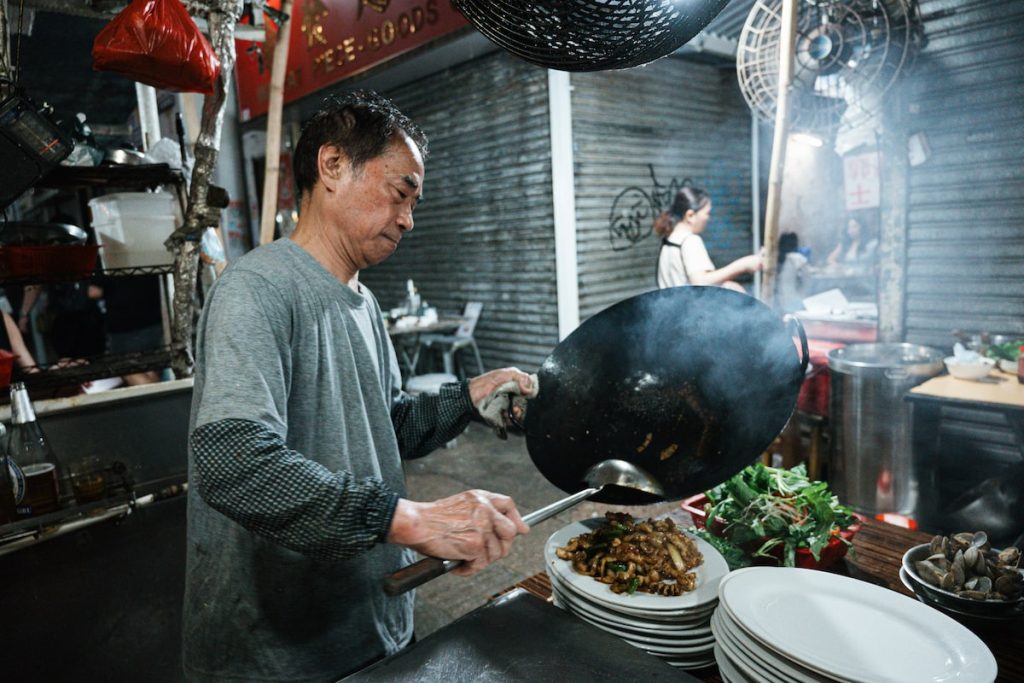
Keung Kee is a dai pai dong, a type of open-air food stall that was once ubiquitous across Hong Kong. Busy even on a humid spring evening in the middle of the week, both customers and staff jostle for space on a small side street in Sham Shui Po, a working-class neighbourhood. Traditional Cantonese dishes are cooked in a giant wok and served outdoors on tables covered in red plastic for easy cleaning.
Shouting to be heard over the roar of a kerosene burner and the near-constant clatter of knives, Gwo Hak-fung is doubtful about the prospects of his six-decade-old restaurant. Red tape and pressure from landlords have made things difficult for many dai pai dong, and today there are fewer than 20 across a territory of 7.5 million people.
“There isn’t really any future − once the licence is gone, it’s gone,” Mr. Gwo said.
The chef at Keung Kee, another dai pai dong located on a side street in the Sham Shui Po neighbourhood, plates a dish for customers.Esme Anderson/The Globe and Mail
Black bean clams at Keung Kee.Esme Anderson/The Globe and Mail
Hundreds of dai pai dong were opened in the decades after the Second World War − the name literally translates to “big-licence stall,” a reference to the size of the government plaque operators had to display − as Hong Kong’s population boomed with an influx of migrants and refugees from China.
But since the 1970s, the authorities have stopped issuing new licences and have restricted the transfer of existing ones to immediate family members. As Hong Kong became an international financial centre, successive administrations took a dim view of dai pai dong. As did the property developers throwing up luxury estates across the city, regarding the slightly chaotic outdoor stalls as a blight on Hong Kong’s new gleaming skyscrapers and banks.
“Dai pai dong were always meant to be a temporary policy,” said Vivien Chan, a U.K.-based design historian who has written extensively on the topic. Officials sought to wind them down as they began to prioritize foot and road traffic in business districts and as formerly public spaces became increasingly privatized. “Pressure from private developers to remove hawkers or dai pai dong mirrors this history − rather than simply being unsightly, it’s also about who gets to control space.”
Unable to pass on their licences after the original owners died, many dai pai dong went out of business or were forced inside, either to government-run markets or private premises. Indoors, a former dai pai dong is much like any other restaurant, without the charm of al fresco dining and facing far tighter regulation on the use of kerosene, vital to create “wok hei,” the unique flavouring imparted by an intensely hot pan wielded by a master chef.
“You have to have it for the wok hei,” Eric Chau, the owner of Wing Fat Seafood Restaurant, a dai pai dong in the Yau Mai Tei district of central Kowloon, said of kerosene. Asked if he would ever consider using an electric heat source, Mr. Chau cursed before saying, “No, no, no, never.”
The death of the dai pai dong has been long foretold, becoming almost a cliché in writings about Hong Kong. And yet, even as their numbers have dwindled significantly, dai pai dong persist, a version of the city’s vaunted “Lion Rock Spirit,” or can-do attitude.
Eric Chau took over Wing Fat Seafood Restaurant from his mother, left, and invested in promotion to nearby tourists, including a flashy LED sign. It paid off, just as official policies have shifted toward more support for dai pai dong.Esme Anderson/The Globe and Mail
Boiled shrimp at Wing Fat Seafood Restaurant.Esme Anderson/The Globe and Mail
Tourism represents a potential lifeline, as exemplified by Mr. Chau’s restaurant. The son of the original owners, Mr. Chau returned from Britain to Hong Kong during the pandemic to take over the 38-year-old Wing Fat and has since overseen a successful “global marketing” campaign.
“I spent a good amount of money promoting the restaurant to nearby countries like Korea, Japan, the Philippines, and it has turned out great,” he said. “For example, now, the biggest nationality of tourists we see is Korean.”
The campaign has been so successful that Mr. Chau has pulled back, wary of the long queues that were already forming during the high tourism season. “Our food is nice and the vibe is good, but no one wants to wait, like, two hours for a table.”
The government has taken note of Wing Fat’s success, using the restaurant in official tourism campaigns, which in turn has empowered Mr. Chau to demand greater support and to push back against still-persistent Food and Environmental Hygiene Department inspections.
“There has been a shift. The Tourism Bureau didn’t used to have a lot of power, but they do now,” he said. “The government didn’t care about us. Now they try to help. What we’re doing here doesn’t just benefit my family, but the whole street. We drive tourism to this area, which they failed to do for 10 years.”
In a debate last year, members of Hong Kong’s “patriots-only” legislature spoke out in favour of relaxing licensing and offering more support for hawkers, including dai pai dong operators.
Lawmaker Doreen Kong, whose mother worked as a hawker, said governments all over the world have recognized the value of street food stalls, both for locals and in attracting tourism, including Singapore and Shenzhen, just across the border from Hong Kong in China.
An open-air food preparation area at Keung Kee Dai. Owner Gwo Hak-fung worries ‘there isn’t really any future’ for restaurants like his, but the importance of tourism has a chance to change that.Esme Anderson/The Globe and Mail
“Despite the deep roots of Hong Kong’s hawker culture, the policy emphasis on law enforcement over the years has equated hawkers with street obstruction,” she said. “However, public space belongs to all Hong Kong people by nature, and the government needs to shift from enforcement to a governance model that emphasizes cultural preservation, economic vitality and community cohesion.”
Even as official policy has shifted in favour of protecting dai pai dong, it seems that those most likely to benefit are restaurants in areas with heavy tourist traffic, such as Yau Ma Tei or the Central district, where there are always long lines outside several stalls on Stanley Street. The area often features in posts about visiting Hong Kong on Xiaohongshu, China’s answer to Instagram.
“Hawkers and dai pai dong from various areas are treated differently based on how visible they are in the global narrative of the city,” Ms. Chan said. Scant attention is paid, however, to “the livelihoods or social, political and cultural contributions of hawkers.”
This could leave restaurants in more obscure, working-class neighbourhoods out in the cold, cutting off dai pai dong from the very demographic they initially catered to.
“Dai pai dong connect many classes of people,” Mr. Chau said. “We don’t care where you’re from. Unlike some fancy fine-dining place, you can come here shirtless, bring your dog, your cat, and just chill and eat food. Unless you’re bothering someone, no one cares what you do.”
With a report from Esme Anderson