
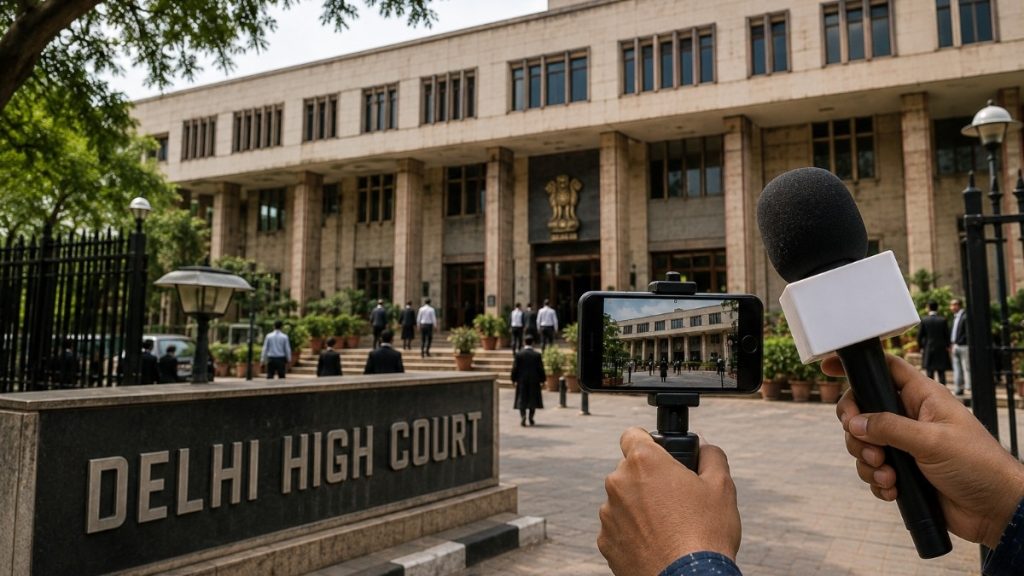
Observing that virtually anyone armed with a mobile phone and microphone can today claim to be a reporter without accountability, the Delhi High Court has called for a legal framework to regulate the media while safeguarding press freedom.
Justice Girish Kathpalia made the remarks while granting bail to two men accused of assaulting freelance YouTube reporters during a 2025 incident in northeast Delhi‘s Seemapuri.
“Today, virtually anyone armed with a mobile phone and a microphone can proclaim themselves to be a ‘reporter’, often without any journalistic training, ethical grounding, or accountability,” the court observed.
It stressed that freedom of the press remains a cornerstone of democracy but cautioned that it cannot be used as a shield for irresponsible journalism, intimidation, or content that threatens public order.
“Of course, the freedom of the press must remain zealously protected. But, it cannot become a shield for irresponsible journalism, intimidation or the dissemination of content that jeopardizes public order,” the court observed.
COURT FLAGS RISE OF SELF-STYLED REPORTERS
The observations came during the hearing of bail pleas filed by Abid Ali and Fukran, who were arrested in connection with an alleged attack on two freelance YouTube reporters.
According to the prosecution, the reporters were recording a video about an allegedly illegal place of worship in Seemapuri in July 2025 when they were attacked by a mob. The mob allegedly snatched their mobile phones and camera battery.
While Ali claimed he was merely a bystander, Fukran argued that he was not present at the scene.
During the hearing, the High Court noted that the reporters had apparently agitated local residents while filming for their report.
Justice Kathpalia observed that “self-styled reporters” at times aggressively question subjects and create misleading narratives, raising concerns about the growing influence of unregulated digital journalism.
WARNING AGAINST SENSATIONALISM, SELECTIVE REPORTING
The court also expressed concern over selective reporting, sensationalism and the publication of unverified allegations. It warned that such practices could deepen social divisions, inflame public sentiments and even trigger communal disharmony or public disorder.
“Such conduct has the potential to deepen social divisions, inflame passions and, at times, even trigger communal disharmony or public disorder. The media must recognise that with the power to shape public opinion comes an implicit attendant duty to exercise restraint, fairness and responsibility,” the court said.
Highlighting the need for professional standards in journalism, the High Court said the time had come for lawmakers to consider a framework that balances press freedom with accountability.
“The time has come for the legislature to consider an appropriate regulatory framework that preserves freedom of press, while ensuring professional accountability, ethical standards, and respect for the rule of law, the rights of citizens and the larger public interest,” the court observed.
The court ultimately granted bail to both accused, but used the occasion to underline the challenges posed by the rise of unregulated digital media and the need for ethical safeguards in journalism.
– Ends
(with inputs from Bar and Bench)