
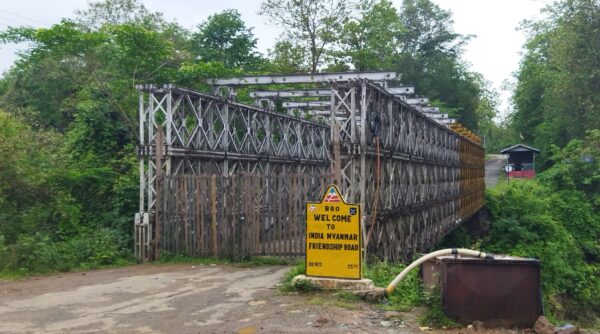
Speculation is rife about a plan being considered by the Indian government to exchange territory with neighboring Myanmar to facilitate demarcation of a part of the boundary that has remained unresolved for decades.
An official document seen by The Diplomat mentions a proposal being examined by the Indian government to complete the demarcation of the boundary between border pillars 65 and 68 along Manipur’s border with Myanmar. The document says 1.4 squar miles is “proposed” to be exchanged with Myanmar following a proposal from the foreign secretary.
The territory that is being considered for exchange lies in Manipur’s Chandel district, contiguous to Myanmar’s Kabaw Valley in Sagaing Region. The document, dated May 26, 2026, further mentions that the boundary demarcation is planned to be completed within three months.
The rationale to expedite demarcation of the border stems from the Indian government’s urgency to fence the border with Myanmar to check cross-border criminal activities, including illegal immigration and movement of insurgents. A sum of $3.22 billion has already been sanctioned for the fence and a patrol track along the entire border, spanning 1,643 km.
The Indian state of Manipur shares a 398 km border with Myanmar. The boundary demarcation was done by the Joint Boundary Commission of the two countries, which was constituted after they signed an agreement in 1967. In 2018, the government informed Parliament that 171 km would be demarcated through a boundary mechanism established by both countries. This would include identification and erection of nine border pillars.
The controversial part of the boundary in Manipur lies between border pillars 64 and 68 at Molcham, border pillars 75 and 79 at Moreh, and border pillars 88 and 95 at Choro Khunou.
The Manipur government set up a cabinet subcommittee in 2000 to resolve the controversy on the boundary, but it did not make any recommendation. Another committee formed in the same year with the mandate to examine the border region bordering Kabaw Valley in Myanmar also suffered the same fate without any resolution.
Some of these zones along the border have triggered disputes periodically. In 2018, residents of K Ashang Khullen Aze village in Kamjong district were reportedly barred by Myanmar residents and army personnel from building new houses. The same year, residents of the border village of Kwatha Khunou in Tengnoupal district alleged that the Indian government relocated a border pillar about three km into Manipur. Civil society groups in the state protested and warned the government not to give away land to Myanmar.
The government, however, clarified in Parliament that there was no installation of border pillars inside Indian territory and ruled out confiscation of land by Myanmar. The statement said that both countries were fully committed to the India-Myanmar Boundary Agreement of 1967, which establishes the international boundary between the two neighbors.
Subsequently, the construction of subsidiary border pillars commenced after a joint border survey undertaken by both governments was completed to sort out issues arising from land disputes.
These episodes, notwithstanding, the Indian government has maintained that there is no border dispute with Myanmar but only “nine unresolved boundary pillars” along the border in Manipur remain.
According to a government official, the border issue also came up for discussion during Myanmar President Min Aung Hlaing’s visit to India last month. He claimed that the possibility of the erection of “auxiliary pillars” and some new pillars at Molcham in Chandel district between border pillars 65 and 68 had been discussed by the two governments. A 2017 proposal by the Ministry of External Affairs on the alignment of the border at Molcham was also being considered.
No reply was received to an application under the Right to Information Act (RTI) sent to the government for information on the new plan to demarcate the border in Manipur. The reply will be added to the story when it is received.
Unresolved issues on boundaries can fuel complications. This has happened in Manipur on several occasions in the past. The renewed efforts to demarcate the border in Manipur have come in the backdrop of the continuing ethnic strife in the state, where issues are not only inter-linked but have cross-border connections. Whether the government is able to implement the plan in a time-bound manner and without triggering controversies remains to be seen.