
Speaking to the media on May 23, Commerce Minister Piyush Goyal said it was a measure of the government’s agility that the ₹33,660 crore scheme was being rolled out without delay. “The idea of allotting 20 parks in two months is to get the scheme rolling. Another 30 will be awarded in the next two months,” he said. The parks are expected to become functional in two-to-three years and differ from the special economic zones (SEZs). “The parks can be used for supplying the domestic market or exports. States can form partnerships with private sector to run the parks as well,” he said. The size of the parks could range from 100 acres to 1,000 acres with the size of the land parcel pared down to just 25 acres for hill states. States are expected to compete and offer earmarked land that meets set criteria. “The scheme envisages creation of ‘investment-ready’ industrial ecosystems with plug-and-play infrastructure, multimodal logistics connectivity, reliable utility systems, worker-support infrastructure, digital governance systems, and sustainable development features,” an official statement said. The BHAVYA scheme, said Goyal, is part of efforts to encourage investments, including foreign capital, and pointed to $94.5 billion in FDI in 2025-26, which is a 16.7 per cent growth, the fastest in the past six years. Analysts have pointed out that net FDI was $7.7 billion but the minister underlined that inflows have not dried up. Other estimates point to sustained domestic investments that have prevented a more dramatic slide in the stock market.
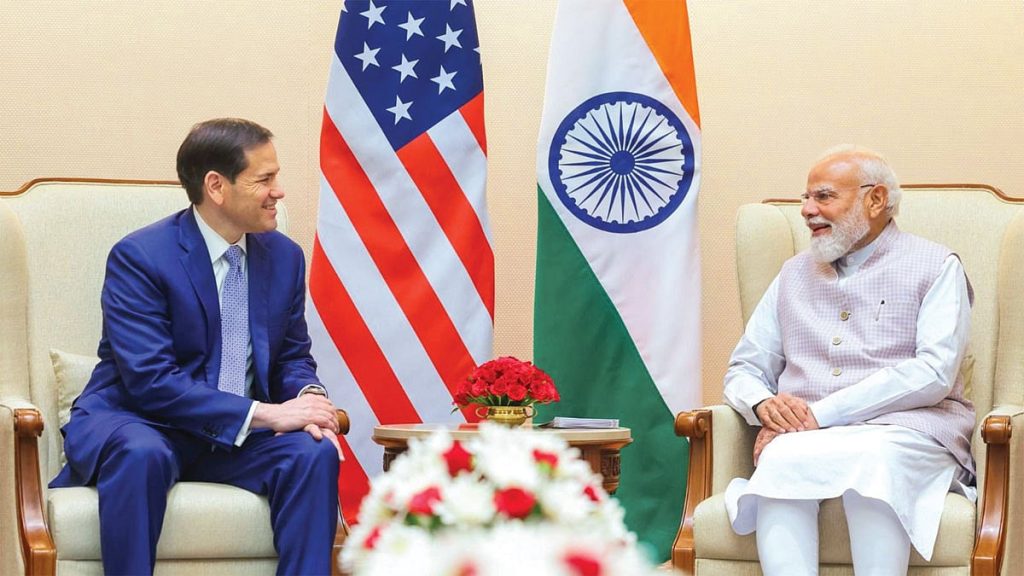
While the Modi government was paying attention to domestic exigencies, it played host to an important meeting of the Quadrilateral Security Dialogue (Quad) foreign ministers that also meant the presence of US Secretary of State Marco Rubio. There were strong complementarities in domestic objectives and External Affairs Minister S Jaishankar’s focus on energy security and safe passage in international waters clearly brought that out. Rubio’s visit was an exercise in repairing India-US ties after a rough 2025 and continuing bumps thereafter. Addressing the media alongside Rubio at their meeting, Jaishankar spelt out that US President Donald Trump’s idea of ‘American First’ would not mean a subordination of India’s interests. “We also have a very strong interest in ensuring that globally energy prices are kept low and that energy sources are more available. So, we are both countries—obviously each one of us has our own national interest and policies, but partnerships and relationships are built on what you share,” Jaishankar said. For good measure he also stated that while India and the US cooperate to deal with illegal and irregular mobility, India expects legal mobility will not be adversely impacted. “After all, this is very relevant to our business, technology, and research cooperation,” he said. Although Rubio sought to clarify that American relations with any other state do not come at the cost of ties with India, Trump’s frequent reference to Pakistani army Chief Asim Munir as “field marshal” in a laudatory tone does not go down well in New Delhi. Rubio would have got the sense of the mood in India when he was asked a question about an increase in racist comments on Indian Americans. Noting that there are stupid people in both countries, Rubio said, “There are stupid people in the United States that make dumb comments all the time. I don’t know what else to tell you other than the United States is a very welcoming country.” The moment passed but it could have gone badly.
Although the dates for a leadership summit were not announced, the Quad meeting was a significant step in reviving the grouping’s relevance and also provided a fresh wind to the sails of the India-US relationship. The outcomes of the Quad meeting specifically include use of economic policy tools and coordinated investment and mobilising $20 billion for critical mineral supply chains, the first Indo-Pacific Maritime Surveillance Collaboration (IPMSC) to boost information exchange, an expanded partnership for maritime domain awareness, an Indo-Pacific energy security initiative, port development in small but crucial Pacific nations, a secure undersea cable network, and work on a common digital standards protocol. There was a separate Quad statement on Indo-Pacific energy security with a clear mention of the need for unimpeded passage through the Strait of Hormuz.