
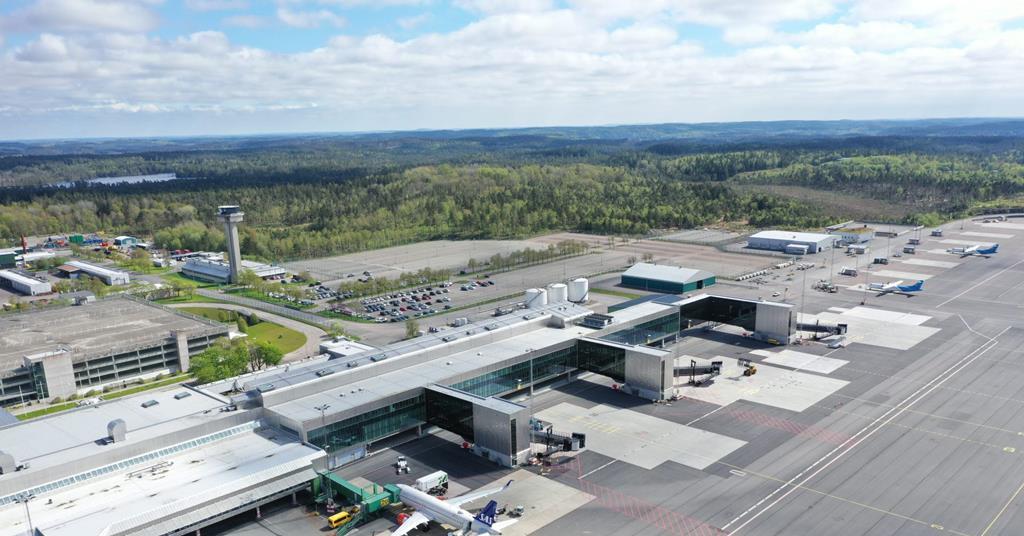
Airport planning is entering a new era of uncertainty and transformation, driven by technological change, climate ambition, and evolving societal demands, requiring airports to adopt flexible, resilient, and scenario‑based approaches to remain future‑ready.
Designing airports for uncertainty, flexibility, and fossil‑free aviation
Medium- to long-term airport planning has always been a complex and uncertain task. Producing a comprehensive and high-confidence blueprint for the future of an airport is near impossible, largely due to the multitude of external and internal factors that influence the aviation industry. Economic cycles, geopolitical developments, evolving regulations, noise mitigation requirements, and changing societal attitudes toward business and leisure travel all shape demand and operational conditions. For Swedavia, responsible for developing and operating Sweden’s national airports, navigating this uncertainty is not an academic exercise, but a daily strategic reality.
Today, this complexity is further amplified by the rapid transformation of aircraft technology. Understanding both the existing and future aircraft fleet – the pace of renewal, operational lifetimes, and, most importantly, the introduction of entirely new aircraft types – adds a new layer of uncertainty to airport planning. Battery-electric aircraft, hydrogen-powered aircraft, and hybrid configurations all bring fundamentally different requirements for energy supply, ground operations, safety systems, and spatial planning. The timing, scale, and market penetration of these technologies remain unclear, yet the infrastructure decisions made today must be robust enough to accommodate them tomorrow.
From traditional airports to fossil-free transport and energy hubs
Swedavia finds itself at a crossroads between yesterday’s established ideas of how airports should be designed and operated, and tomorrow’s vision of airports as fossil-free, multi-modal transport nodes and integrated energy hubs. This transition is both exciting and challenging. Airports are no longer solely aviation facilities; they are increasingly becoming nodes in wider energy systems, logistics networks, and regional development ecosystems. Enabling this transformation requires new value chains, involvement from new stakeholders, and deeper co-operation across sectors such as aviation, energy, transport, and digital infrastructure.
At the same time, Swedavia must ensure that its airports remain cost-competitive and financially sound. Infrastructure investments at airports are capital-intensive, long-lived, and difficult to reverse. This makes it essential to identify new business model opportunities while avoiding overcommitment to solutions that may not scale or mature as expected.
From a Swedavia perspective, the ability to implement flexible solutions – solutions that can be ramped up, scaled down, repurposed, or shared depending on how markets and technologies develop – is becoming one of the most important success factors for future airport operators.
De-risking infrastructure investments is therefore a central concern. One key strategy is identifying shared or alternative uses for new infrastructure, particularly in the energy domain. For example, energy systems designed to support future aircraft may also serve ground operations, landside transport, buildings, or even external stakeholders connected to the local or regional energy grid.
By designing for multi-functionality, Swedavia reduces the risk of stranded assets while strengthening the resilience and efficiency of its airports.
The evolving role of airports as conveners and co-ordinators
In this evolving landscape, the role of the airport is also changing. Swedavia increasingly sees its role as a convener and co-ordinator, bringing together stakeholders from both the aviation and energy sectors to explore the opportunities and challenges associated with new aircraft technologies. Aircraft manufacturers understandably aim to develop future aircraft that align as closely as possible with today’s operational concepts, thereby reducing the need for costly and complex airport adaptations. However, if aircraft designs do not sufficiently account for airport constraints and infrastructure realities, the resulting inefficiencies will ultimately translate into higher costs, which are either passed on to passengers through higher ticket prices or will undermine the viability of new air transport business models altogether.
Preparing for new ground handling and energy requirements
Nonetheless, aircraft-specific infrastructure and new or modified ground handling processes will be unavoidable. Charging systems, hydrogen handling, safety zones, energy storage, and power distribution are all areas where airports will need to adapt.
Swedavia believes airports should take a proactive role, together with aircraft OEMs and other partners, in conducting feasibility studies, pilot projects, and demonstration programmes. These initiatives are essential to test new concepts in a real operational environment, develop practical and financially viable solutions, and ensure that safety standards are maintained or improved.
The importance of standardisation and scenario-based planning
Equally important is the need for standardisation. For new technologies to scale globally, airport infrastructure concepts must be transferable and interoperable across regions. Early collaboration helps identify potential blocking points, whether technical, regulatory, or economic, and supports the development of realistic and credible future scenarios for fossil-free aviation.
One of the main challenges for airports lies precisely in planning under uncertainty regarding the pace and extent of future aircraft penetration. Infrastructure investments are often “forward-heavy”: they require large upfront capital, long planning horizons, and careful integration into existing operational and logistical layouts. At the same time, there is no single, agreed-upon scenario for how quickly battery-electric or hydrogen-powered aircraft will enter service, on which routes, or at what scale. The number of scenarios is at least as large as the number of reports, studies, and forecasts currently available.
For Swedavia, this reinforces the importance of scenario-based planning and adaptive decision-making.
Rather than designing infrastructure for one assumed future, multiple plausible futures must be considered in parallel.
This approach allows Swedavia to identify common denominators – investments that create value across scenarios – and delay or modularise elements that depend on more uncertain developments. By combining flexibility, phased investments, and resilient energy systems, Swedavia aims to ensure that its airports are prepared not for one future, but for many.
In an era of rapid technological change and increasing climate ambition, airport planning is no longer about predicting the future with certainty. It is about creating infrastructure that is robust, adaptable, and capable of supporting the transition to fossil-free aviation while maintaining safe, efficient, and financially sustainable operations. This is the challenge – and the opportunity – that Swedavia is actively addressing today.
John Nilsson will explore these themes in greater depth during his fireside chat ‘Planning airport infrastructure amid uncertainty: future fuels, flexibility and resilient energy systems’ at International Airport Summit on 12 November. The session will examine how airports can plan and stage long-life infrastructure amid uncertainty, with a focus on future fuels, operational and infrastructure flexibility, and resilient energy systems. Attendees will have the opportunity to discuss how airports can balance investment risk with airline choice, navigate competing commercial and regulatory pressures, and use master planning and energy infrastructure as practical tools to support multiple decarbonisation pathways.
Register for the summit today to ensure you are in the room when John takes to the stage.