
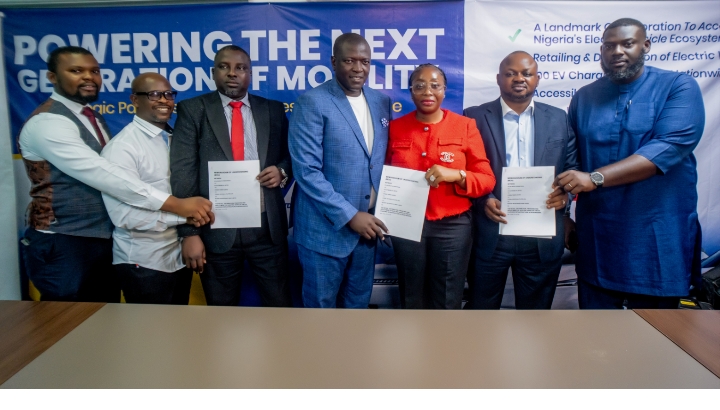
Nigeria’s transition to cleaner and more affordable transportation received a boost with a strategic partnership between EV Automobiles Ltd and ReTrust Microfinance Bank aimed at making electric vehicle ownership accessible to more Nigerians through innovative financing. The collaboration, which also includes Citadel Power, Citadel Estates and Zylus International Group, seeks to address the key barriers to EV adoption by combining vehicle financing, charging infrastructure and energy solutions, while supporting the country’s shift towards sustainable mobility. Royce Okolie reports
Nigeria’s journey towards cleaner, smarter and more affordable transportation took a major step forward yesterday following the signing of a strategic partnership between EV Automobiles Ltd and ReTrust Microfinance Bank.
The major aim of the partnership is making electric vehicles accessible to ordinary Nigerians through innovative financing solutions. The landmark collaboration, which also involves Citadel Power, Citadel Estates and Zylus International Group, is expected to tackle some of the most significant obstacles slowing the adoption of electric vehicles in Nigeria, particularly high acquisition costs, inadequate financing options and insufficient supporting infrastructure.
At the centre of the initiative is a consumer financing programme that will allow qualified Nigerians to purchase brand-new electric vehicles through affordable credit facilities provided by ReTrust Microfinance Bank.
This model could become a major catalyst for accelerating the country’s transition from petrol-powered mobility to cleaner and more sustainable transportation systems.
For many Nigerians, the dream of owning a brand-new vehicle has become increasingly difficult due to inflationary pressures, exchange rate fluctuations and the rising cost of imported automobiles.
The emergence of electric vehicles has offered hope for lower transportation costs and reduced dependence on petrol and diesel, but the relatively high upfront cost of acquisition has remained a major barrier.
The new partnership seeks to bridge that gap by spreading the cost of ownership over manageable repayment periods, thereby making electric mobility available to a wider segment of the population.
The initiative comes at a period when Nigeria is witnessing one of the most significant transformations in its transportation sector in decades. Since the removal of fuel subsidies and the subsequent increase in petrol prices, businesses and households have struggled with soaring transportation expenses.
Commercial transport operators have faced shrinking profit margins, while private vehicle owners continue to grapple with rising fuel costs and maintenance expenses associated with ageing internal combustion engine vehicles.
Against this backdrop, electric vehicles are increasingly being viewed not merely as an environmental necessity but as an economic alternative capable of reducing operating costs and improving mobility efficiency.
Speaking during the signing ceremony, Dr. Kennedy Okonkwo, Group Managing Director of NEDCOMOAKS, described the partnership as a timely intervention designed to respond to the changing realities of Nigeria’s transportation landscape.
According to him, the rising cost of petrol has made the transition to electric mobility more urgent than ever before.
He noted that wider adoption of electric vehicles would significantly reduce dependence on fossil fuels while lowering the cost of transportation for both businesses and individuals.
Okonkwo explained that the partnership combines expertise from the automotive, financial, energy and real estate sectors to create an integrated ecosystem capable of supporting the growth of electric mobility in Nigeria.
He stated that providing access to vehicles without simultaneously developing charging infrastructure and financing mechanisms would not deliver the desired transformation.
Instead, he said the partnership focuses on building a complete value chain that addresses vehicle supply, electricity access, charging infrastructure and consumer affordability.
“The rising cost of fuel makes the transition to electric vehicles increasingly important for Nigerians seeking more affordable means of transportation,” he said.
Studies have shown that the lifetime ownership costs of electric vehicles can be substantially lower than those of traditional vehicles, particularly in countries where fuel prices are high and electricity is relatively affordable.
Also speaking at the event, the Managing Director of ReTrust Microfinance Bank, Oladimeji Babatunde, said the bank would play a central role in democratizing access to electric mobility by providing affordable financing to qualified customers.
He explained that the initiative would allow more Nigerians to own new electric vehicles rather than continue relying on imported second-hand automobiles and ageing petrol-powered cars that often require expensive maintenance.
According to Babatunde, eligible customers will have access to flexible credit arrangements tailored to their income levels and repayment capacities.
He noted that reducing the burden of large upfront payments would encourage more Nigerians to embrace environmentally friendly transportation alternatives.
“The financing model is designed to remove one of the biggest barriers to electric vehicle ownership, which is affordability,” he said.
Financial experts have repeatedly identified limited access to consumer credit as one of the major constraints affecting vehicle ownership in Nigeria. Unlike developed economies where automobile financing is common, many Nigerians still purchase vehicles through outright cash payments, making ownership difficult for middle-income earners and small business operators. Microfinance-led interventions such as this are expected to play an important role in changing that narrative.
For commercial operators including taxi drivers, logistics companies, ride-hailing businesses and delivery services, the implications could be particularly significant.
Electric vehicles offer lower daily operating expenses because charging costs are substantially cheaper than petrol consumption. For businesses operating multiple vehicles, the savings could translate into improved profitability and more competitive pricing.
The partnership also has broader implications for Nigeria’s environmental sustainability agenda.
Transportation remains one of the major contributors to urban air pollution in major cities such as Lagos, Abuja and Port Harcourt. Increased adoption of electric vehicles could help reduce carbon emissions, improve air quality and support Nigeria’s commitments to global climate targets.
Beyond environmental benefits, the development of an electric mobility ecosystem has the potential to stimulate job creation across several sectors including vehicle assembly, charging infrastructure deployment, maintenance services, battery management and renewable energy solutions.
Speaking further at the event, Chief Executive Officer of Zylus International Group, Dr. Tosin Olatujoye, said the high cost of vehicle acquisition remains one of the biggest challenges facing the electric vehicle market in Nigeria.
According to him, many consumers are already interested in cleaner and more efficient transportation alternatives but are discouraged by the initial purchase price of new vehicles.
Olatujoye described the partnership as a practical private-sector response to Nigeria’s evolving mobility needs and growing demand for sustainable transport solutions.
He explained that the collaboration goes beyond vehicle sales and financing by focusing on the broader infrastructure necessary to support long-term growth in the electric vehicle market.
According to him, investments in charging stations and power solutions will be essential to ensuring confidence among consumers considering the transition to electric mobility.
The inclusion of Citadel Power in the arrangement reflects the recognition that reliable electricity supply and charging infrastructure are critical components of a successful electric vehicle ecosystem.
Globally, one of the major drivers of electric vehicle adoption has been the availability of convenient charging options both at homes and public locations.
Nigeria’s electricity challenges have often been cited as potential barriers to EV adoption. However, industry experts argue that innovations involving solar energy, independent power systems and dedicated charging stations could help overcome these obstacles.
By integrating vehicle distribution, financing and charging infrastructure within a coordinated framework, the partners hope to create a model capable of accelerating adoption rates while improving consumer confidence.
This initiative without any iota of doubt could encourage additional private-sector investment in electric mobility and inspire similar collaborations across the country.
The Nigerian automotive industry is already witnessing growing interest in electric vehicles as global manufacturers continue to shift investments away from conventional internal combustion technologies toward cleaner alternatives.
As international markets move rapidly toward electrification, there is increasing recognition that Nigeria must position itself to participate in the global transition rather than remain dependent on obsolete technologies.
The partnership between EV Automobiles, ReTrust Microfinance Bank and its partners therefore represents more than a commercial arrangement; it signals the emergence of a new vision for mobility in Africa’s largest economy.
For consumers burdened by rising fuel costs, businesses searching for operational efficiencies and policymakers seeking sustainable solutions, the initiative offers a glimpse into what the future of transportation in Nigeria could look like.
As electric mobility gains momentum worldwide, collaborations that combine technology, financing and infrastructure may ultimately determine how quickly Nigeria joins the global movement toward cleaner and more sustainable transportation.
For now, the partnership stands as one of the most ambitious private-sector efforts yet to redefine vehicle ownership and accelerate the adoption of electric mobility in Nigeria’s rapidly evolving transportation landscape.