
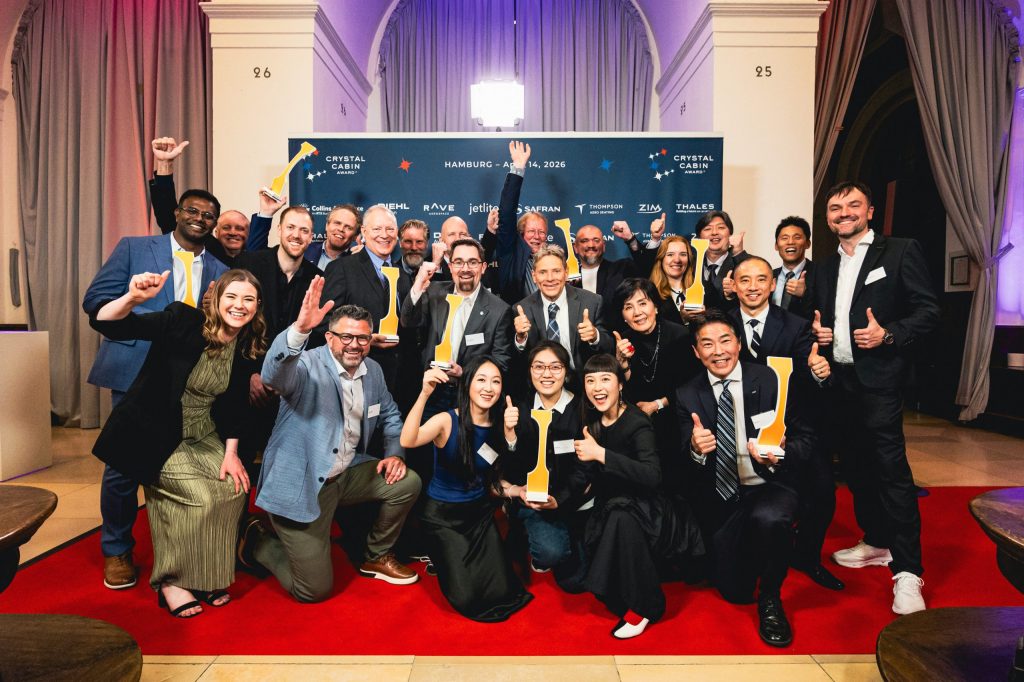
 The Crystal Cabin Award, the world’s leading award for cabin innovation, presented its 2026 trophies on 14 April in front of an international audience at the Hamburg Chamber of Commerce. This year’s awards go to All Nippon Airways, AviusULD, Collins Aerospace, Delta Air Lines, Diehl Aviation, Quvia, RECARO Aircraft Seating, and the Georgia Institute of Technology. A total of 27 international experts selected the eight most compelling solutions of the year from 85 submissions, entered by airlines, manufacturers, design studios, and startups from around the world.
“The Crystal Cabin Award 2026 demonstrates that the people building today’s aircraft cabins are taking responsibility for passengers who want to travel on equal terms regardless of mobility and deserve not to depend on assistance onboard; for a planet that demands solutions; and for a future that requires bold ideas. The fact that we are recognising startups with a dedicated category for the first time this year is no coincidence, but a signal for the future,” said Ralf Gust, President of the Crystal Cabin Awards Association.
Winners
 Accessibility – Winner: Diehl Aviation: AURS, The Adaptive User Routing System: The goal of making air travel accessible to everyone has not yet been fully achieved. This year’s winner in the Accessibility category demonstrates how inclusive design can set new standards for the personal dignity, independence, and onboard comfort. AURS, The Adaptive User Routing System, is an inclusive cabin concept that makes aircraft lavatories navigable for blind and deaf passengers. The solution combines an accessible layout with a digital interface that adapts to individual needs, providing visual safety announcements and tactile wayfinding aids. The jury recognized the concept “as a highly innovative and practical approach to aircraft lavatory accessibility, integrating universal design into a standard lavatory architecture that can be adapted for a wide range of use cases. It combines personalised beacon settings and a tailored interface to address diverse accessibility needs in an intuitive, dignified, and near-term implementable solution with potential applicability across the wider aviation ecosystem.”
 Cabin Concepts – Winner: All Nippon Airways, in cooperation with Acumen Design Associates, THE Room FX: What will the aircraft cabin of tomorrow look like, and how will it feel? The Cabin Concepts category recognises visions that redefine space, function, and aesthetics. This year’s winner sets a clear benchmark for how radically comfort and efficiency can be integrated. THE Room FX concept combines two seats into a single compact structure, thereby reducing weight and space requirements – an important foundation for increased comfort and higher seating capacity. This is enabled by an innovative mechanism: the seatback remains fixed while only the legrest moves, creating a continuous lie-flat surface. The jury chose this concept “for delivering a spacious passenger experience within a highly constrained footprint through exceptional design efficiency and minimal mechanical complexity. It optimizes weight while enhancing comfort and functionality, balancing passenger needs and airline requirements. By improving existing seat architecture without compromise, even in smaller fuselage cross-sections, it provides a deeply innovative solution expanding space without added weight.”
 Passenger Comfort – Winner: Collins Aerospace, SkyNook: Comfort is no longer a luxury in air travel, but a core passenger expectation. This year’s winner in the Passenger Comfort category presents a solution that enhances onboard well-being by focusing on spatial experience, privacy, and new usage possibilities within the cabin. SkyNook is a semi-private zone located in the aft section of widebody aircraft. The solution utilises previously unused space between the sidewall and reduced-density economy seating rows to create flexible retreat areas that provide privacy, security, and rest for families, passengers with special needs, and travelers with pets, assistance dogs, or bulky carry-on luggage. The jury selected this concept “for transforming previously unusable cabin space into a flexible, value-generating area that enhances passenger comfort and airline revenue potential. It addresses real passenger and operational pain points, including families traveling with toddlers, by improving underutilised economy-class zones. The solution is practical, quickly implementable, and adaptable, turning unused space into desirable seating with clear multi-purpose benefits.”
 Cabin Technologies – Winner: AviusULD, in cooperation with Eloc8, AviusULD SmartULD – Fire Tag: Technology delivers its full value in aviation when it enhances safety and operational processes reliably in the background. The Cabin Technologies category winner represents innovations that strengthen operational excellence and safety and integrate seamlessly into existing cabin systems. The AviusULD SmartULD – Fire Tag tracking device detects early thermal runaway conditions in lithium-ion batteries – up to two hours before a fire occurs. It can be installed both in cabin overhead bins as well as in Unit Load Devices (ULDs) loaded into the cargo hold, thereby improving safety in both passenger and cargo aircraft. The jury awarded this solution “for its simple and elegant approach to a highly relevant safety challenge. It addresses the growing issue of device-related risks without adding certification burden or complex system integration. Recognising its practicality and forward-looking relevance, the jury sees strong potential for it to become an industry baseline, prioritising safety as a fundamental and necessary innovation.”
 IFEC & Digital Services – Winner: Delta Air Lines, Delta’s Connected Onboard Platform: The in-flight digital experience has become a key differentiator in aviation. This year’s winner demonstrates how an integrated system architecture and consistent connectivity can transform a flight into a seamless, personalised experience. The Connected Onboard Platform (CoP) is a digital integration architecture within the Delta Sync ecosystem. The solution links data from In-Flight Entertainment (IFE), In-Flight Connectivity (IFC), and operational onboard processes, consolidating previously separate systems from multiple providers into a unified data structure. This establishes the foundation for consistent digital processes onboard and integrated use of system and passenger data in cabin operations. The jury granted the award to the platform “for its groundbreaking advancement in integrating customer, crew, and operational experiences within a unified digital architecture. By consolidating maintenance, cabin crew, passenger experience, and operations into a single open platform, it enables seamless integration of multiple vendors and services. Its system- and connectivity-agnostic design provides Delta with exceptional flexibility, laying the foundation for a true technological breakthrough in IFEC ecosystems.”
 Sustainable Cabin – Winner: RECARO Aircraft Seating, The R Sphere – Sustainability Concept Seat: Sustainability has become a central design principle in aviation. This category winner demonstrates how environmental requirements and high functional standards can be consistently combined in cabin design. The modular R Sphere – Sustainability Concept Seat saves approximately 1.5 kg per passenger and reduces CO₂ emissions by around 55 metric tons per single-aisle aircraft annually. The seat is made of recyclable materials, service-friendly modular components, and optimized surfaces for cleaning and maintenance, thereby supporting a sustainable and flexible cabin configuration. The jury recognised this entry “for its long-standing commitment to sustainability and continuous incremental innovation. It combines multiple dimensions of sustainability—including materials, weight reduction, and circularity—into a single seat concept. A key highlight is the use of a sugar cane-based composite material. Already in revenue service, the seat delivers significant weight savings, modern premium design, and a strong focus on recyclable materials.”
 Breakthrough Start-ups – Winner: Quvia, In-Flight Digital Experience Platform: With the new Breakthrough Start-ups category, the Crystal Cabin Award recognises companies that bring fresh perspectives and entrepreneurial agility to a long-established industry. This category’s first winner highlights the relevance of this approach. The In-Flight Digital Experience Platform is an AI-powered solution for analyzing the digital onboard experience. It provides real-time visibility into connectivity, in-flight entertainment, and system performance. Through optimised analytics, fault diagnostics, and data traffic management, Quvia helps airlines resolve issues faster, prevent outages, and improve the fleet-wide reliability of digital cabin systems. The jury selected this platform “for its significant impact on airline operations and customer experience, describing it as a true game changer. It addresses a core and growing industry need by consolidating data from multiple IFEC and IFC suppliers into a unified view. By removing ambiguity in a complex environment, it provides airlines with unprecedented visibility, control, and optimisation across fleets and aircraft types.”
 University – Winner: Georgia Institute of Technology, in cooperation with Airbus, Delta Air Lines, and TU Delft, SMARTrack | Optimised Cabin Cleaning Dispatching System: The best ideas for the future of aviation often emerge at the intersection of research and practice. The University category winner demonstrates how academic research and industrial application can together deliver solutions that drive tangible operational improvements in aviation. The SMARTrack | Optimised Cabin Cleaning Dispatching System optimises cabin cleaning dispatch operations to reduce turnaround delays between landing and return to service, while supporting the net-zero 2050 target. Centralised information, filters, colour coding, and real-time communication improve coordination between crew, cleaning teams, and dispatchers. Fewer delays translate into reduced fuel burn, lower CO₂ emissions, and higher aircraft utilisation. The jury awarded this concept “for its clear real-world operational benefit combined with a relatively simple technological and implementation approach. By streamlining aircraft cleaning through centralised task management and real-time data flow, it improves turnaround efficiency and reduces workload across roles. The solution enables faster boarding processes, delivering measurable cost and CO₂ savings, with significant benefits for airlines and passengers alike.”
