
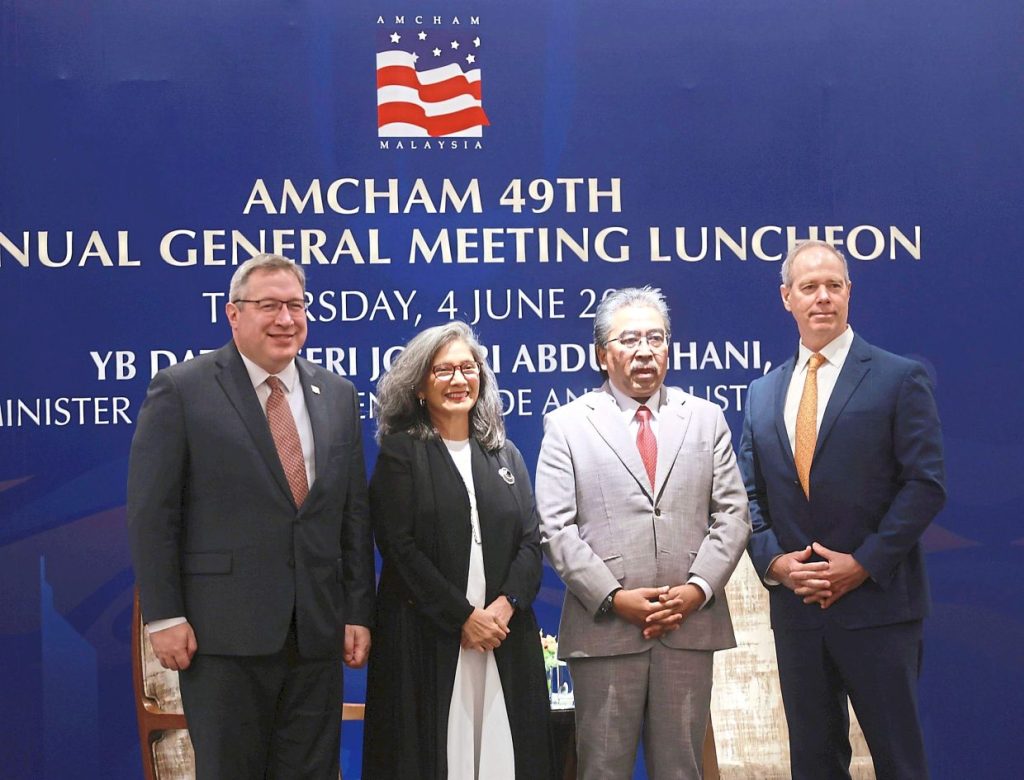
KUALA LUMPUR: Malaysia does not practise forced labour and is engaging with the United States to address concerns involving third-country suppliers in global supply chains, says Datuk Seri Johari Abdul Ghani.
The Investment, Trade and Industry Minister said Malaysia has laws protecting against forced labour, but issues raised by the United States under Section 301 extend beyond activities within the country.
“We do not have forced labour in the country because we have specific laws, in fact, many laws to protect against forced labour.
“But forced labour under Section 301 goes beyond that. It also includes third countries that we deal with, where we buy raw materials or semi-finished products, process them and export the finished products to the United States,” he told reporters after attending the American Malaysian Chamber of Commerce 49th Annual General Meeting luncheon yesterday.
Johari said Malaysia complies with international labour standards as a member of the International Labour Organisation, and that forced labour is already governed under the national legal framework.
However, he said Malaysia currently lacks a mechanism to assess whether suppliers in third countries are linked to forced labour.
“When people say Malaysia has no forced labour, we say we don’t. But we do not have a mechanism to evaluate a third country that engages in forced labour.
“As such, Malaysia is studying a mechanism that would assess compliance at company level, rather than imposing blanket restrictions on an entire country. For example, if four out of five companies in a country comply with forced labour regulations while one does not, we will only choose the compliant companies.”
He said Putrajaya is seeking further engagement with Washington to ensure there is a common understanding of the issue.
“What we want to do is have tariff engagement with the United States to make sure they understand this issue. If they do not understand the issue, it is very difficult to get it ratified.”
Johari said Washington’s review of Malaysia’s trade practices was focused largely on allegations of excess production capacity and forced labour, with concerns centring on whether products from countries with surplus capacity were being incorporated into Malaysian exports destined for the United States.
“We have maintained that Malaysia does not have excess production capacity.
“The concern may be that products from other countries with excess capacity are sold to Malaysia, used as inputs to manufacture other goods and then exported to the United States,” he added.
Under the International Emergency Economic Powers Act (IEEPA), the United States had initially imposed a 19% tariff on Malaysian exports, scheduled to take effect on Aug 1, 2025.
However, after the US Supreme Court ruled in February that IEEPA could not be used for such purposes, the US government invoked Section 122 of the Trade Act of 1974 to impose a temporary 10% tariff on Malaysia.
The tariff, he said, is valid for only 150 days and will expire on July 24, 2026.
“After that date, they cannot continue using the same provision to maintain the tariff.”
Following the implementation of the temporary tariff, the United States launched investigations under Section 301 involving several selected trading partners.
Johari said Malaysia was informed that the review covered four key areas: excess capacity, forced labour, environmental considerations and government subsidies.