
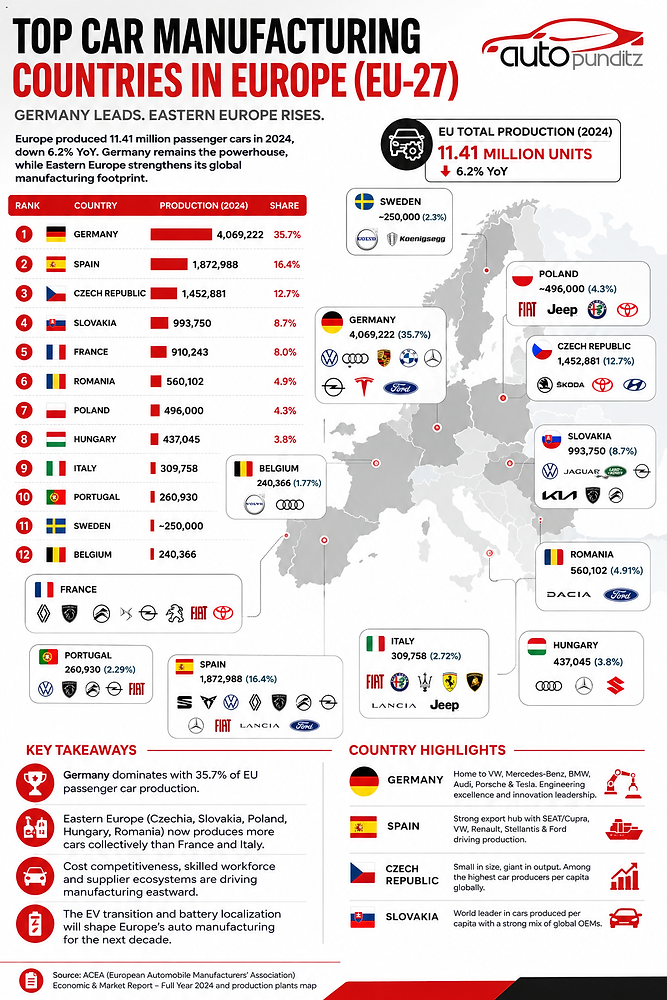
Germany remains Europe’s undisputed automotive powerhouse, but the center of gravity is steadily shifting east. While Germany alone accounted for over one-third of all passenger cars produced in the European Union (EU-27) during 2024, countries such as the Czech Republic, Slovakia, Poland, Hungary and Romania have emerged as some of the world’s most efficient automotive manufacturing hubs.
Based on the ACEA (European Automobile Manufacturers’ Association) production data for 2024, the EU manufactured 11.41 million passenger cars, despite production declining 6.2% year-on-year amid slowing demand, high energy costs and the industry’s transition toward electrification. (ACEA)
Top Car Manufacturing Countries in the EU (2024)
Germany’s leadership is built on:
-
Advanced manufacturing automation
-
Strong R&D ecosystem
-
Extensive supplier network
-
Premium vehicle exports
-
High-value engineering capabilities
However, Germany is also facing significant challenges from rising production costs, weaker domestic demand, Chinese EV competition and the expensive transition toward electric mobility.
Major manufacturers operating in Spain include:
-
SEAT/Cupra
-
Volkswagen
-
Renault
-
Stellantis
-
Mercedes-Benz
-
Ford
-
Lower labour costs than Germany
-
Strong export infrastructure
-
High manufacturing flexibility
-
Large supplier ecosystem
Much of Spanish production is exported across Europe.
With a population of just around 11 million, the country produced 1.45 million cars. Key manufacturers include:
The Czech Republic has become one of Europe’s highest vehicle producers on a per-capita basis thanks to:
Despite its small size, Slovakia produced almost 1 million passenger vehicles.
Manufacturing plants include:
-
Volkswagen
-
Kia
-
Jaguar Land Rover
-
Stellantis
-
Land Rover
-
Citroën
The country consistently ranks among the world’s highest in cars produced per capita, making the automotive industry the backbone of its economy.
Eastern Europe Is Becoming Europe’s Production Hub
One of the biggest long-term shifts has been the migration of vehicle manufacturing eastward.
-
Slovakia
-
Czech Republic
-
Poland
-
Hungary
-
Romania
now collectively manufacture more passenger cars than many traditional Western European producers.
France and Italy: Former Giants Under Pressure
France remains among Europe’s largest manufacturers with over 910,000 cars, supported by Renault, Peugeot, Citroën and Toyota production.
Italy, however, tells a very different story.
Despite being home to iconic brands such as:
-
Ferrari
-
Lamborghini
-
Maserati
-
Alfa Romeo
-
Fiat
Italy produced only around 310,000 passenger cars in 2024—its lowest level in decades, reflecting declining domestic production and broader industry restructuring.
The EV Transition Is Redrawing Europe’s Automotive Map
Electrification is reshaping manufacturing investment across Europe.
-
New battery gigafactories
-
Dedicated EV platforms
-
Battery supply-chain localization
-
Increased Chinese investment
-
Expansion of EV production in Germany, Hungary and Central Europe
Manufacturers are increasingly choosing locations that offer:
The next decade may therefore look very different from today’s manufacturing landscape.
What This Means for India
Europe’s production shift offers several lessons for India’s automotive sector.
-
Manufacturing clusters matter
Germany’s supplier ecosystem and Eastern Europe’s integrated industrial clusters demonstrate the importance of deep localization.
-
Cost competitiveness attracts investment
Countries that balance competitive labour costs with skilled talent continue to win global production programs.
-
Battery localization is becoming critical
The EU’s push toward localized battery manufacturing mirrors India’s own Production Linked Incentive (PLI) and Advanced Chemistry Cell (ACC) initiatives.
-
Supply chains are the real competitive advantage
Vehicle assembly alone isn’t enough. Winning countries increasingly control battery manufacturing, electronics, software and component ecosystems.
Auto Punditz Take
Germany may still dominate European passenger car production today, but the bigger story is unfolding in Central and Eastern Europe. Countries like the Czech Republic, Slovakia, Hungary and Romania are proving that competitive costs, skilled labour and focused industrial policy can reshape global automotive manufacturing.
For India, the lesson is clear: building a globally competitive auto industry requires more than assembling vehicles. It demands a resilient supply chain, localized battery production, world-class manufacturing clusters and continuous investment in advanced technologies. As the global industry pivots toward electrification and software-defined vehicles, the nations that combine scale with innovation will define the next chapter of automotive leadership.