
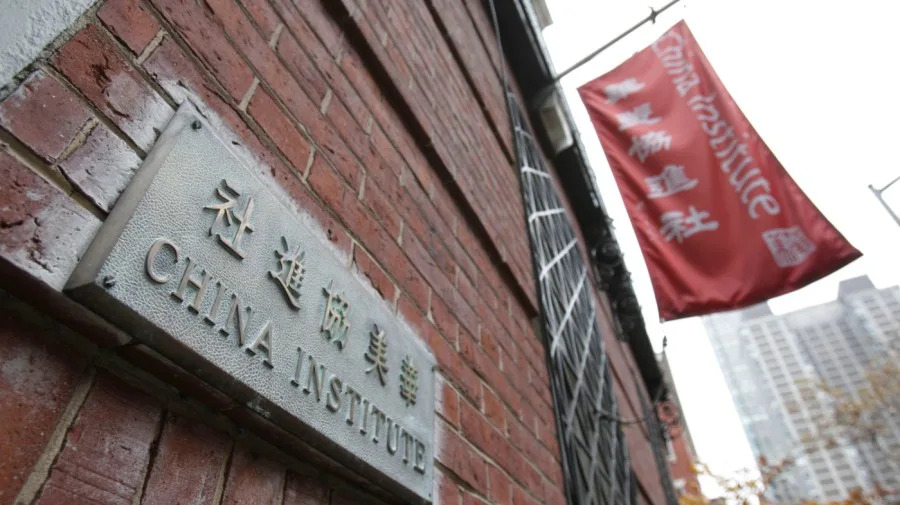
If students are learning Chinese in public schools, they could be using a curriculum shaped by the Chinese Communist Party.
In 2004, Beijing began to establish Confucius Institutes on American university campuses, which in turn partnered with K-12 public schools to establish roughly 500 Confucius Classrooms. A backlash on Capitol Hill led to the closure of nearly all the Confucius Institutes, leading most to assume that the problem had been solved.
But as the National Association of Scholars documented in a 2022 report, some of the institutes survived by changing their names or transferring their operations to third-party organizations with innocuous names. This is preserving Beijing’s influence over American students.
One successor group is the Center for Bridging Cultures, a K-12 education nonprofit based in Virginia, just outside the nation’s capital. The center helps bring teachers from China into American classrooms, organizes student and administrator exchange trips to China, and continues to operate as Alfred University’s Confucius Institute’s Confucius Classroom partner with the same Chinese government and university partnerships, according to K-12 public school documents.
It has not been identified previously as a Confucius successor, but the evidence is in the public domain.
To start, there is a connection in terms of personnel. The Center for Bridging Cultures was founded in 2021, amid the mass closure of campus-based Confucius Institutes. The executive director of the center is Gao Qing, the long-time director of the Confucius Institute U.S. Center, which the State Department described as “the de facto headquarters of the Confucius Institute network.”
In August 2020, the State Department designated the headquarters as a Chinese government foreign mission, calling it “an entity advancing Beijing’s global propaganda and malign influence campaign on U.S. campuses and K-12 classrooms.”
The picture is less clear as to whether there is a funding relationship. As a tax-exempt nonprofit, the Center for Bridging Cultures does not have to publicly disclose donors, although it does have to provide that information to the IRS in an annual filing known as a Form 990. Whereas Beijing acknowledged its funding of the old Confucius Institutes, the center does not publicly identify donors.
Even so, the website of the Beijing Language and Culture University does list the Center for Bridging Cultures as one of its “global institutes” — a category that previously included many campus-based Confucius Institutes in the U.S. — and refers to it specifically as filling the roles that the Confucius Institutes once played.
Over the last two decades, the Beijing Language and Culture University had made itself into the leading sponsor of Confucius Institutes, serving as the partner for 29 of them across the globe, from the U.S. to Nepal. It also won recognition multiple times as one of the “Outstanding Confucius Institute Chinese Partners of the Year.”
According to the Beijing Language and Culture University website, the Center for Bridging Cultures has a nationwide reach and “plays a crucial role in continuing and expanding the Chinese language programs for K-12 schools and communities that were previously offered by Confucius Institutes and Confucius Classrooms.”
Beijing Language and Culture University operates directly under the supervision of the Chinese Ministry of Education, and its Confucius Institute operates in coordination with the United Front Work Department. Indeed, the university’s own organizational chart lists a Party Committee United Front Work Department as a formal administrative unit of the university.
According to the U.S. State Department, the United Front Work Department’s mission is conducting foreign influence operations designed to “neutralize sources of potential opposition.” A former head of the department even chaired the global headquarters for Confucius Institutes in Beijing.
The best sources of information about how the Center for Bridging Cultures carries out its mission are the three annual 990 forms it has filed with the IRS for 2022, 2023 and 2024. Without disclosing the identity of donors, the filings indicate the center has received more than $2.5 million in donations. Its 990 forms also show it has distributed funds across several public-school districts, private schools, a community college, a private university, an online Chinese learning platform and a Chinese immersion charter school in Washington, among others.
The center’s website advertises opportunities for American principals and district superintendents to participate in 12-day trips focused on education in China and exchange opportunities. It has also launched the U.S.-China Friendship Schools Initiative, which pairs American schools with a Chinese counterpart.
State and local education authorities could simply say no to partnering with Beijing-backed organizations, but a lack of transparency often prevents parents and lawmakers from even knowing that such partnerships exist.
That concern led to the introduction in Congress of the TRACE Act, which would make federal K-12 funding contingent on schools making information about the influence of adversaries like China available to parents. Unless amended, however, the bill would not require schools to disclose information about U.S.-based nonprofits like the Center for Bridging Cultures that remain nominally independent.
Another option for federal action would be for the IRS to conduct more thorough vetting of organizations seeking tax exempt status. Reviews could assess the relationship between applicants and entities that appear on the Defense Department’s list of Chinese military companies, the Commerce Department’s Entity List for export controls and the like.
These changes will require substantial effort. But what we cannot afford to do is sit back and let China focus the lenses through which our children are going to see the world.
Jennifer Richmond, an education adviser and China specialist, is the deputy director of Education and National Security at the Foundation for Defense of Democracies.
Copyright 2026 Nexstar Media, Inc. All rights reserved. This material may not be published, broadcast, rewritten, or redistributed.
For the latest news, weather, sports, and streaming video, head to The Hill.