
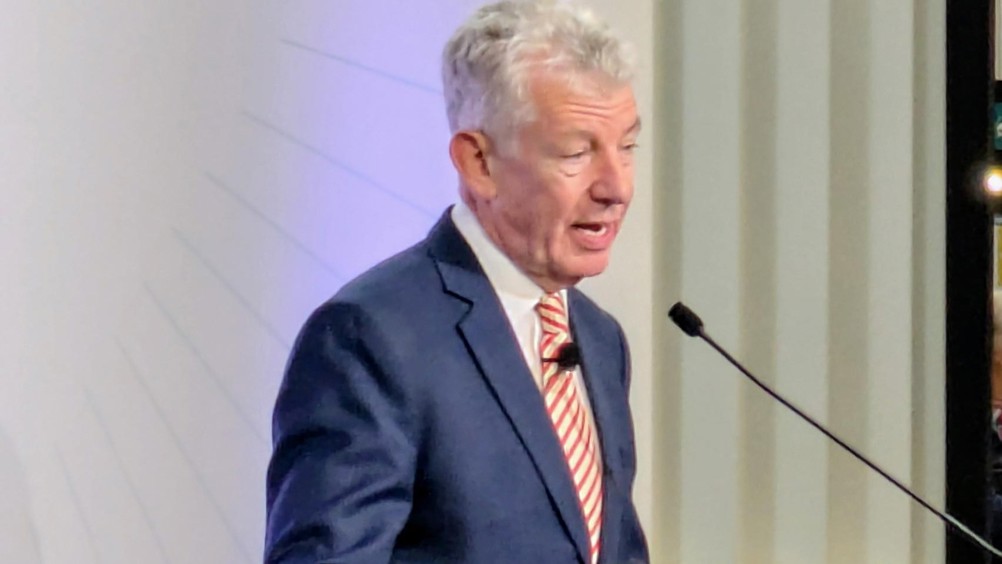
Speaking at the Farnborough Airshow on 20 July, Griffiths said the aviation sector has once again demonstrated its ability to withstand significant challenges, including geopolitical tensions, operational disruptions, fluctuating costs and changing travel demand.
While recent months have tested the industry’s resilience, he said long-term plans for Dubai World Central (DWC) remains unchanged.
DWC project, which is set to become the world’s largest airport, continues to move forward, he said, and is expected to eventually have the capacity to handle up to 260 million passengers annually.
He said Dubai’s central geographical location continues to support its role as a global aviation hub. “A fascinating statistic is 30% of the world’s population are within four hours of flying time, and 60% within eight hours,” he said.
Passenger demand continues to recover
Dubai Airport has seen a steady recovery in passenger traffic, reflecting broader global trends. Griffiths said demand has returned across most markets, with airlines rebuilding their networks and increasing capacity.
Transfer traffic remains a key strength for Dubai, accounting for a significant share of passenger movements through the airport. He added that load factors across many airlines remain high and are approaching pre-pandemic levels.
The recovery of international travel has strengthened confidence in future growth, with airlines continuing to expand operations and restore routes across multiple regions.
Long-term expansion
Looking beyond current challenges, Griffiths said aviation demand is expected to continue growing over the coming decades.
Industry forecasts suggest global passenger traffic could rise from around 9.9 billion passengers in the mid-2020s to approximately 17.7 billion by 2045, representing sustained annual growth driven largely by emerging markets in Asia-Pacific, the Middle East and other developing regions.
“The real question is not whether growth will happen, but how we ensure it is managed responsibly and sustainably,” he said.
SAF key to decarbonisation
A major focus of Griffiths’ remarks was aviation sustainability. He argued that sustainable aviation fuel (SAF) represents the most practical pathway currently available for reducing aviation’s carbon emissions.
With thousands of conventional aircraft already on order from manufacturers such as Boeing and Airbus, he noted that jet-powered aircraft are expected to remain the backbone of commercial aviation well into the 2040s.
While technologies such as electric propulsion show promise for smaller aircraft, Griffiths said they are unlikely to provide a near-term solution for long-haul aviation.
“It’s the only solution that works today as a drop-in fuel,” he said of SAF, noting that it can be used with existing aircraft and airport infrastructure while significantly reducing lifecycle carbon emissions.
However, he stressed that the biggest challenge is not the technology itself but scaling production. Griffiths called for government mandates, investment incentives and supportive policy frameworks to encourage greater SAF production and improve supply.
Building sustainable growth
Griffiths concluded by highlighting aviation’s wider role in supporting economic development, connecting communities and facilitating trade and tourism.
He said future growth must be built on three key pillars: sustainability, resilience and capacity. Investments in infrastructure, technology and environmental initiatives will be essential to ensure the industry can withstand future shocks, including climate-related risks, cyber threats and other disruptions.
“Aviation connects people, creates opportunity and reduces inequality,” he said. “If we address these challenges successfully, we will not simply sustain aviation’s benefits, we will multiply them.”