
On this June 29, the national teams of Brazil and Japan will decide their own fate in a direct clash for the 2026 World Cup and, of course, the Historical Archive won’t miss the chance to make the most of the topic and talk a little more about São Paulo’s history, fitting in six very interesting episodes from the Tricolor’s relationship with the Japanese.
The first time São Paulo and the Japanese met in a football match was during the completion festivities of what was then the “Cícero Pompeu de Toledo,” MorumBIS, in 1970. Just as in 1960, at the inauguration of the stadium while it was still under construction, São Paulo held the ceremony over two weekends (on that occasion, with matches against Sporting Lisbon and Nacional of Uruguay). This time, the guests were Porto, from Portugal, and Mitsubishi Heavy Industries, from Japan.
The Japanese team, which was part of the giant business conglomerate of the same name, was touring South America in order to gain experience for upcoming Asian competitions, as well as for those in their home country, but above all to promote the Mitsubishi name in the places they visited.
Although all the players were amateurs and company employees – with other jobs – the Japanese squad had some well-known players, including a Japanese-Brazilian (Nelson “Daishiro” Yoshimura). Goalkeeper Kenzo Yokoyama; midfielders Hiroshi Katayama and Takaji Mori; and forward Ryuichi Sugiyama represented Japan at the 1964 and 1968 Olympic Games, and Vicente Feola, who coached the Brazilian National Team in Tokyo/64, recognized them, since they had even trained with him.
The São Paulo man said they had improved a lot, and that the main characteristics of those players were speed off the ball and quick passing. But for Zezé Moreira, Tricolor’s coach, only left winger Sugiyama had any real skill, standing out from the others. In any case, nine players from the visiting squad were part of the Japanese national team in 1970.

Judging by the newspaper reports: no, the bicycle kick did not work out.
The match against Tricolor would be Mitsubishi’s third on the tour. Before that, they had faced River Plate in Argentina and lost 3-1, but managed to return from Córdoba with a 1-1 draw against the local select team. (And, after playing at MorumBIS, they still faced América-RJ and Flamengo in Brazil – 1-0 and 3-1 for the home sides – and Unión Canárias and the Venezuelan League in Caracas – 2-0 to the locals in both matches).
After drawing 1-1 with Porto on January 25, and after two youth-category preliminaries (Nacional x Pinheiros and São Paulo x Banespa) on February 1, São Paulo beat the guests by one of the biggest routs ever seen to this day at what was then called Cícero Pompeu de Toledo. In fact, it was the biggest win in the stadium’s history up to that point.
11,786 fans watched Zé Roberto score a hat-trick, Miruca add two, and Carlos Alberto, Gerson and Roberto Dias each get on the scoresheet, for a total of eight balls in the net that afternoon. The final score was 8-0 in favor of Tricolor. A complete thrashing that, as the footage from the match showed, illustrated that the Japanese still had a very long road ahead of them on the world football stage.
SÃO PAULO 8 x 0 MITSUBISHI HEAVY INDUSTRIES02/01/1970. Readers Digest National Teams Trophy: Final (single match).São Paulo (SP), Cícero Pompeu de Toledo Stadium – MorumBIS.
SPFC: Sérgio; Cláudio Deodato, Jurandir, Roberto Dias and Tenente; Carlos Alberto (Nenê) and Gérson; Miruca (Válter Zum-Zum), Zé Roberto, Toninho Guerreiro (Babá) and Paraná. COACH: Zezé Moreira. GOALS: Zé Roberto, 8/1; Carlos Alberto, 12/1; Gerson, 18/1; Roberto Dias, 31/1; Miruca, 32/1; Miruca, 8/2; Zé Roberto, 14/2; Zé Roberto, 23/2.
OPPONENT: Kenzo Yokoyama; Yoshio Kikugawa, Tadao Onishi, Hiroshi Katayama and Nelson “Daishiro” Yoshimura (Seiichi Sakiya); Kuniya Daini and Takaji Mori; Ichiro Hosotani (Michio Ashikaga), Kenji Okubo, Hiroshi Ochiai and Ryuichi Sugiyama. COACH: Hiroshi Ninomiya.
REFEREE: Wilmar Serra.ASSISTANTS: João Araújo dos Santos and Pedro Paja…an GATE RECEIPTS: NCr$ 78,177.00.ATTENDANCE: 10,532 paid.
THE FIRST TRIP TO THE EAST
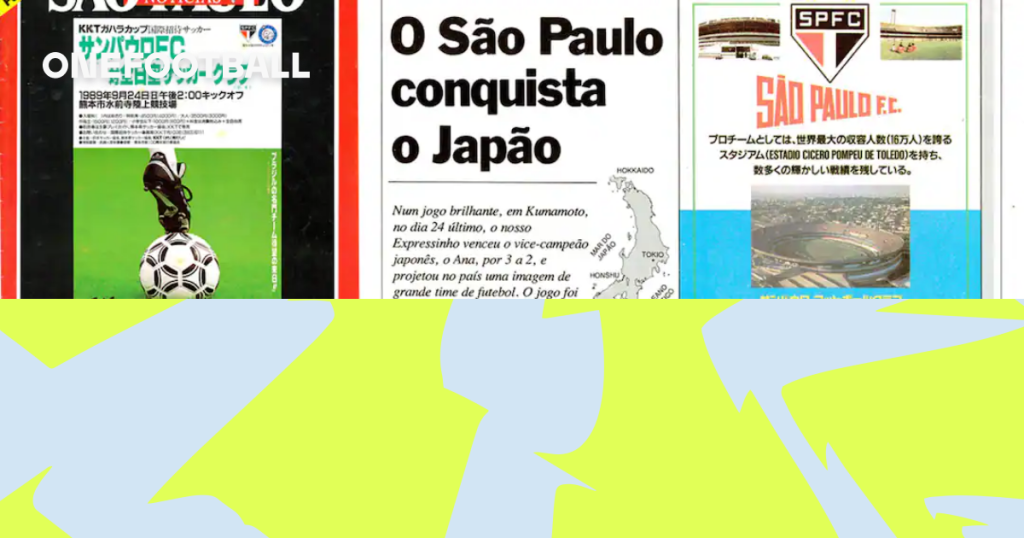
As visitors, however, Tricolor’s first opportunity to visit the “Land of the Rising Sun” only came in 1989, with help from the Expressinho in the friendly KKT Gahara Cup. On September 24 – the same date on which the first team would lose 2-1 to Corinthians in the 1989 Brasileirão – in Kumamoto, the São Paulo side would take the field in a very rare shirt, the result of a marketing action by Japanese TV network KKT (Kumamoto Kenmin Televisions), organizer and broadcaster of the event: one of the station’s brands was stamped over the red stripe of the traditional kit.
Not that it was needed, but it brought luck. With the unusual logo on their chest, São Paulo beat the 1988/89 Japanese champions, All Nippon Airways (the football team of the airline company that later became independent under the name Yokohama Flügels, currently Yokohama F. Marinos after a merger). The score was 3-2, with goals by Manu, Zigomar and Betinho.
It was in this official match for Expressinho (São Paulo’s traditional mixed team – a combination of reserves and youth prospects) that the famous full-back Cafu made his debut for Tricolor – although at the time he still played in midfield.


ALL NIPPON AIRWAYS 2 x 3 SÃO PAULO09/24/1989. KKT Gahara Cup Trophy: Final (single match).Kumamoto (Japan), Mitsuzawa Stadium.
SPFC: Marcos; Osmar, César, Zigomar and José Valdo; Cafu, Betinho and Aritana; Anílton, Manu (Cláudio) and Elivélton (Neto). COACH: Pupo Gimenez. GOALS: Manu, ??/?; Zigomar, ??/?; Betinho (penalty), ??/?.
OPPONENT: Ryuji Ishizue; Fernando Moner, Naoto Hori, Yasuharu Sorimachi and Syuta Sonoda; Motohiro, Masanao, Osamu Maeda and Hitoshi Tomishima; Tatsuya Makiuchi (Hideki Hamada) and Nobuhiko Ueno. COACH: Toshihiko Shiozawa. GOALS: Unknown.
REFEREE: Unknown.ATTENDANCE: ~18,000 paid (more than the Majestoso, it should be noted).
From then until now, São Paulo have had four more matches against Japanese teams (Shimizu S-Pulse, Nagoya Grampus, Jubilo Iwata, in 1995; and Kashima Antlers, in 2013), totaling a record of three wins, one draw and two losses, with 17 goals scored and nine conceded.
On June 5, 1997, São Paulo had the honor of receiving an official visit from Emperor Akihito and Empress Michiko. The Japanese imperial court was welcomed by the heads of state of Brazil and the São Paulo state government in a ceremony that included the planting of a cherry tree at the social headquarters, a tour of Tricolor’s trophy room – including an honorary plaque installed in the club’s Memorial – and an exchange of gifts.
The emperor and empress were presented by São Paulo with an amethyst cuirass adorned with a small replica of MorumBIS Stadium.

Tricolor’s strong bond with Japan was also built through players. One of the first São Paulo players to leave the club and venture into the East was Marco Antônio Menezes de Godoy, better known as Lange, in 1987, when he agreed to a loan move to Yanmar Diesel Engine.
Actually… The player’s registration rights were traded for a machine to trim the Morumbi pitch, high-tech and practically nonexistent in Brazil before the market was opened to foreign products in the early 1990s.
Later, Lange was transferred permanently to Matsushita, also from Japan.
The following took the same path: Wagner Lopes (Hitachi, 1985, in a story already told here), Ronaldão (Shimizu S-Pulse, 1993); Elivélton (Nagoya Grampus, 1993); Bentinho (Kashiwa Reysol, 1995); Alexandre, midfielder (Kyoto Purple Sanga, 1995); Capone, center-back (Kyoto Purple Sanga, 1996); Emerson, forward (Consadole Sapporo, 1999); Ricardinho, midfielder (Kawasaki Frontale, 2000); Marcelo Ramos (Nagoya Grampus, 2001); Luizão (Nagoya Grampus, 2005); Roger (Kashima Antlers, 2005); Danilo and Fabão (Kashima Antlers, 2006); Leandro (Tokyo Verdy, 2008); Jorge Wagner (Kashiwa Reysol, 2010); Rodrigo Souto (Jubilo Iwata, 2011); Carlinhos Paraíba (Omiya Ardija, 2012); Ademilson (Gamba Osaka, 2017) and Danilo Gomes (Albirex Niigata, 2020).
And the following came the other way, returning from Japan: Bentinho (Verdy Tokyo), forward in 1995; Almir (Bellmare Hiratsuka), forward in 1995; Jorginho (Kashima Antlers), right-back in 1999; Ricardinho (Bellmare Hiratsuka), midfielder in 1999; César Sampaio (Sanfrecce Hiroshima), defensive midfielder in 2004; Christian (Omiya Ardija), world champion forward in 2005; and Borges (Vegalta Sendai), two-time Brazilian champion forward in 2007 and 2008.

Although the contract mentions another piece of equipment, this flyer was found among Lange’s documents, which may indicate that this was the machine originally intended…

… or that this was the one actually received.
Super Champions/Captain Tsubasa is not the only manga that São Paulo influenced and was portrayed in. Even in just a few pages, Tricolor’s crest also appears briefly in a few panels of volume 4, chapter 22 of Golden Boy, a publication, let’s say, more adult (downright erotic) released by Egawa Tatsuya in 1992.

Anyone who wants to get to know it won’t have much trouble finding it on otaku sites…

However, what every Tricolor fan directly associates with Japan is the Club World Cup. And all three of São Paulo’s world titles were won on Japanese soil. At the old National Stadium in Tokyo, in 1992 and 1993, master Telê Santana’s Tricolor overcame its opponents in unquestionable fashion and also won over the hearts of the local fans for decades.

In 1992, São Paulo came from behind to beat Cruyff and Stoichkov’s Barcelona 2-1 – with goals from Raí. And the following year, they controlled the match against Milan, never trailing on the scoreboard, and defeated the Italians 3-2, with goals by Palhinha, Cerezo and Müller, with a backheel, in the final minutes of the game.
Tokyo also saw Tricolor return to a Club World Cup in 2005, in the first stage of the competition, when São Paulo beat Al-Ittihad of Saudi Arabia 3-2. The title itself came in the city of Yokohama, at the International Stadium, which saw another great European team fall before Rogério Ceni, Lugano, Aloísio and company’s Team of Warriors. São Paulo 1 x 0 Liverpool, goal by Mineiro.

And on top of that, between the official titles, São Paulo also won the 1994 Recopa Sudamericana on Japanese territory. In theory, as champions of the 1993 Libertadores and Supercopa, Tricolor would automatically have been the Recopa winner, but because of an agreement with the tournament sponsors, the club agreed to play the competition against the 1993 Copa Conmebol champions, Botafogo. Thus, in Kobe, Japanese fans saw another São Paulo victory: 3-1, with goals by Leonardo – who would make history in Japan years later – Guilherme and Euller.
Overall, in Japan, São Paulo hold a record of ten matches, seven wins, one draw and two losses. They have scored 21 goals and conceded 15.
This article was translated into English by Artificial Intelligence. You can read the original version in 🇧🇷 here.
 Lihat jejak penerbit