
In a nutshell
Set within Ise-Shima National Park on the shores of Ago Bay, Amanemu – meaning ‘peaceful joy’ – sits on a coastline so abundant it once supplied the Imperial Court, and has been fished, farmed and revered for three thousand years. Its 24 suites and eight two-bedroom villas are a contemporary reimagining of a traditional Minka farmhouse architecture, each with its own natural hot-spring bath fed from the same thermal springs as the spa. Around the hotel, a bay where oyster rafts drift, forested pilgrimage trails of the Kumano Kodō and the ancestral waters of the ama freedivers.
Can’t-miss feature
An ama-goya dinner. Spend an evening in one of the divers’ waterside huts where the morning’s catch is cooked over a sunken fire pit.
Rooms
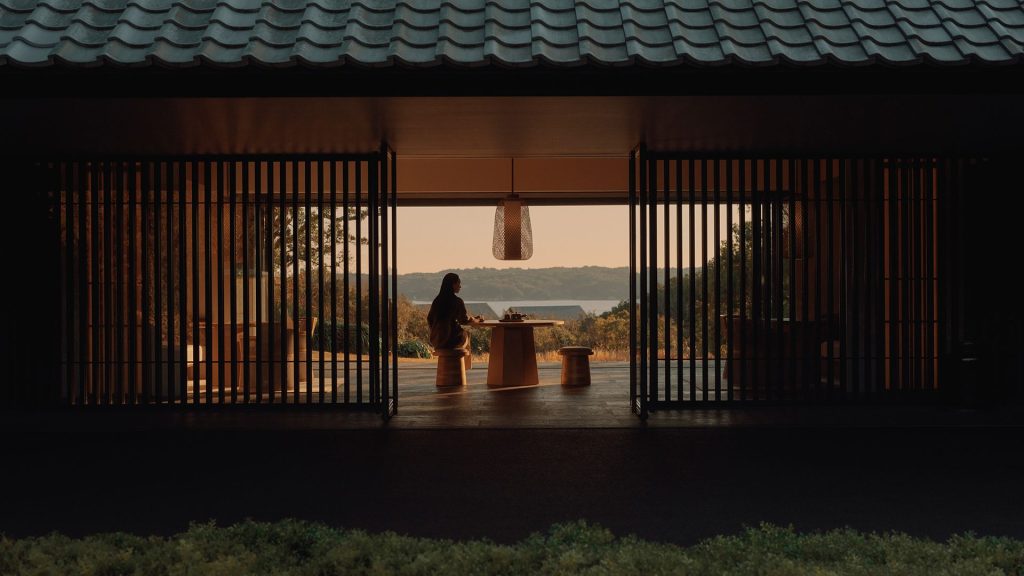
Every morning at Amanemu begins with unlatching the woven timber shutters. They slide apart with a low wooden knock and then Ago Bay enters the room: forested islets, oyster rafts drifting in the early light and gleam of blue-green water. The shutters are shitomido, a form of traditional Japanese latticed screen that has been used in domestic architecture for centuries to mediate between inside and out. It’s thoughtful, contemporary touches on traditions like this that make the design so seamless. The palette reflects the surrounding nature: stone, pale cedar, woven textiles and the restraint is the point. Kerry Hill Architects understood that in a landscape this arresting, a room that competes is a room that loses.
Amanemu takes the instincts of a traditional ryokan – the reverence for natural materials, onsen as daily ritual and deliberate framing of the outside world – and opens them up. Literally. The cedar-clad ceilings soar in tall, vaulted rooms. There’s no futon on the floor, beds are sumptuous and deep with fluffy bath robes to match. But the ryokan’s essential philosophy is intact: this is a room designed to dissolve into its surroundings.
Suites are divided into three categories depending on their views, the best being panoramic vistas over Ago Bay. Even from the hillside rooms, the bay doesn’t so much disappear as retreat and can still be glimpsed between the treeline as a slip of blue that the eye keeps returning to. The private onsen makes the most of this, each room has a tub set in dark granite, positioned dead-centre before a vast picture window. Lying in mineral-warm and nutrient-rich water fed directly from the natural hot spring beneath the hillside, I watched a black kite carve through the sky. It is, without question, the finest view from a bathtub I’ve encountered.
The two-bedroom villas expand the same template with generous outdoor living space, well suited to families or group that wants to co-habit without ever feeling crowded. The private gardens make a strong case for finding a reason to bring the family together to celebrate. At sunset, the bay turns amber, then copper. There are certainly worse places to open champagne.
Food and drink
Everything here is impossibly fresh. Ise Ebi lobster, awabi abalone, kaki oysters. At Amanemu the sourcing radius is, roughly, the view from your window. The region’s concept of satoumi (village seas) means for centuries the fishing communities here have taken only what the water offers and tends it carefully in return. The result is plentiful fresh seafood from an abundant and healthy peninsula. There’s also Matsusaka beef shabu shabu, this region’s wagyu: rich, buttery and so delicately marbled it barely needs the hot pot.
All dishes are served as spectacle. Sashimi arrives on a bed of ice, glinting like crystal, arranged in a nest of twigs and seasonal flowers with the spiny lobster as the jewel in the crown. Of course, I had to take a picture before picking up my chopsticks. The Japanese breakfast is also worth lingering over in the amber-lit dining room, its curved cedar ceiling glowing like the inside of a lantern and floor-to-ceiling windows pulling the bay and treeline into the room on both sides. Traditional Japanese dishes are complemented by avocado on toast, probiotic shots and smoothies with Kumano’s Local ‘Niihime’ Citrus Juice.
For great food outside Amanemu, head to Okage Yokocho (the stone-paved street of wooden tea houses and sweet shops that approaches Ise Jingu) for the region’s wagashi sweets. There you can try Akafuku mochi, soft rice cakes topped with sweet red bean paste or Mitarashi-dango (which you might recognise from the emogi), all made to symbolise offerings to the gods.
Highlights and experiences
The 2,000-square-metre spa is designed around a thermal spring that feeds two outdoor pools at different temperatures as well as two private onsen pavilions. Despite the scale, it never feels exposed due to dark timber screens that section the onsen into quieter enclosures, so even at capacity there’s a sense of privacy that most communal onsens can’t offer. Daybeds are arranged around the thermal spring garden and treatment rooms draw on Kampo herbal traditions and locally sourced essential oils alongside the Aman Skincare range. There’s also a gym, yoga pavilion, Pilates studio and a pool for aquatic bodywork.
Although it’s tempting to spend all day relaxing in the onsen, it’s worth leaving the resort. Guests receive one complimentary private experience per night of stay from pearl jewellery-making to Ama-no-Iwato waterfall purification via sunset fishing.
The most unforgettable experience, though, belongs not to the resort but to the bay below it. For more than 3,000 years, the women known as ama have dived these waters without breathing apparatus, surfacing with baskets of shellfish, abalone, sea urchin and seaweed. The legendary skill is isobue, a controlled breathing technique that enables extended immersion. Guests can join the ama and dive for urchin and shellfish, before dining together in a hut. I sat across from Mia, a diver, and our translator, and asked what her favourite thing about this lifestyle was. As she turned cuttlefish and mackerel on the hot coals, she replied: ‘the sea is always changing, every day the colour and the water is different.’ As we talked about her connection to the sea, it seemed there was lots to learn about life from this sustainable way of fishing. Ama don’t take more than they need, both out of a respect for the ocean and the physical constraints of how long they can be in the cold water each day. When they see an abalone – a flattened seasnail with a sweet, buttery taste – they measure the shell and wait until it’s bigger. We could all learn to be more patient for our rewards. At their peak there were around 6,000 ama in Iseshima, but the number has dwindled with more young women heading to cities for work. The profession is now designated by the Japanese government as an Important Intangible Folk Cultural Property. Divers gather in the ama-goya huts before and after the water, cooking their catch over an open fire, keeping the knowledge alive in the same way it has always been kept: by living it. Mia told me that the women mentor one another and that it’s a way of life built on friendship and communication. Ama have to learn to be loud and speak up to be able to communicate with the boat from the water. ‘You can’t speak quietly like you have a secret,’ she told me.
What to do nearby
The fine distinctions within each season in Ise-Shima offer their own produce, ritual and temperature of water. Spring brings cherry blossom along the Kumano Kodō pilgrimage trails and the start of the ama diving season. Summer deepens the bay’s warmth and the kitchen’s seafood. Autumn brings Matsusaka wagyu and the first cold mornings when you lower yourself into the onsen and feel the heat move over your body. Winter is the spa at its most restorative with steam rising off the thermal pools into cold clear air and the maples burning red and ochre against the dark timber pavilions.
At the heart of the region is Ise Jingu, home to the sun deity Amaterasu-Omikami. Its two main shrines, Naiku and Geku, are surrounded by more than 125 structures, set in ancient cedar forest crossed by stone pathways. The complex is rebuilt in identical form every twenty years (the 1,300-year-old Shikinen Sengu ritual) preserving through perpetual renewal. The forest walk is cool and cathedral-quiet, the only sound the crunch of stone underfoot. Ancient cedar and hinoki cypress tower overhead, their canopy filtering the light into shafts that catch the leaves as they move in a shimmer like tambourines. The air carries the scent of both trees: cedar’s deep earthiness and the citrusy-woody warmth of hinoki.
The pearl heritage of Iseshima is worth an afternoon’s exploration too. The world’s first cultivated pearl was created here in 1893. Family-run workshops and small ateliers dot the coast, sharing the techniques of generations, with the chance to make your own jewellery to take home.
The backstory
Amanemu opened in March 2016 as Aman’s second Japanese property, and its name means ‘peaceful joy’. The resort sits on over three hundred acres within Ise-Shima National Park and nearby to the revered 2,000-year-old Shinto shrine whose peaceful ambience shaped much of the design. The proximity is felt throughout: in the spare materials, attentiveness to season and peaceful atmosphere. Artist Kenji Yoshida, whose copperplate engravings of ama divers are displayed in a studio a short walk from the water, puts it plainly: ‘The sea is a window to Mother Earth.’ Amanemu was built with that view in mind.
Final considerations
- Best for: Couples, wellness seekers and those looking to connect with Japan’s coast, far beyond the tourist route
- Location: Ise-Shima National Park, Mie Prefecture
- Family friendly: The two-bedroom villas are well suited to families
- Wellness: There is a spa and wellness centre, with a natural hot spring onsen
- Accessibility: The hillside setting means some areas involve slopes, there are wheelchair-friendly paths and accessible parking