
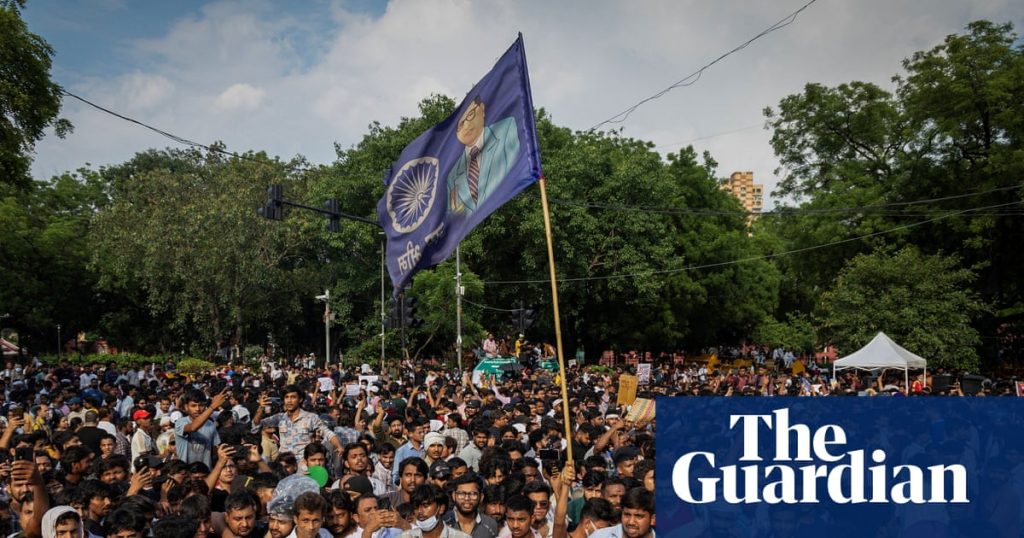
As the poster bearing the face of the prime minister, Narendra Modi, was thrown to the floor, a cheer went up. Then came the feet, trampling the image into the muddy ground with gleeful abandon. “Thief, thief,” chanted the crowd.
Just a week earlier, such scenes in the heart of India’s capital would have been almost unthinkable. For the 12 years Modi and his Bharatiya Janata party (BJP) have been in power it was widely acknowledged that you criticised the government at your peril. Dissent was swiftly, routinely and expertly crushed.
That was, until the cockroaches came along. A movement that began as an online meme has swiftly escalated into one of the most unexpected and significant challenges to Modi’s political power in years, instigated by a young generation who are fed up and startlingly unafraid of their government. Humour has become their greatest weapon and insults to Modi now abound online in the form of memes and Instagram reels as gen Z Indians vilify the government.
Education, and the scandal over a leaked examination for medical colleges, remain at the heart of the protest, and the resignation of Modi’s education minister, Dharmendra Pradhan, is the core demand. But after a peaceful protest held on Monday in Delhi was met with police batons, teargas, pellet guns and the alleged manhandling of female protesters, it has escalated into something far bigger: a fight for the country’s flailing democracy.
Among those who braved the police response to take part in the Delhi demonstrations this week was Aniruddh Gautam, a 21-year-old law student from the capital. “I had a place to study at a UK university and I chose to stay in India because I believe in my country,” he said. “But this government has taken away the hopes and dreams of young people. Young people have died because of their failures. I will die for this cause if I need to.”
While protests have erupted in India under the Modi government before – first in 2019 against a divisive citizenship law and then in 2020 with a huge farmers’ strike – analysts say the “cockroach” movement presents a more complex problem for the government.
Education failures and exam leaks are uniquely bipartisan issues that concern even Modi’s most vital vote bank: upper-class Hindu families. The visuals of children and young students being beaten by police caused discomfort even among the BJP’s own ranks.
“Modi has always been very good at overcoming a crisis,” said Tavleen Singh, a political columnist. “But I talk to people who are quite close to him and they’re all really puzzled and not sure what to do next. They say that he’s been listening to the wrong people and misread the mood completely.”
While previous protests have been smeared by the government as the actions of Muslim or Pakistani terrorists, or sinister forces abroad, the fiercely secular nature of these demonstrations has made that impossible. Those taking part are from across religions and social classes and many of them are children of BJP supporters. At the Delhi protest site, Hindus and Muslims have prayed and eaten together. A Muslim cook has become a celebrity for feeding protesters every day and Sikh gurdwaras have set up community kitchens on site.
“They are clever because they’ve made these protests deeply patriotic and taken back the nationalism card from the BJP,” said Singh. “They’ve also taken back secularism. These guys are using religion to unite.”
Crucially, the BJP has come up against the limits of its own propaganda machine. While in the past decade mainstream media outlets have been co-opted to follow a strict government line, gen Z protesters have taken to social media to create their own information ecosystem, exposing the stark dissonance between what is being broadcast on mainstream news channels – referred to as godi, or lapdog, media – and what they are experiencing on the ground.
“Our media is disgusting. Night after night they have broadcast lies to try and bring down our movement, calling us terrorists, Pakistanis and anti-nationals,” said Sanna, 26. “But unfortunately for them, we are here getting the message out.”
Anish Gawande, a young politician who has been a champion of the cockroach movement, said the protests were erupting en masse because “increasingly, young people do not see a bright future for themselves in this country”.
“An entire generation of aspirational young Indians grew up on the idea – and this includes me – that the country had flaws and needed to improve, but was on the whole heading towards progress,” he said.
Now, he added, “we are confronted with the bitter reality that the whole story we were sold by the BJP in 2014 never materialised. The promises that have been made over the last 12 years have been repeatedly broken – and the crushing of that illusion is unleashing a pent-up rage unlike any other.”
Gawande was insistent they posed an unassailable challenge to the BJP’s grip on power: “This is a rude awakening for the government that the people of India cannot be silenced forever.”
When it first emerged in early May, it was easy for the government to dismiss the Cockroach Janata party (CJP), whose name was a deliberate poke at Modi’s ruling party. Its founder, Abhijit Dipke, 30, who had recently completed a masters at Boston University, initially created the CJP as a parody website in response to remarks by India’s chief justice, Surya Kant, referring to the swathes of unemployed young people and activists as “parasites” and “cockroaches” during a court hearing (though he later denied saying it). The CJP’s original tagline was: “A voice for the lazy, unemployed and chronically online”.
But when young Indians pounced upon it with delight, following in their tens of millions online, it became clear to Dipke that satire was proving more representative of their frustrations than mainstream politics.
Two days before Kant’s alleged “cockroach” comment, the lives of more than 2 million students were upended when it emerged that a highly competitive exam for admission to medical college had been leaked and sold for millions of rupees. About 2.2 million students would have to take the gruelling test for a second time, competing for just 130,000 places. For some, it was too much to bear. More than a dozen took their own lives.
It was not the first time this had happened: dozens of leaks had blighted these exams and others in recent years. The government had set up the private agency responsible, yet has never been held accountable. As he flew back into Delhi in early June, Dipke formalised the CJP’s core objectives: accountability for the exam leak, the resignation of Pradhan and the reform of a higher education system seen as chronically underfunded, corrupt and systematically failing millions of young Indians.
The turnout at the CJP’s first Delhi protest was just a few hundred. But by the end of June, they returned, vowing they would not move from their Delhi protest site until Modi sacked his education minister.
This time, the CJP had a new powerful figurehead. Sonam Wangchuk, a renowned Indian engineer and activist, announced that he would go on hunger strike in solidarity with the “cockroaches” – resonant of the hunger strikes made by Mahatma Gandhi in the fight for Indian independence. He too had come up against the Modi government’s crackdown on dissent, when he was jailed under terror laws for a protest last year.
The Modi government initially met the protests with silence. But after the Delhi police aggressively removed Wangchuk on the 20th day of his hunger strike and dragged him to hospital against his will, popular outrage galvanised the movement.
Delhi police, who are directly under the control of the home minister, Amit Shah, Modi’s closest political ally, had refused permission for protesters to march on parliament the following Monday. But that did not stop young people coming in unprecedented numbers. Delhi police prepared for 10,000 – an estimated 100,000 turned up, many chanting Wangchuk’s name.
The demonstration was a critical turning point, an expression of dissent unlike anything seen in Delhi in years. For many of the young people, it was their first ever protest, marking something of a political awakening. They sobbed at the solidarity and fanned each other in the heat. But as the numbers swelled, the police were far outnumbered and began to resort to brutal tactics to prevent people marching on parliament.
The use of teargas, batons and alleged pellet guns against young people made for horrifying footage, and hardened the position of many protesters. Among those targeted was 17-year-old Deeksha Mishra. She was there for her sister, whose dream was to be a doctor, but who had fallen into depression since the exam leaks. “I watched her losing her dream and passion and I knew I had to come,” she said.
“We came peacefully but they treated us as terrorists,” she added. “The police beat us so badly. Some had blood flowing down their skulls and their noses were broken.” Hundreds ended up in hospital, some in intensive care.
At the protest site days later, Mishra said she was now standing for more than just exam leaks. “This is about corruption, it’s about our dying democracy,” she said. “The government want to keep ignoring us until the protest dies but it’s not going to happen. We are not afraid any more.”
While Modi has promised fast action against those responsible for the exam leaks, he has still refused to sack his minister. Analysts say he has been backed into a tricky corner: Pradhan is one of his most loyal and politically important ministers – to fire him could undermine cabinet loyalty and be seen as a sign of weakness for the strongman leader. Yet protesters say they won’t move until he’s gone.
It remains to be seen just how much the movement has rattled the electoral grip of Modi, who still has three years left in office and recently won a string of crucial state elections. But as the political analyst and columnist Pratap Bhanu Mehta said: “Most importantly, this movement has lifted the pall of fear.”
“This government is used to governing with impunity,” he said. “Re-establishing unchallenged authority is going to be difficult for them.”