Published: July 13, 2026
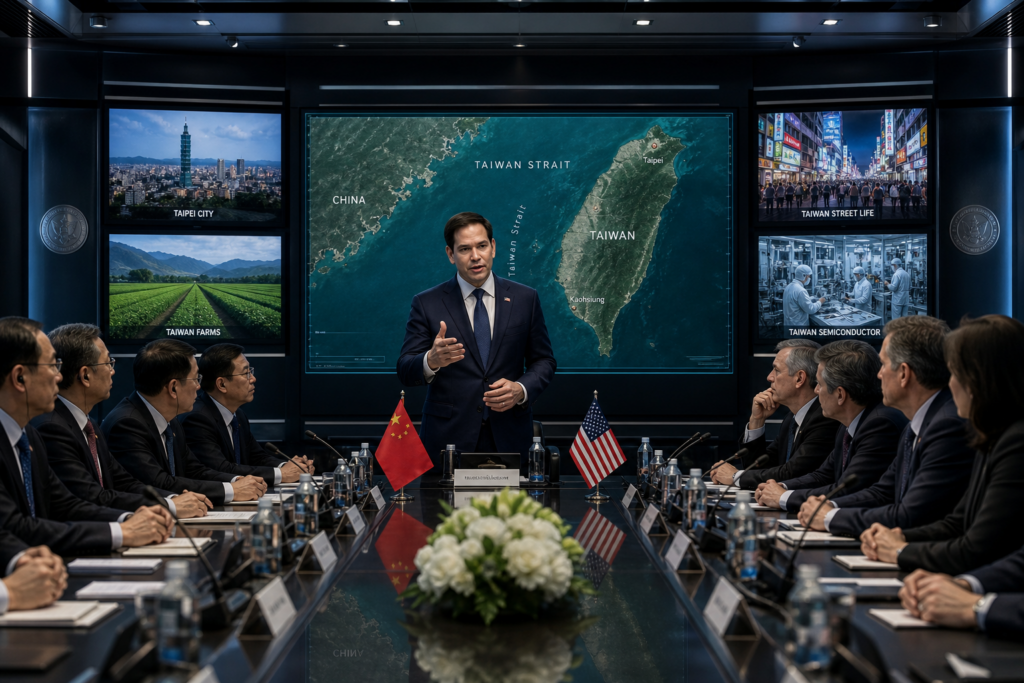
The central issue underlying the 2026 Beijing summit was not trade, agriculture, or aircraft purchases, but the future of Taiwan and the evolving structure of U.S.-China relations in the Indo-Pacific. For Beijing, the commercial agreements reached during the summit represented part of a broader strategic effort to influence Washington’s posture toward the Taiwan Strait.
For decades, the United States has maintained a policy of strategic ambiguity toward Taiwan. Under the Taiwan Relations Act, Washington committed itself to supporting Taiwan’s defensive capabilities while avoiding a direct declaration about whether the United States would intervene militarily in the event of a conflict. The framework was designed to deter both a unilateral declaration of independence by Taipei and the use of force by Beijing.
Comments made by President Trump during and after the summit suggested a more openly transactional approach toward the issue. As his trip concluded, Trump stated publicly that the administration had paused approximately $14 billion in arms sales to Taiwan, describing the weapons packages as a “very good negotiating chip” tied to China’s cooperation on trade and broader geopolitical matters, including Iran.
Trump also questioned the traditional logic behind American deterrence in the region. He remarked that he was “not looking” to travel “9,500 miles to fight a war” over Taiwan and said he was “cooling off a bit” regarding support for Taiwanese independence. The statements immediately generated concern among policymakers and regional allies who viewed them as a potential departure from decades of carefully managed strategic ambiguity.
Critics argued that openly linking Taiwan’s security to trade negotiations risked weakening deterrence in the Taiwan Strait. Foreign policy analysts warned that treating arms sales as bargaining tools could encourage Beijing to test the limits of Washington’s commitment while increasing uncertainty in Taipei.
The controversy also reflected deeper structural tensions in U.S.-China diplomacy. Under the 1982 U.S.-China Joint Communique, Washington acknowledged that arms sales to Taiwan were expected to decline over time, while still preserving its commitments under the Taiwan Relations Act. Beijing has long viewed the gradual reduction of American military support for Taiwan as an established principle rather than a concession to be newly negotiated.
Within Taiwan, Trump’s remarks intensified an already polarized political debate. President Lai Ching-te and the ruling Democratic Progressive Party (DPP) maintained that American arms sales remain a critical component of Taiwan’s deterrence strategy and should not be subject to approval by Beijing. The DPP argued that preserving Taiwan’s defensive capabilities is essential to maintaining stability across the Taiwan Strait.
The opposition Kuomintang (KMT), however, used the summit to criticize the DPP’s approach toward Washington. The KMT has capitalized on Trump’s remarks to attack the DPP’s platform, saying that the ruling party has wagered a “dangerous, one-sided bet on Washington.” Some opposition leaders called for a more balanced strategy that would preserve strong ties with the United States while reducing tensions with mainland China.
Chinese state media interpreted Trump’s remarks differently. Official commentary portrayed the statements as evidence that Washington’s commitment to Taiwan was weakening and suggested that support for Taiwanese independence was becoming increasingly unsustainable. Beijing framed the summit as evidence that long-term trends in cross-strait relations were shifting in China’s favor.
Additional uncertainty emerged from comments made by Secretary of State Marco Rubio following the summit. Rubio attempted to reassure regional allies by insisting that official American policy had not fundamentally changed and warned that unilateral changes to the status quo would carry “catastrophic consequences.” At the same time, he also remarked that Beijing favored eventual unification through a public process rather than direct military coercion. Those comments generated debate because they appeared to narrow Taiwan’s political room for maneuver. Critics argued that framing Taiwan’s future primarily through the preferences of the two major powers risked sidelining the democratic choices of Taiwan’s 23 million residents.
The summit therefore highlighted a growing tension between geopolitical stabilization and regional security credibility. On one hand, the easing of U.S.-China tensions reduced the immediate risk of economic escalation between the world’s two largest economies. On the other hand, uncertainty surrounding Washington’s security commitments created new anxieties among allies and partners throughout the Indo-Pacific.
For the United States, the summit reflected a broader preference for transactional diplomacy centered on measurable economic outcomes. The White House prioritized trade purchases, market access, and reduced tariff pressure while signaling greater flexibility on sensitive geopolitical issues. For Beijing, the summit represented a strategic success. China secured movement toward its preferred framework of “constructive strategic stability,” which seeks to manage competition with the United States while limiting the risks of direct confrontation. The negotiations also provided Beijing with additional time to continue pursuing technological self-reliance and military modernization. The summit further reinforced longstanding concerns in Taiwan about the durability of external security guarantees in a changing international system. Debate within Taiwan over how best to balance sovereignty, economic interests, and security ties with Washington is likely to intensify in the coming years.
Although the Beijing summit temporarily stabilized relations between Washington and Beijing, it did not resolve the deeper disputes surrounding Taiwan’s future, military deterrence, or the balance of power in East Asia. Instead, it created a more uncertain environment in which strategic competition continues beneath the surface of diplomatic engagement.
The future of Taiwan-U.S. relations will likely depend not only on official policy statements but also on how both governments respond to domestic political pressures, military developments, and economic competition in the years ahead. The summit established temporary rules for managing rivalry, but the fundamental tensions surrounding Taiwan’s geopolitical role remain unresolved.
Muhammad Shahzad Akram is a Research Officer at the Centre for International Strategic Studies, AJK. He holds an MPhil in International Relations from Quaid-i-Azam University, Islamabad. He is an alumnus of the Near East South Asia (NESA) Centre for Strategic Studies, National Defense University (NDU), and Washington, DC. His expertise includes cyber warfare and strategy, arms control, and disarmament. The views of the author are his own.