
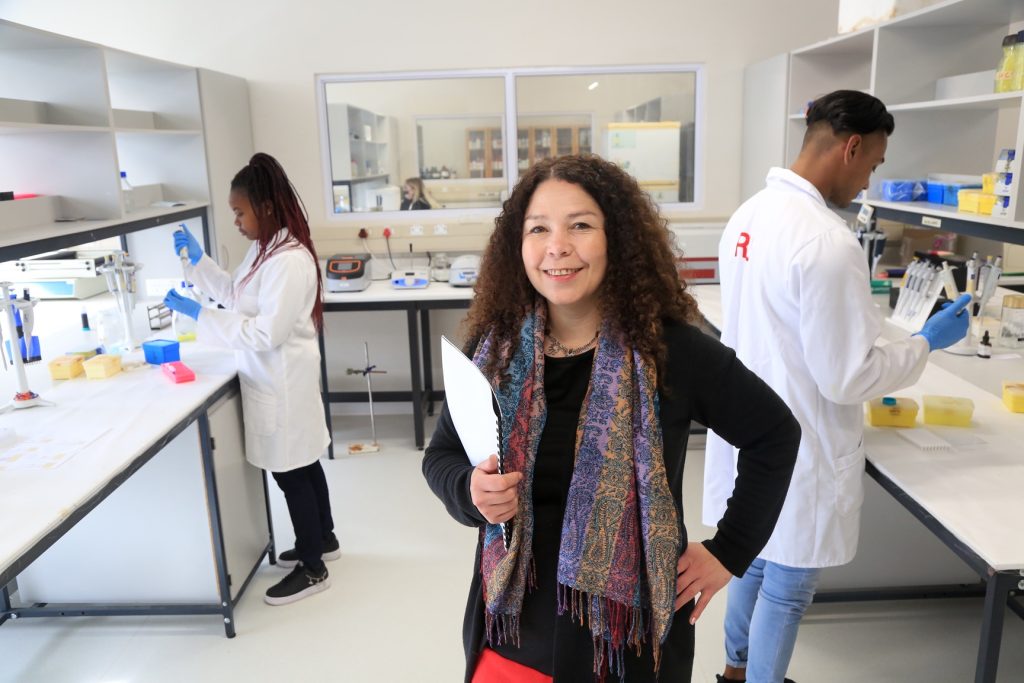

Professor Janice Limson, South African Research Chair (SARChI) in Biotechnology Innovation and Engagement, in one of the Rhodes University Biotechnology Innovation Centre (RUBIC) labs
Rhodes University has been selected by the National Research Foundation (NRF) to host one of five Presidential PhD Programme Hubs, and the only one dedicated to Advanced Biotechnology. This award places Rhodes University at the centre of an ambitious national effort to reimagine what a doctorate can be, and what its graduates can do for society.
The Presidential PhD Programme, spearheaded by President Cyril Ramaphosa and led by the NRF, is a groundbreaking initiative to build a new model for training South Africa’s doctoral candidates. Rhodes University emerged from a highly competitive national field to secure the Advanced Biotechnology hub, which will support roughly 45 PhD candidates over three years, with funding of around R21 million and a first cohort enrolling in 2027.
Rhodes University’s bid was designed as a predominantly Eastern Cape universities initiative in collaboration with its node partners: Nelson Mandela University, the University of Fort Hare and Walter Sisulu, complemented by two universities of technology, Tshwane University of Technology and Cape Peninsula University of Technology, and the Council for Scientific and Industrial Research, whose Biomanufacturing Impact Area opens a pathway from doctoral research to market-ready technologies.
Alongside Rhodes University, programme hubs have also been awarded to the University of Johannesburg, the University of the Witwatersrand, Nelson Mandela University and the University of Cape Town. These hubs span themes from the Just Energy Transition to Digital Transformation.
A natural fit
For Professor Janice Limson, who will lead the hub, the award reflects decades of groundwork. As the South African Research Chair (SARChI) in Biotechnology Innovation and Engagement, she heads the Rhodes University Biotechnology Innovation Centre (RUBIC), home to the country’s first transdisciplinary academic programme in biotechnology backed by the institution’s 40-year track record in biotechnology doctoral training. As Professor Limson stated, “building on outstanding training in biotechnology, this programme will go further and equip our graduates with the wider set of skills that will be needed to address societal challenges in a rapidly changing world.”
That ethos runs through Rhodes University’s biotechnology work, which links laboratory science to real-world need, from biosensors and rapid diagnostics to water-quality tools. The University also leads one of the Department of Science, Technology and Innovation’s Nano-Micro Manufacturing facilities, hosted in RUBIC, which houses core equipment for prototyping and developing rapid diagnostic tests. “It serves as a bridge between research and the development of commercialisable products,” Professor Limson explained, “and gives our students and businesses a pathway to product development and supports spin-out companies.”
Rethinking the PhD
The Programme is deliberately transdisciplinary, integrating biotechnology with engaged research, technology innovation and policy frameworks within a formal, curriculated degree.
Rather than the solitary path of a conventional STEM doctorate, candidates will learn through cohort and multi-disciplinary supervision, participation in short courses, international visits, and through partnerships with industry, communities and policymakers. The aim is to produce PhD graduates equipped for careers not only in academia, but in industry, entrepreneurship, governance and policy, the newer pathways being shaped by AI and the changing future of work.
Research at the hub and its nodes spans biomedical fields such as precision medicine, drug discovery, diagnostics and bioinformatics, as well as environmental biotechnology, including marine natural products and biological control. Collectively, the work has the potential to advance 13 of the 17 United Nations Sustainable Development Goals, from good health and clean water to responsible production and life below water.
A cross-institutional effort
Leading this programme from within the Eastern Cape is especially relevant given the region’s rich natural resources and the potential that biotechnology holds there to unlock an inclusive bioeconomy for the benefit of all.
Within Rhodes University, the win drew on the expertise of centres and institutes across every faculty, including Community Engagement, the Environmental Learning Research Centre, the Centre for Postgraduate Studies, the Centre for Higher Education Research, Teaching and Learning, the Centre for Biological Control, and the Institute for Water Research.
“This level of collaboration and established thought leadership around doctoral studies training, sustainability and transdisciplinarity really helped cement Rhodes University as one of the five hubs,” Professor Limson said.
For a research-intensive university, the award is both a recognition and an invitation: to students weighing where to pursue a world-class biotechnology PhD, and to partners and investors looking to back research with genuine societal return.
Beyond the hub and its nodes, this application received wide support from research councils, industry players, community organisations and NGOs, research institutes such as the South African Institute for Aquatic Biodiversity as well as national policymaking entities including the Human Sciences Research Council (HSRC) and locally, the Eastern Cape Socio-Economic Consultative Council.
Dr Kwezi Mzilikazi, Rhodes University’s Deputy Vice-Chancellor for Research, Innovation and Strategic Partnerships, said: “We are extremely proud of Professor Janice Limson and colleagues for her leadership in this initiative. We look forward to creating a signature PhD programme, housed at Rhodes University.”
With the first candidates set to enrol in 2027, the hub gives Rhodes University the chance to build something lasting: a community of scientists trained not only to push the frontiers of their field, but to put their discoveries to work in service of people and the planet.