
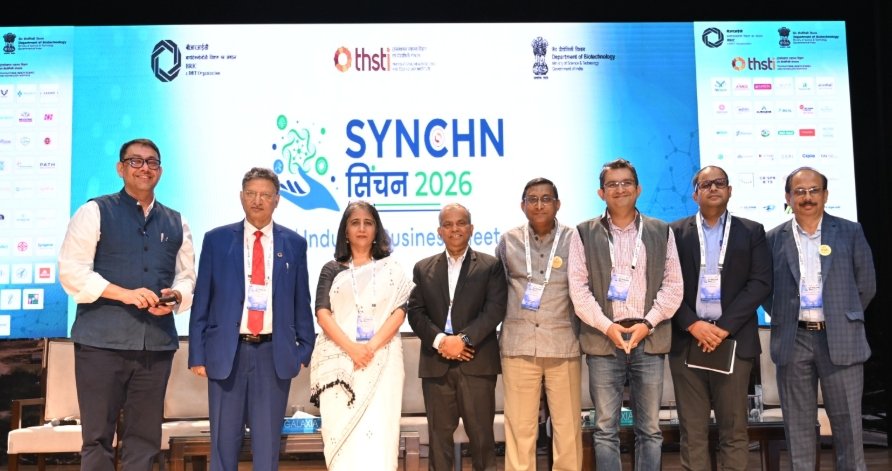
Translational Health Science and Technology Institute hosts 3rd Industry Meet ‘SYNCHN 2026’
July 16, 2026 | Thursday | News
Event brought together key global leaders in the healthcare sector

image credit- pib
The Translational Health Science and Technology Institute (THSTI) of the Biotechnology Research and Innovation Council (BRIC), under the Department of Biotechnology (DBT) successfully organised its 3rd Annual Conference – SYNCHN 2026 at the NCR Biotech Science Cluster Campus in Faridabad on 14 July.
The event brought together key global leaders in the healthcare sector, biotechnology experts, venture capitalists, startups, and policymakers to create a solid platform to address coordination gaps and translate lab-grown scientific research into commercially scale patient solutions.
Chief Guest of the event, Dr Kiran Mazumdar Shaw, Executive Chairperson, Biocon, addressed virtually, outlining the profound technological changes that are reshaping global healthcare.
Prof. Ganesan Karthikeyan, Executive Director, THSTI highlighted the institute’s strong capacity, fully operational Medical Research Centre (MRC), and accelerated product manufacturing and epidemic preparedness (APEX) initiative. MRC has an early-stage clinical trial unit, an advanced CAR-T cell research unit, and India’s first controlled human infection study (CHIS) facility. “APEX utilises a national-level flagship production platform, designed to rapidly bridge the gap that exists between proven research findings and manufacturable, organic products”, he said.
Dr Rajiv Singh Raghuvanshi, Drugs Controller General India, CDSCO said that CDSCO is actively shaping a new regulatory system for biological drugs that involves non-governmental industry experts to transform national policy and operational procedures.
Dr Manish Diwan, while discussing the deep-tech financial landscape, mentioned the recently established BIRAC Research Development and Innovation (RDI) Fund as a key catalyst in bridging the lifecycle financing gaps for startups, industry, and national labs.
Several important panel sessions were held during this major annual industry conference highlighting India’s growing influence in addressing global health challenges by strengthening international scientific collaborations and integrated research ecosystems. Discussions were held to highlight the need to remove barriers to commercialisation by bringing together innovators, investors, and accelerators to scale up biotechnology startups; and streamlining processes to rapidly deliver on significant advances made in academia to human testing and using integrated clinical research platforms as critical adjuncts for real-world validation.
The event concluded with open, interactive forums, with delegates having the opportunity to interact directly with the scientists of THSTI.