
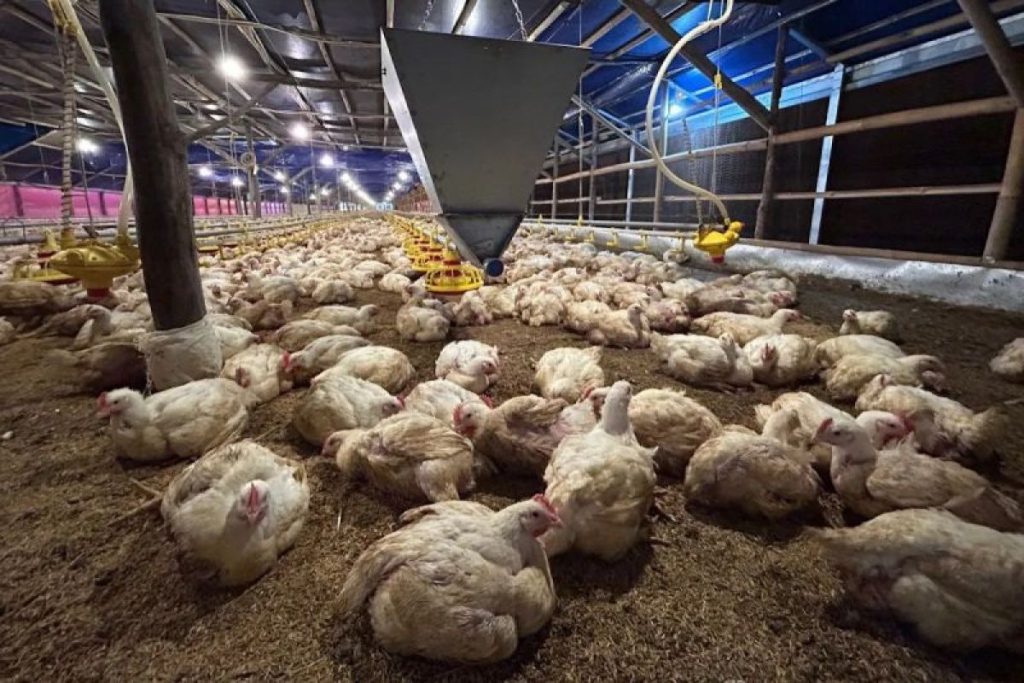
As long as prices do not meet the government reference, all recommendations related to various poultry businesses at the ministry are requested to be temporarily postponed,
Jakarta (ANTARA) – The Agriculture Ministry (Kementan) is monitoring and stabilizing live chicken prices to protect farmers from market pressures amid declining demand.
The ministry’s Director of Veterinary Public Health, Ketut Wirata, stated that his office is strengthening measures to stabilize live chicken prices at the farm level, following reports that selling prices remain below the government’s reference price in several regions.
“This effort is being made to protect the sustainability of smallholder farmers’ businesses while maintaining the balance of the national poultry industry,” Wirata said in a statement on Saturday.
The ministry held a coordination meeting with the Indonesian Poultry Slaughterhouse Association (ARPHUIN) and poultry slaughterhouse operators (RPHU) to reinforce the commitment of the entire poultry business chain to maintaining price stability at the farm level.
Wirata noted that he received reports that live chicken prices in several regions are still below the government’s reference price of Rp19,500 per kilogram.
“The information we received, particularly in Central Java, shows that live birds are being sold for Rp15,000. This is a very difficult situation for independent or small-scale farmers,” Wirata said.
This situation requires collective attention, as smallholder farmers are the most impacted when prices fall below production costs.
“Large farmers may still be able to survive because they are supported by strong capital. But for independent farmers, this situation could accelerate the process of bankruptcy,” he said.
The government is urging all industry players to strengthen collaboration to maintain market balance, including through purchasing patterns that do not exacerbate price pressures at the farm level.
“We urge and expect a joint commitment from RPHU operators to not purchase chickens below the agreed reference price,” he said.
Wirata emphasized that poultry slaughterhouses play a strategic role in the national poultry supply chain because they are a crucial instrument in absorbing farmers’ production and controlling market supply.
As part of the stabilization effort, the ministry is also implementing control measures by temporarily postponing corporate recommendations for certain businesses in the poultry sector until prices return to the government reference.
“As long as prices do not meet the government reference, all recommendations related to various poultry businesses at the ministry are requested to be temporarily postponed,” Wirata said.
Director of Livestock Breeding and Production Hary Suhada added that this step demonstrates the government’s commitment to maintaining live chicken prices at a level that benefits farmers.
“We have agreed that we will temporarily postpone all recommendations related to poultry until the government-determined price is reached. I sincerely ask for your collaboration and not to contribute to price declines,” Suhada said.
On the other hand, industry players stated that they are also facing market pressure due to weakening demand and a high supply of live chickens on the ground.
The Agriculture Ministry emphasized that stable live chicken prices are key to maintaining the business sustainability of millions of smallholder farmers and ensuring the national poultry industry grows healthily, competitively, and sustainably.
Therefore, synergy among the government, farmers, slaughterhouses, and business players is crucial in maintaining market balance and national food security.
Sigit Pambudi, Chairman of the Indonesian Poultry Slaughterhouse Association (ARPHUIN), stated that slaughterhouses continue to strive to absorb livestock production to help maintain market balance.
“The situation we are facing is equally difficult. So it is not something we should be euphoric about, taking advantage of, or exploiting,” Pambudi said.
According to him, poultry slaughterhouses continue to operate at maximum capacity, including during long holidays, to help absorb live chickens from farmers.
“Even on public holidays, we continue to slaughter heavily to absorb the chickens. So, if we suppress prices, there is no such thing,” Pambudi said.
Related news: Poultry exports reach Rp18.2B, reflecting production surplus: Minister
Related news: Indonesia ships 545 tons of poultry to Singapore, Japan, Timor Leste
Related news: Indonesia to build integrated poultry farms to support MBG program
Translator: Arie Novarina
Editor: M Razi Rahman
Copyright © ANTARA 2026