
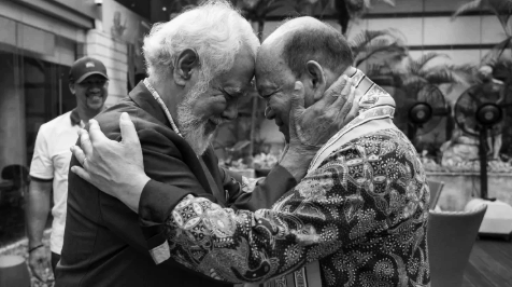
A former Indonesian special forces officer and Timor-Leste’s first president, now Prime Minister Xanana Gusmão, once on opposing sides of a protracted conflict, reunited in Jakarta after nearly 34 years, in a meeting that underscored a broader journey from confrontation to reconciliation.
From adversaries to allies: when Timor-Leste’s first president Xanana Gusmão reunited with his former Indonesian adversary in Jakarta
The encounter brought together retired Major General Mahidin Simbolon, a former member of Kopassus, and Xanana Gusmão. The two last met in 1992 during a period of conflict, before seeing each other again more than three decades later.
Revisiting a shared history
Reflecting on the reunion, Gusmão recalled their first encounter during his capture in Lahane, Timor-Leste, in 1992.
“Finally, we can meet again. He is also getting old. At that time, he held the rank of lieutenant colonel. In 1992, I was hiding at the house of Mana Aliança Araújo in Lahane,” Gusmão said during the meeting held on Saturday, May 2, as reported by Indonesia Defense.
He recounted that Simbolon and Kopassus troops apprehended him and brought him to their base.
“Because I was not properly dressed, they gave me clothes. For several days there, he observed my condition, then took me to Bali and Jakarta for questioning before I was eventually returned. That means we have actually known each other since the day I was captured in Lahane,” he said.
Following the 1992 incident, the two had no further contact until this recent meeting.
Diplomatic channels enable reunion
According to Indonesia Defense Magazine (IDM), the reunion was initiated by Simbolon, who sought to meet Gusmão through diplomatic intermediaries.
The request was conveyed via Roberto Soares and Laurentius Amrih Jinangkung during the third round of official negotiations on maritime boundary delimitation between Indonesia and Timor-Leste in Singapore.
“Mahidin Simbolon heard that I was transiting in Jakarta, so he asked Ambassador Roberto Soares for permission to meet me. In Singapore I also met the Indonesian ambassador, who was a former military officer who once escorted me from Semarang to Cipinang. Through their communication, this meeting was finally arranged,” Gusmão explained.
A moment of reconciliation
During the meeting, both figures reflected on their shared past, including memories of Timor-Leste. They communicated in Tetun and spoke in a spirit of friendship.
“All of this is carried out in a spirit of friendship. Today, when we recall past memories—who did what—it feels like mutual forgiveness, bringing a sense of calm and happiness. That is the meaning of our meeting today,” Gusmão said.
While Simbolon initially remained private about the request, subsequent reports described the encounter as deeply emotional. Sources close to the retired general indicated he viewed the reunion not only as a personal milestone, but also as a reflection of long-standing reconciliation between the two neighboring nations. Several Indonesian outlets characterized the moment as a “historic reconciliation.”
The meeting highlights a personal moment of reconciliation between two figures once divided by conflict, underscoring how historical ties continue to shape present-day relations between Indonesia and Timor-Leste. It also illustrates how former adversaries have transitioned into actors of diplomacy, mirroring the evolving bilateral relationship.
Historical context: the road to independence
Timor-Leste’s independence was the result of a long and violent struggle that reshaped relations with Indonesia.
The country formally broke away following a United Nations-backed referendum in 1999, in which an overwhelming majority voted for independence, effectively ending decades of conflict.
The aftermath of the vote was marked by widespread violence that killed more than 1,000 people and displaced hundreds of thousands, underscoring the intensity of tensions at the time.
Gusmão, who was captured by Indonesian forces in 1992, later emerged as a central figure in the country’s transition to independence and eventually became its first president.