
✕
Battered by typhoons and shaken by earthquakes, the city of Guangzhou in southern China challenges architects working there to create buildings that are both strong and flexible. For the headquarters of a new cloud technology company established by Sany, a construction equipment manufacturer, SOM designed a two-tower complex that exploits the efficiencies of a steel diagrid structure and engages its urban context with an open podium hovering above a shaded public plaza. Integrating architecture, engineering, and landscape was a key goal for the firm and its client.

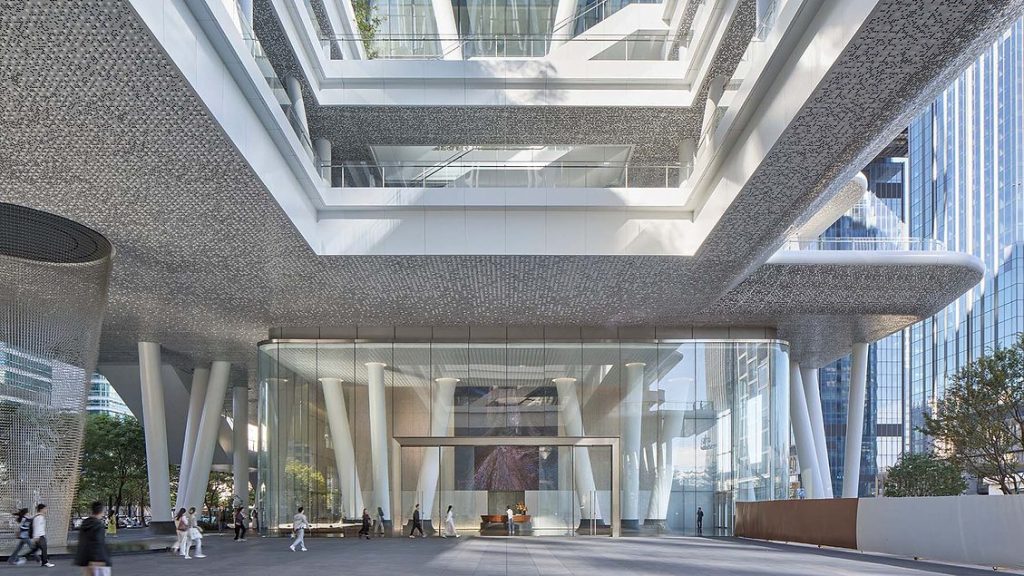
The pair of towers, with their distinctive exoskeletons (above), are linked by a bridge-like connector that shades a ground-level plaza (top of page). Photo © Dave Burk / SOM, click to enlarge.
Located in the rapidly developing Pazhou business district across the Pearl River from the historic part of Guangzhou, the 1.89 million-square-foot project sets itself apart from its mostly glass-skin neighbors with its distinctive steel exoskeletons. “The area is being built at enormous speed and there’s a sameness to all the buildings,” says Brian Lee, SOM design partner. “We wanted to take a different approach here.” The clearly expressed structure appealed to the client, says Lee, because it manifests the parent company’s roots in construction. It also offered the flexibility of column-free interiors, an asset that proved especially important when the client changed the program for some floors midstream. Around 12 floors in the 38-story tower are now slated to be a hotel, while residential units are planned for approximately five floors of that tower and 10 floors in the 36-story one. About 2,000 employees of Sany Irootech work in the two buildings.
The fraternal twin towers rise from an elevated podium that connects them above the street with a covered arcade offering retail, food, and recreational spaces and a landscaped terrace above that—all open to the public. At ground level, the bridge-like connector shades a public plaza extending from a large avenue on one side of the site to a future park on the side closest to the river. “We wanted landscape flowing throughout the project,” says Lee, “linking different levels and eventually reaching out to the park when it is completed.”
The architects minimized the size of the lobbies and wrapped them with highly transparent, low-iron glass to make them feel like pavilions set within the plaza. Taking advantage of the diagrid structure, SOM configured the towers themselves as stacked five-story blocks suspended from a perimeter ring beam at every fifth floor. Leaning the curtain wall inward reduced direct sun loads on interiors and created an outdoor terrace on the lowest floor of each five-level module.

The towers’ lobbies are wrapped in low-iron glass. Photo © Dave Burk / SOM
The external structure was erected with five-story-tall steel columns connecting to prefabricated steel nodes that employ an innovative assembly of steel plates, vertical slots, and bolts using friction to control slippage during seismic events. Mark Sarkisian, SOM structural engineering partner, says he got the idea for the pin-and-friction joints after visiting the attic of a Jesuit church in South America. It had survived a major quake in 1960 thanks to its wood-dowel connections. While Sany Irootech’s diagrids provide a high degree of stiffness, the nodes introduce ductility and dissipate energy when the earth shakes. The goal, says Sarkisian, is to create resilient structures that not only survive extreme events, but can be occupied shortly afterward. The steel columns—3.9 feet in diameter on the lower 10 floors and 3.6 feet in diameter above—were filled with concrete after assembly on-site, while the nodes remain hollow. The design minimizes moment connections and the size of bracing elements, making the project more efficient and faster to build, according to SOM.
In combination with the canted curtain walls, the exterior structure helps shade interiors and reduce energy use. Operable exterior wall vents, along with sliding glass doors on the terrace floors and perforated metal ceilings permit the buildings to be naturally ventilated when outdoor conditions are right. According to SOM, the project was designed to achieve three stars in the China Green Building Label program (the highest rating) and meet LEED Gold standards.

Each five-story diagrid module includes a terrace. Photo © Dave Burk / SOM
With its suspended floors, its open podium hovering above the ground, and its landscaping flowing around and up its paired towers, Sany Irootech elicits a sense of floating—both in terms of its engineering and its relationship to its surroundings. By accommodating movement—of structural elements and the people using and visiting it—the project injects a dose of dynamism to the typically static realm of an office complex.

Image courtesy SOM

Image courtesy SOM

Image courtesy SOM
Credits
Architect:
SOM — Brian Lee, design partner; Mark Sarkisian, structural engineering partner; Xuan Fu, managing partner; Rupa Garai, principal; Joyce Lam, Hong Kong practice leader; Kevin Rodenkirch, Xuemei Li, associate principals; Yao Xiao, project architect
Architect of Record:
Beijing Institute of Architectural Design (BIAD)
Engineers:
SOM (structural design); BIAD (structural engineer of record, MEP); Eckersley O’Callaghan (lobby facade)
Consultants:
Shenzhen L&A Design Holding, Astone Studio (landscape); TS Lighting, Enzo Design Studio (lighting); Shenyang Zhengxiang Decoration Design (facade); Percept Space Interior Design (interiors)
General Contractor:
3rd Construction Co., Ltd. of China Construction 5th Engineering Bureau
Client:
Sany Group
Size:
1.89 million square feet
Cost:
Withheld
Completion:
July 2025
Sources
Glazing:
Zhaoqing CSG Energy-Conservation Glass, Tianjin Northglass Industrial Technical Company, Guangdong Kibing Energy-Saving Glass
Exposed Steel fireproofing:
Jotun Coatings