
An investigation documents Iran’s use of a Chinese-built satellite for military targeting. Against this backdrop, the analysis highlights a broader supply network — spanning Pakistan and intermediary hubs — that underpins the resilience of Iranian capabilities under sanctions pressure
When asked in the Oval Office whether he was angered by China’s shipments of dual-use materials to Iran, President Donald Trump replied yesterday: “No. We do the same thing, don’t we, with other countries?”
A revealing aside in Washington. An almost incidental remark, yet one that captures a deeper ambiguity shaping the current phase of the conflict.
- The line between commercial exchange and strategic support has narrowed to the point where attribution is contested — and often politically inconvenient.
- Trump’s comment also comes weeks before a planned visit to Beijing — the first by a US president since 2017, when he himself travelled there during his first term.
The satellite case. New evidence makes that ambiguity harder to sustain. A Financial Times investigation shows that Iran’s Islamic Revolutionary Guard Corps acquired a Chinese-built satellite, significantly expanding its ability to monitor and target US military assets across the Middle East.
- The system, TEE-01B, was launched from China in late 2024 and later transferred in orbit — an emerging “in-orbit delivery” model that allows providers to keep formal distance from end use. According to the documents, the renminbi-denominated agreement — about Rmb250mn (roughly $36.6mn) — covered the platform, services and access to ground infrastructure.
- Leaked documents indicate the satellite was actively tasked to surveil US bases in the weeks following the outbreak of hostilities, when Iran launched retaliatory strikes against attacks by the US and Israel using drones and missiles. High-resolution imagery — about half-metre resolution, versus roughly 5 metres for Iran’s Noor-3 — enabled target identification, battle damage assessment and near real-time operational refinement.
From episode to pattern. This episode, documented by the investigation, fits within a broader shift. Beyond the satellite case, Iran’s capabilities appear increasingly sustained by external inputs sitting at the intersection of commercial technology and strategic application.
- Rather than acquiring finished systems, Tehran operates within a distributed ecosystem of suppliers, intermediaries and facilitators.
China’s role: capacity, not platforms. Within this analytical frame, China occupies a central position. Its contribution takes the form of a steady transfer of industrial materials, technological components and precision-enabling systems.
- Available data and estimates on sodium perchlorate shipments point in the same direction as the satellite case: capacity embedded within civilian or dual-use channels.
Pakistan as logistical backbone. On the analytical level, the infrastructure sustaining these flows is equally consequential. Pakistan emerges as a logistical node, leveraging overland routes developed under the China-Pakistan Economic Corridor (CPEC) to connect western China to Iran’s operational space.
- Within this framework, the Gilgit-Baltistan axis — linking Xinjiang to Islamabad, Rawalpindi and the port of Gwadar — forms a critical land backbone for the movement of goods and materials.
- These routes reduce exposure to monitored maritime lanes and allow sensitive cargo to move within commercial traffic, shielded by the opacity of overland logistics.
Buffer, deniability, and tempo. Islamabad’s role — which includes moving the de-escalation talks between Iran and the US — operates along facilitation and risk absorption.
- In this reading, Iran also functions as an extension of China’s projection towards the Indian Ocean, offering redundancy along critical energy and trade routes, notwithstanding the well-known political and security frictions surrounding the Pakistani corridor.
- More broadly, in fact, CPEC provides Beijing with direct access to the Arabian Sea and the Indian Ocean, reducing reliance on the Strait of Malacca and reinforcing projection towards the Middle East and Africa.
- In practice, this arrangement sustains continuity while preserving Beijing’s distance from the operational end of the chain. It also regulates the tempo at which Iran can rebuild and adapt its capabilities, maintaining plausible deniability while limiting exposure.
A dispersed supply chain. The system appears to rely on dispersion. By March 2026, US assessments indicated that drone components, propellant materials and navigation systems were integrated within this distributed architecture.
- Materials and technologies rarely move directly from origin to destination; they transit across multiple jurisdictions, often involving commercial actors that provide cover and financial intermediation. This modular structure complicates traceability and weakens enforcement.
Turkey at the margins. Turkey offers, in this patchwork, a case of how these dynamics operate at the margins.
- Of course, there is no evidence of state-directed military transfers to Iran, consistent with Ankara’s NATO commitments.
- Yet Turkish-based entities have repeatedly appeared in sanctions frameworks tied to procurement networks supporting Iran’s programmes.
- Their role is functional, operating through commercial and financial channels — access to electronics, industrial materials and payment systems, often via front companies — placing Turkey as an indirect enabler within the network.
A system without a centre. Taken together, a system emerges without a clear centre of gravity. China provides technology and materials; Pakistan underpins logistical continuity; intermediary hubs sustain procurement and finance; Iran integrates and deploys.
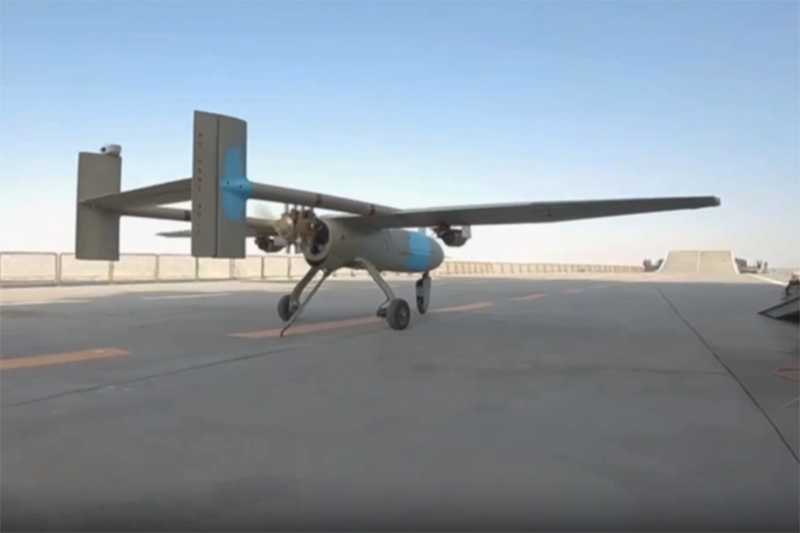
- Operational indicators reinforce this reading. Iran retains a significant share of its launcher capacity — estimated at roughly half — while continuing to deploy UAVs at scale, suggesting sustained access to external inputs and rapid regeneration cycles.
Beyond Iran. The implications extend beyond the immediate theatre. The core challenge lies not in a single actor but in the network itself — a transnational web that blends state interests, commercial incentives and dual-use technologies.
- In that sense, the satellite documented by the investigation is more than a tactical asset. It signals a broader shift: modern military capability is assembled incrementally, diffusely and, increasingly, with corridors in plain sight.