
When Energy Markets Split: Understanding the Gas-Oil Pricing Divide
Commodity markets are rarely efficient across all assets simultaneously. When one segment of a sector breaks out to multi-year highs while a closely related asset stagnates, experienced traders pay close attention. That gap between asset prices represents either a fundamental divergence that will persist or a dislocation that will correct. In the energy complex, few dislocations have attracted as much attention in 2025 as the widening chasm between crude oil and natural gas prices, a setup that many analysts are describing as a textbook natural gas catch-up trade against oil.
Understanding why this opportunity exists, what forces could close the gap, and what risks stand in the way requires digging into both the structural mechanics of energy markets and the seasonal forces that routinely reshape commodity price relationships.
When big ASX news breaks, our subscribers know first
Why Natural Gas and Crude Oil No Longer Follow Each Other
For much of the twentieth century, natural gas and crude oil prices maintained a relatively predictable relationship. Both were shaped by shared production infrastructure, particularly in the Gulf of Mexico, and broad macroeconomic demand cycles kept them broadly correlated. That relationship began breaking down after the US shale revolution accelerated from approximately 2009 onward.
The shale boom flooded domestic markets with natural gas at a pace that outstripped infrastructure capacity. Henry Hub prices, which serve as the US natural gas benchmark, collapsed while crude oil remained anchored to a globally benchmarked pricing structure. Today, Henry Hub reflects domestic supply, storage levels, pipeline access, and weather-driven demand. WTI and Brent futures, by contrast, are moved by OPEC production decisions, geopolitical tensions, global shipping dynamics, and international demand cycles.
This structural decoupling is not a temporary anomaly. It is now a permanent feature of how energy markets are organised. The practical result is that crude oil can rally sharply on, for example, Middle East supply concerns, while natural gas languishes on a mild winter storage surplus. Conversely, a regional pipeline bottleneck in the US Northeast can send spot gas prices into triple-digit territory per MMBtu while oil remains unaffected. As explored by Investopedia, the correlation between oil and natural gas has weakened significantly since the shale era began.
The Gas-to-Oil Ratio and What Extreme Readings Signal
The natural gas-to-oil ratio is a tool used by energy traders to measure whether the two commodities are priced fairly relative to each other on an energy-equivalent basis. When the ratio becomes historically extreme, it typically signals that one commodity has become significantly underpriced relative to the other, creating conditions for mean reversion.
As of mid-2025, that ratio had reached one of its most extreme readings in recent market history. Crude oil benchmarks, including WTI, Brent, gasoline, and heating oil, all broke out above four-year highs during April and into May 2025. Natural gas, measured at Henry Hub, lagged considerably. This divergence, with the broader energy complex posting multi-year breakouts while gas remained subdued, is the foundation of the catch-up trade thesis. Furthermore, understanding crude oil price trends provides essential context for measuring just how wide this dislocation has become.
A historically wide gas-to-oil ratio has repeatedly preceded periods of natural gas outperformance. The wider the dislocation, the more compressed the eventual catch-up move tends to be.
The Demand Forces Converging Behind Natural Gas in 2025
Multiple demand catalysts were aligning simultaneously during the mid-2025 period, each independently supportive of higher natural gas prices and collectively creating a compounding effect.
Summer Cooling Demand: An Underappreciated Seasonal Driver
The summer season is almost universally discussed in terms of its impact on gasoline demand via the driving season. What receives far less attention is the substantial uplift that summer heat delivers to natural gas consumption through electricity generation. Natural gas-fired power plants represent the largest single source of electricity generation in the United States.
When temperatures rise and air conditioning units run at full capacity across residential, commercial, and industrial sectors, electricity demand surges and natural gas-fired generation responds in kind. This creates a dual seasonal tailwind during summer months: the driving season supports crude oil and refined product prices, while the cooling season supports natural gas demand. For the catch-up trade, this dynamic is particularly relevant because it means both sides of the dislocation are being addressed simultaneously during peak summer conditions.
LNG Exports: Building a Bridge to Global Prices
One structural development that has permanently altered the natural gas pricing landscape is the growth of US liquefied natural gas export capacity. Prior to the construction of major export terminals, Henry Hub prices were entirely a function of domestic supply and demand. There was no effective mechanism for US gas to seek higher international prices.
That has changed significantly. The LNG supply outlook for 2025 shows that European and Asian LNG markets regularly price at substantial premiums to Henry Hub. European TTF hub prices and Asian JKM spot prices have historically traded at multiples of domestic US gas benchmarks during periods of global supply tightness. As US export terminals operate near capacity, they draw down domestic supply available for storage and consumption, tightening the domestic market and providing structural support for Henry Hub prices.
The AI Infrastructure Demand Layer
A newer and increasingly important demand driver is the electricity consumed by data centres supporting artificial intelligence workloads. The rapid scaling of AI infrastructure requires enormous quantities of reliable, continuous electricity. Unlike solar or wind generation, which are intermittent, natural gas-fired power plants can provide dispatchable baseload generation that follows demand patterns precisely.
This positions natural gas as a critical bridge fuel during the AI infrastructure buildout, creating a sustained and growing demand layer that extends well beyond traditional seasonal patterns. Some energy analysts have cited this AI-driven electricity demand as capable of supporting a meaningful structural uplift in energy prices over the medium term, though such projections carry inherent uncertainty and should be treated as analytical scenarios rather than forecasts.
Regional Price Dynamics: Where the Dislocation Is Most Extreme
The national Henry Hub benchmark understates the severity of regional natural gas price dislocations that occur during high-demand periods. Pipeline infrastructure constraints in the US Northeast, particularly around hubs like Transco Zone 6 near New York City, have historically produced spot prices that bear little resemblance to the national benchmark.
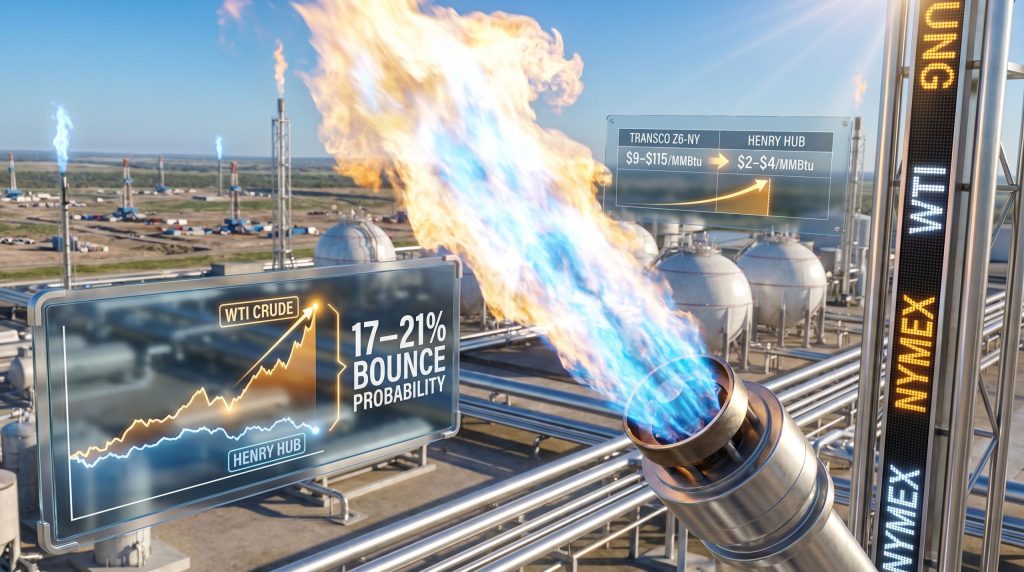
During peak winter and summer demand events, spot prices at constrained Northeastern hubs have reached levels between $91 and $115 per MMBtu, compared to national benchmark prices in the low single digits. This represents a fundamental infrastructure bottleneck rather than a market anomaly. Transmission capacity into the most densely populated region of the country simply cannot always keep pace with peak demand, and the price system responds accordingly.
| Hub | Typical Price Range | Primary Driver |
|---|---|---|
| Henry Hub (benchmark) | $2 to $4/MMBtu | Gulf Coast supply dynamics |
| Transco Zone 6 NY (peak) | $9 to $115/MMBtu | Pipeline capacity constraints |
| European TTF | $10 to $30/MMBtu | LNG import dependency |
| Asian JKM | $12 to $35/MMBtu | LNG spot market |
These regional premiums demonstrate that when infrastructure constraints interact with demand spikes, the price response in natural gas can be extraordinarily sharp, a dynamic that adds another dimension to understanding the upside potential embedded in catch-up trade positioning.
The Shale Factor: How Crude Oil Prices Can Tighten Gas Supply
One of the least understood aspects of the natural gas market is how crude oil production activity directly influences gas supply. In major shale basins such as the Permian, natural gas is frequently produced as an unavoidable byproduct of oil drilling, referred to as associated gas. When oil prices weaken and drilling programmes slow, the associated gas that would have been produced alongside crude oil also disappears from the supply picture.
This creates a counterintuitive dynamic. A decline in crude oil prices can, by suppressing drilling activity, reduce natural gas supply by an estimated 1.5 to 2 billion cubic feet per day during significant downturns, as observed during the 2020 market collapse. For traders watching the gas-to-oil ratio, this means that oil price weakness does not necessarily translate into gas price weakness. If oil falls enough to curtail drilling, gas supply tightens, potentially supporting natural gas prices even as the oil complex softens.
Technical Price Signals and the Catch-Up Setup
From a technical analysis perspective, natural gas was testing multi-year support trendlines during the mid-2025 period, levels that had historically acted as high-probability reversal zones. Technical analysts following the energy complex had identified a bounce probability in the 17 to 21% range from those support levels, with the UNG ETF (United States Natural Gas Fund) frequently cited as an accessible vehicle for retail market participants seeking directional exposure.
The broader energy complex context reinforced this technical setup. WTI crude oil, Brent crude, gasoline, and heating oil all confirmed breakouts to four-year highs during April and into May 2025. When the broader sector breaks out and a component asset lags, historical pattern analysis suggests the lagging asset frequently follows with a delayed but amplified move. The US natural gas forecast for the remainder of 2025 aligns with this technical picture, reinforcing the case for natural gas as the lagging asset in an otherwise bullish energy complex.
The next major ASX story will hit our subscribers first
Navigating the Risks: What Could Derail the Catch-Up Trade
No directional commodity trade is without risk, and the natural gas catch-up thesis carries several specific vulnerabilities that traders and investors should weigh carefully.
- Weather normalisation remains the most significant near-term risk. A cooler-than-expected summer would suppress air conditioning demand and substantially reduce the seasonal demand uplift that underpins the thesis.
- Associated gas oversupply is a structural risk. If crude oil prices recover and incentivise accelerated Permian drilling, associated gas volumes could overwhelm the market and cap any natural gas price recovery.
- LNG demand disruptions, such as a mild European winter reducing import demand, could redirect export cargoes and loosen the domestic supply picture.
- Above-average storage builds during injection seasons can independently suppress Henry Hub prices regardless of structural demand dynamics.
- Macro risk-off episodes represent a systemic risk. Broad commodity sell-offs, which have historically concentrated in late May and into June, can temporarily drag the entire energy complex lower.
Seasonal Risk Windows: Does Timing Matter?
The well-known phrase among commodity traders, sell in May and go away, contains an important nuance that is frequently overlooked: the risk-off period it describes does not typically materialise at the very beginning of May. Market strength often persists through the first half of the month before giving way to a more cautious phase as the calendar moves toward late May and into June.
June in particular has a historical reputation among energy traders for risk-off conditions, similar in character to the sharp corrections that have occasionally hit metals markets during comparable seasonal windows. Traders positioning for the natural gas catch-up trade against oil must account for this seasonal volatility window before the summer demand peak takes hold in July and August.
| Period | Historical Tendency | Implication |
|---|---|---|
| Late April to Mid-May | Commodity strength, breakout momentum | Potential entry window |
| Late May to June | Risk-off, seasonal correction risk | Active risk management required |
| July to August | Summer demand peak, energy strength | Core thesis validation period |
| September to October | Shoulder season, demand moderation | Position reassessment warranted |
Investment Vehicles for the Natural Gas Catch-Up Trade
Market participants have several instruments available for gaining exposure to a potential natural gas price recovery, each with distinct characteristics, risk profiles, and suitability considerations. Understanding how CFDs work is particularly relevant for those considering short-term tactical positions, as leverage can significantly amplify both gains and losses in a volatile commodity like natural gas.
| Instrument | Key Feature | Primary Consideration |
|---|---|---|
| Henry Hub Futures (NYMEX/CME) | High liquidity, standardised contracts | Requires margin management and futures account |
| UNG ETF | Accessible without futures account | Contango decay risk over extended holding periods |
| Natural Gas CFDs | Leverage available, no physical delivery | Short-term tactical use; leverage amplifies losses |
| Energy Sector ETFs | Broad sector exposure | Diluted pure-play exposure to gas prices |
| Gas Producer Equities | Direct company exposure | Equity-specific risks layered on commodity exposure |
According to OilPrice.com, understanding how to trade commodity disconnects requires careful attention to both the structural drivers of the dislocation and the precise instruments used to express the view.
Risk Disclosure: Natural gas is one of the most volatile commodity markets in the world. Price moves of 10% or more in a single session are not uncommon during demand spikes or supply disruptions. Any leveraged position in this market carries the potential for losses that can exceed the initial capital deployed. Robust position sizing and disciplined risk management are essential components of any energy trading strategy.
Key Takeaways for Investors and Traders
The natural gas catch-up trade against oil thesis rests on a convergence of structural, seasonal, and technical factors that were aligning simultaneously in mid-2025. The core elements of the setup include:
- The natural gas-to-oil ratio reached one of its most extreme historical readings, creating measurable mean-reversion potential.
- The broader energy complex, including WTI, Brent, gasoline, and heating oil, broke out to four-year highs while natural gas lagged, identifying it as the underperforming asset within an otherwise bullish sector.
- Summer cooling demand, expanding LNG export infrastructure, and AI-driven electricity consumption represent three independent and converging demand catalysts.
- Technical analysis identified a 17 to 21% bounce probability from multi-year support levels for natural gas.
- The shale-associated gas dynamic means that crude oil price movements can influence gas supply in counterintuitive ways, adding further complexity to the trade.
- Seasonal risk windows in late May and June require careful timing and position management before the core summer demand period validates the thesis.
The natural gas catch-up trade against oil is not a guaranteed outcome. It is a probabilistic setup built on the historical tendency of dislocated asset prices within the same sector to converge. Whether that convergence materialises depends on weather patterns, macroeconomic conditions, and the pace of LNG export demand, all of which carry inherent uncertainty. Investors and traders should conduct their own due diligence and consult qualified financial professionals before acting on any commodity market analysis.
Want to Stay Ahead of the Next Major Resource Opportunity?
While energy traders track commodity dislocations like the gas-to-oil ratio, Discovery Alert’s proprietary Discovery IQ model scans ASX announcements in real time, instantly identifying significant mineral discoveries before the broader market reacts — explore historic examples of major discovery returns to see what’s possible, then start your 14-day free trial at Discovery Alert to position yourself ahead of the next transformative find.