
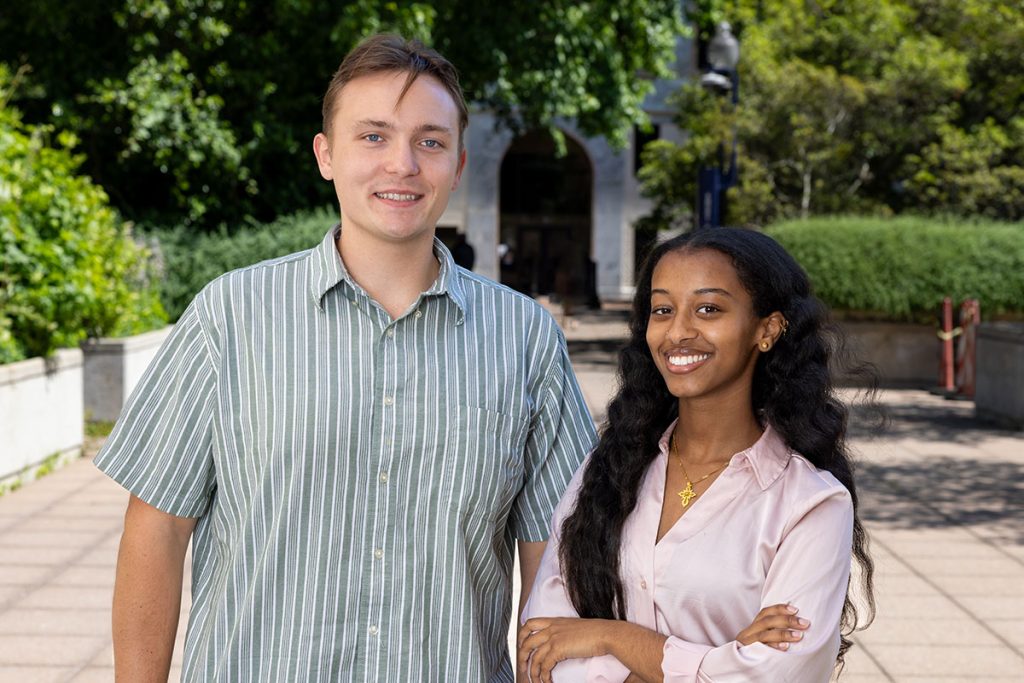
Andrew Conlon and Hlina Temesgen have been named as Beckman Scholars within Emory College of Arts and Sciences. The rising juniors will begin 15 months of intensive research in biology and chemistry, respectively, this summer.
“This is a great opportunity for Andrew and Hlina to have a long runway to getting really engaged in a project and to have the time to make their research their own,” says Anita Corbett, senior associate dean for research and Samuel C. Dobbs professor of Biology in Emory College. She also serves as principal investigator of the Beckman Scholars Program.
Earlier this year, the Arnold and Mabel Beckman Foundation selected Emory as one of 14 institutions for its signature program for high-achieving undergraduates studying chemistry and life sciences.
The program provides funding for two students to work with one of 15 Beckman research mentors from Emory College and the Emory School of Medicine. The Beckman Scholars Selection Committee chooses second-year students who are already conducting research in mentors’ labs and plan to pursue PhDs in their fields.
Conlon will work with Emory ethnobotanist Cassandra Quave, professor of dermatology at Emory School of Medicine and Emory College’s Center for the Study of Human Health. Temesgen will work with Bill Wuest, Georgia Research Alliance Distinguished Investigator and professor of chemistry.
Both students also will have the opportunity to work with Emory’s Biological Discovery through Chemical Innovation initiative, which fosters cross-disciplinary research to accelerate understanding of disease and advance drug discovery.
“The time that the Beckman allows for this level of work is incredible, not only for the scholars but also for other students we can now support because of this funding,” Wuest says. “It helps pay forward research opportunities for all of our undergraduate students.”
Adds Quave, “Undergraduate research is essential for developing future scientists. It is a privilege to work with intellectually curious students, guiding them through the scientific process as they build skills and contribute to discoveries in the service of human health.”
Different approaches to a health care threat
Conlon, a biology major from metro Atlanta, wanted to attend Emory in part due to Quave’s research on medicinal plants and antibiotic resistance. He first learned about plants from his mother, an Austrian native who taught him to forage in forests here and in Europe. His interests have expanded to plant-derived pharmaceuticals.
Quave directed Conlon to the Emory Herbarium during his semester at Emory, where he helped curator Tharanga Samarakoon with specimen collection. During his second semester, he completed an analysis of Georgia Poison Control data that showed mushroom poisoning cases are on the rise statewide.
He presented his findings at Emory’s 2025 Undergraduate Research Symposium, just before he joined Quave’s lab as one of the Garden Club of America’s Zeller Summer Scholars in Medicinal Botany.
Quave has since guided Conlon’s efforts to examine potential antibiotic properties of a small evergreen shrub in the Lamiaceae (mint) family. The Beckman funding will allow him to take an even deeper dive into identifying compounds from the plant with antibiotic properties.
Determining the molecular structure of those compounds would allow synthetic chemists to create new molecules based on their chemical blueprints, which researchers can then test for pharmaceutical safety and efficacy.
“I want to continue on this project for as long as I can,” says Conlon, president of the Emory Botanical Society, who plans to pursue a joint MD/PhD. “If we can find the biological pathways that allow these plants to inhibit bacteria, you could create a whole new class of drugs that deal with the antibiotic resistance crisis.”
Temesgen is also tackling antibiotic resistance. A chemistry major who grew up in metro Atlanta after moving from Ethiopia, Temesgen’s project focuses on creating new disinfectants for household use. The work lies at the intersection of biology and chemistry — a passion she originally thought would send her to medical school.
She pivoted during her first year on campus when Antonio Brathwaite, a teaching professor and director of undergraduate research in the Department of Chemistry, encouraged her to consider where else those interests could take her.
Temesgen found herself deep in research shortly after meeting with Benjamin Chiok, a Pathways Center undergraduate research ambassador. He recommended she learn more about Wuest’s “slaying superbugs” lab.
Wuest rewarded Temesgen’s curiosity with an original project: to take the first steps in a synthetic sequence and prove the reactions had the potential to create new antimicrobial agents. She has since completed the novel sequencing and has had opportunities to attend the American Chemical Society (ACS) national conference and the ACS Graduate Readiness Bootcamp.
The Beckman funding will provide her with the resources to determine which synthesis will work best and develop the microbiology assays needed to test whether the preferred molecules are effective.
“Being in the lab has shown me that I really like the pace of work and the independence to pose my own questions and track a project start to finish,” says Temesgen, a QuestBridge scholar who is considering a PhD in chemistry or chemical biology. “I can envision myself working in chemistry in ways related to public health, but I’m grateful to explore and experience everything I can.”