
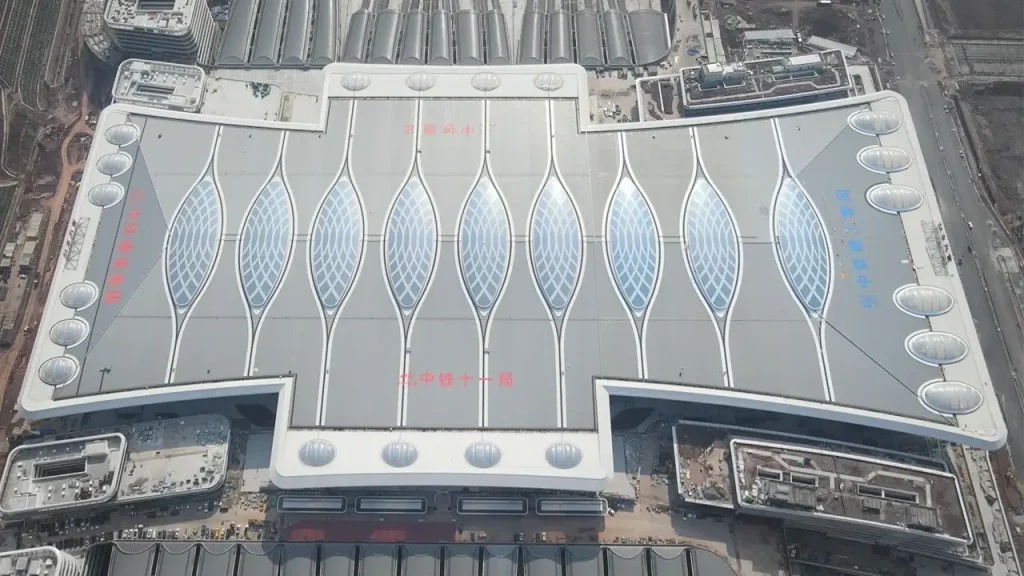
China has opened what it says is the world’s largest railway station, a vast new hub in the city of Chongqing that covers 1.22 million square metres, or about 170 football fields.
Chongqing East Railway Station began full operations on 27 June 2025 after about seven years of construction. It is designed to handle 300,000 passengers a day and is built as both a transport interchange and a business centre.
The station has 15 platforms and 29 tracks and uses direct metro links to connect with the wider city. Officials say the site reflects China’s continued investment in high-speed rail as an alternative to short-haul flights.
The scale of the project is striking even by China’s standards. The station’s footprint is said to be twice the size of the Vatican and larger than 170 football fields, underlining the ambition behind one of the country’s latest transport mega-projects.
Planning for the station began in 2011, when China Railway carried out logistics analysis for the site. Construction started in 2018 and main works were completed in spring 2024, before the station opened to passengers in 2025.
Builders used 2 million cubic metres of concrete and 366,000 tonnes of steel on the project. The station sits on the outskirts of the 10 million population metropolis of Chongqing, one of western China’s major urban centres.
The building has been designed to resemble an airport terminal rather than a traditional train station. It is intended for high-speed rail services only, a choice that officials say should help improve efficiency despite a smaller number of platforms than some older intercity stations.
From the new hub, high-speed train journeys to major Chinese cities are expected to be relatively fast. Trips to Beijing and Shanghai take about 6 hours, while Wuhan can be reached in 3 hours and Wanzhou and Qianjiang in about 1 hour.
China has spent heavily on high-speed rail in recent years, linking major cities and reducing reliance on domestic flights for shorter journeys. The Chongqing East project is now a central part of that network, and one of the clearest examples of the country’s continuing push to expand rail capacity.
For travellers, the station adds another major gateway to one of China’s biggest inland cities. For the rail industry, it is a new benchmark in size, capacity and integrated transport planning.