
“It’s time, it’s time… it’s World Cup time”. Xuxa’s little tune echoes in the heads of all Argentinians as they await a World Cup that promises to be unique, literally, because for the first time it will be hosted by three countries and will feature 48 national teams, when the maximum had been 32, offering a massive group stage made up of 72 matches.
But going back to the Brazilian singer’s little tune that fascinated the youngest kids, one issue to keep in mind starting on June 11 will be the kickoff times of the matches in North America, which will be spread across venues located in three different time zones. And the schedule, confirmed after the playoffs, already has winners and losers. Because some countries will enjoy the tournament from home on TV during the day and at night, while others will suffer through having to do so in the early hours of the morning. Because of the time zones, but also because of FIFA’s preferences.
The clock plays on fans’ minds during World Cup times, and the best way to prove it is by remembering a torment of our own. If Argentine fans are asked which is the worst World Cup they remember, most will point to the combo of disappointment and bleary eyes left by Korea-Japan 2002, when we were eliminated in the first round despite having a great team, with the added sting that those blows came at ridiculous hours. Shall we go over them?
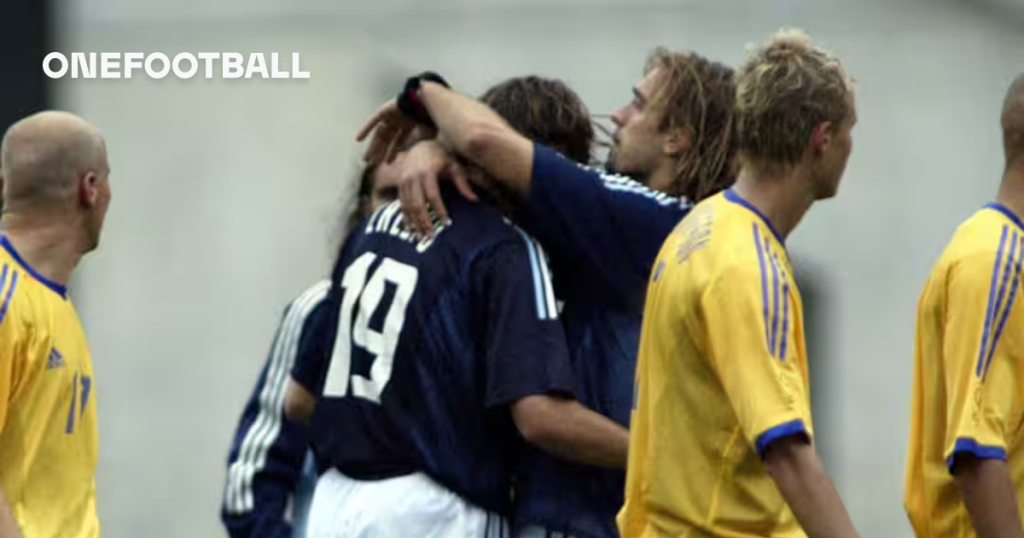
The debut against Nigeria was late on a Saturday night, at 2:30 in the morning, and we went to sleep happy after the win, relaxed because Sunday laziness could stretch late into the day; the defeat against England was a hammer blow that hit us on a Friday at 8:30 in the morning, with the whole workday still ahead. But the worst came against Sweden, on a Wednesday at 3:30 a.m., and we went off to work or school knowing we had been eliminated.
After that Far East nightmare, Argentina enjoyed better results, including the 2014 final and, of course, the third star in 2022, still etched in everyone’s heart. But with one important detail: we never again had to play at such difficult hours for watching from home, a situation that will continue at the tournament that begins in a little over a month.
It’s worth reviewing: the Scaloneta’s action in Group J will be against Algeria on Tuesday, June 16 at 10 p.m.; against Austria on Monday the 22nd at 2 p.m.; and against Jordan on Saturday the 27th at 11 p.m. A piece of cake, at least in scheduling terms.
If they advance as group winners, the national team will continue on its way at friendly hours: the round of 32 knockout match (against Spain or Uruguay?) will be on Friday, July 3 at 7 p.m.; the round of 16 on Tuesday the 7th at 1 p.m.; the quarterfinals on Saturday the 11th at 10 p.m.; and both the semifinal on Wednesday the 15th and the final on Sunday the 19th, both at 4 p.m. Having said all that… let’s not jinx it.
But going back to the time zones, one side’s benefit means another’s hardship. In this 48-team World Cup, there will be countries that will have to go through hoops to watch their teams if you consider that in cities like Vancouver, San Francisco, Los Angeles or Seattle, far to the west on the map, the clock is “only” four hours behind Buenos Aires, but there is a nine-hour gap with Switzerland or Belgium and ten hours with Egypt or Qatar, all teams that will have to visit those venues.
But attention, because the most confused when it comes to time will be the Australians: the Oceanian side will be playing a full 17 hours away from its people! So when they make their debut against Turkey on the night of June 13 at 9 p.m. in Vancouver, in Melbourne it will be 2 in the afternoon the following day. At least they won’t have to wake up early.
In that sense, it is possible to determine which countries will suffer most from FIFA’s scheduling, though with some nuances that go beyond geography. The fact is that Tunisia or Algeria, with just a one-hour difference from Europe’s leading nations, top the list of countries whose fans will have to set the alarm clock (or just stay up) to watch their teams.
In an imaginary table of late-night matches, those two African countries would be at the top. Algeria will play its group-stage matches at 2, 4 and 3 in the morning; while Tunisia will do so at 3, 5 and midnight. Behind them comes a pack with two late-night appointments, including the Czech Republic, which will play at 4 and 3 a.m., or Egypt, forced to turn on the TV at 4 and 6 in Cairo to watch Mohamed Salah.
Only on the third tier of the “hardest hit,” with just one awkwardly timed match, do we find the first world champions on the list. France will face Iraq when the clocks in Paris strike 1 a.m.; and in Madrid it will be 2 a.m. when the match begins in which Spain, led by Lamine Yamal, will likely battle Uruguay for first place in Group H.
A brief parenthesis. The World Cup will be missing a couple of players with their own peculiarities in time-zone terms: Russia, absent due to a FIFA ban, is so vast that it spans 11 different time zones; and China, for its part, which failed to qualify for the second World Cup in its history, has a landmass that stretches across five time zones even though the time is always the same in every corner of the country.
However, when it comes to oddities, France is a record case: if you count its overseas territories, scattered all over the planet, it has between 12 and 13 different time zones, so Kylian Mbappé can be watched whenever the hands of the clock decide.
That said, there will be one cursed match in time-slot terms, which could be called the insomnia match, and by chance it is part of the dynamics of Argentina’s group. On matchday two of Group J, Algeria and Jordan will face each other on Monday, June 22 in San Francisco when it is 8 p.m. in that part of the world, but 12:00 a.m. on Tuesday the 23rd in Buenos Aires, 4 a.m. in Algiers and 6 a.m. in Jordan’s capital, Amman. There is no more inconvenient match than that one, although at the World Cup, anything goes.
This article was translated into English by Artificial Intelligence. You can read the original version in 🇪🇸 here.
 View publisher imprint