
The Catholic diocese, which celebrated its 80th anniversary recently, should get back to standing up for the vulnerable
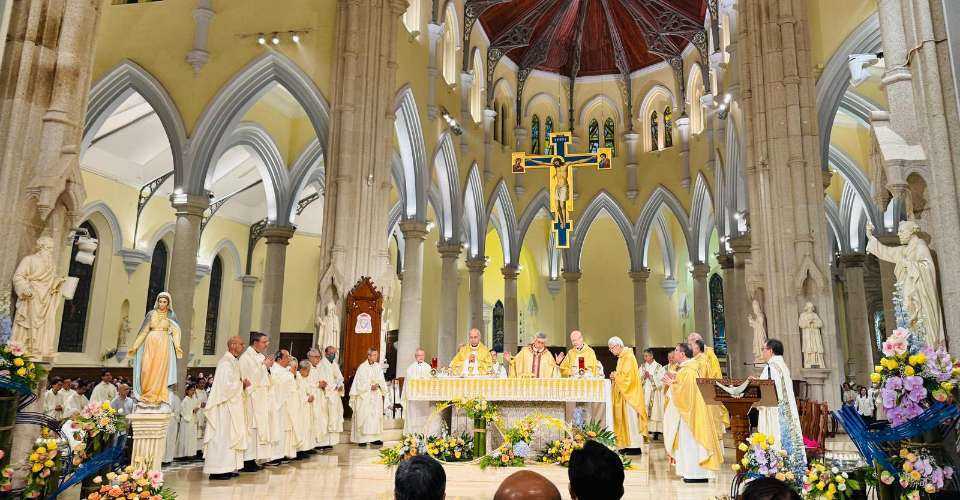
Hong Kong’s Catholic diocese celebrated its 80th anniversary earlier this month.
On April 11, 1946, Pope Pius XII declared the creation of the Hong Kong diocese, elevating the Church in the city from its previous status of an Apostolic Vicariate
A celebratory Mass marking the anniversary was led by the current Bishop of Hong Kong, Cardinal Stephen Chow Sau-yan, and concelebrated by its former Bishops, Cardinal Joseph Zen, Cardinal John Tong, and the current Auxiliary Bishop Joseph Ha Chi-sing.
In his homily, Cardinal Chow — a Jesuit appointed by Pope Francis — reflected on the history of Catholicism in Hong Kong. For 185 years, since the creation of the Apostolic Prefecture in the city on April 22, 1841, the Church has been at the forefront of providing vital services to the wider community in healthcare, education, and charitable work.
“The Church of Hong Kong has always stood up for the most vulnerable,” Cardinal Chow said. “And in the future, it will continue to preserve the legacy of the past and pass it on to the future, forming a bridge and a synodal path for the universal Church and the Church on the Chinese mainland.”
Those two sentences raise key questions about how Hong Kong — and the Church’s voice within it — has changed since the handover of the city to China in 1997, particularly since the intensifying crackdown on basic freedoms following the draconian National Security Law imposed by Beijing in 2020.
The Church in Hong Kong now finds itself at a crossroads.
Once led by the courageous Cardinal Zen, who, as bishop of Hong Kong from 2002 to 2009 and previously as coadjutor bishop from 1996 to 2002, spoke truth to power, today’s leadership under Cardinal Chow is much more diplomatic.

While Cardinal Zen spoke out strongly and repeatedly for democracy and human rights, and on occasions undertook hunger strikes and even participated in demonstrations and vigils, Cardinal Chow makes regular visits to Beijing and engages in dialogue with the state-controlled Catholic Patriotic Association about Xi Jinping’s program of “Sinicization” of religion.
While Cardinal Zen attended the trial of prominent lay Catholic pro-democracy campaigner Jimmy Lai and visited him in prison, Cardinal Chow has been tight-lipped regarding the imprisonment of pro-democracy activists and other human rights violations. It was, after all, Cardinal Zen who baptized Lai into the Catholic Church in 1997, six days after the handover, so his support is unsurprising.
But Cardinal Chow’s silence — at least in public — is troubling.
The Hong Kong diocese used to hold annual vigils to mark the June 4 anniversary of the 1989 Tiananmen massacre. Churches across the city would be open for prayer to commemorate that tragedy. But that stopped in 2022, due to fears of violating the National Security Law.
Furthermore, other prominent Catholics — clergy and laity — were closely associated with the pro-democracy movement.
Cardinal Zen and Jimmy Lai are undoubtedly the best known and the most courageous, but during the 2019 protests, the auxiliary bishop Joseph Ha spoke out in support of the movement, participated in vigils, and told protesters that “no matter how long” they stayed on the streets, he would stay with them.
“The shepherd should not just be with the sheep but also guide them,” he added. And he spoke out against police brutality, saying: “They just want to voice their demands. Why do they deserve that [violence]? I can’t understand why Hong Kong has become like this today. We just want to live freely. We don’t deserve it.”
Bishop Ha was the obvious choice to succeed as Bishop of Hong Kong, as I argued five years ago — but his support for democracy and human rights cost him that job.
Among the laity, some of Hong Kong’s most prominent democrats are devout Catholics, including Martin Lee, the father of the democracy movement, and Anson Chan, the former chief secretary of Hong Kong. And Britain’s last colonial governor of Hong Kong, Chris Patten, who did far more than any of his predecessors to try to embed democratic values and institutions in the city, is a practicing Catholic.
But today, so much has changed.
Jimmy Lai, aged 78, is serving a 20-year prison sentence in solitary confinement and denied the right to receive the Sacrament of Holy Communion. In deteriorating health, his sentence amounts in effect to a death sentence, unless he is released soon.
Cardinal Zen, aged 94, has understandably been less vocal since his arrest under the National Security Law in 2022 and his subsequent trial on charges of “colluding with foreign forces”. He is not in prison, but he knows that if he steps out of line again, he could be. His passport has been confiscated and returned only temporarily on a few occasions to allow him to travel to Rome.
Similarly, Martin Lee and Anson Chan have retired from politics and public life, maintaining an understandable but notable silence, knowing they could be top targets for arrest.
In this context, it is unsurprising that Cardinal Chow is cautious.
But if his statement this month — that “the Church of Hong Kong has always stood up for the most vulnerable” — is to prove true, then he ought to be exercising his responsibility to plead for those of his flock who are unfairly in prison. He ought to find ways to use his pulpit to defend basic human rights and dignity, even in subtle, nonconfrontational ways.
Yet it appears he is placing a higher priority on the second part of his remarks, trying to form “a bridge and a synodal path for the universal Church and the Church on the Chinese mainland.” Such a role may serve some purpose, but he appears to be rather too eager to kowtow to Beijing.
He claims the Sino-Vatican agreement is working, when it clearly is not; he claims religious freedom in Hong Kong is not threatened, when it clearly is; and he has gone further than required to embrace the Chinese Communist Party (CCP) regime and its state-approved church institutions. It is one thing to be silent on injustices, out of fear for the consequences of speaking out, but it is quite another to appease, collaborate with, and kowtow to the dictators in Beijing.
As the Church marks the 80th anniversary of the Hong Kong diocese — which has approximately 268 priests, 404 nuns, and runs 249 Catholic schools, and provides medical and social services through hospitals, schools, nursing homes, and rehabilitation centers — there is much to celebrate. But there is also much to be concerned about.
Hong Kong has changed rapidly in recent years from being one of Asia’s freest and most open cities to one of its most repressive police states. The future for its 7.5 million residents — including 392,000 Catholics — looks increasingly dark. So, within the constraints and fears it faces, the diocese should get back to standing up for the most vulnerable.
*Benedict Rogers is a human rights activist and writer, Senior Director at Fortify Rights, co-founder and Chair of Hong Kong Watch, and author of “The China Nexus: Thirty Years In and Around the Chinese Communist Party’s Tyranny.” The views expressed in this article are those of the author and do not necessarily reflect the official editorial position of UCA News.