
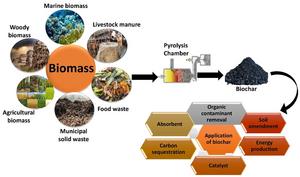
As the world searches for scalable solutions to climate change, a growing body of research is highlighting biochar as a promising carbon-negative technology with far-reaching environmental benefits. A new comprehensive review published in Biochar explores how this carbon-rich material could help tackle global challenges ranging from greenhouse gas emissions to soil degradation and water pollution.
Biochar is produced by heating organic materials such as agricultural residues, forest waste, or manure in a low-oxygen environment, a process known as pyrolysis. The result is a stable, carbon-dense material that can persist in soils for hundreds to thousands of years, effectively locking away carbon that would otherwise return to the atmosphere as carbon dioxide.
“Biochar represents a unique opportunity to address multiple environmental issues at once,” said the study’s lead author. “It not only captures carbon but also improves soil health, supports agricultural productivity, and contributes to cleaner water systems.”
The review synthesizes findings from a wide range of recent studies, showing that biochar applications can lead to a net negative carbon footprint. By stabilizing carbon in soil, biochar helps reduce greenhouse gas emissions, including carbon dioxide and nitrous oxide, both major contributors to global warming.
Beyond climate mitigation, biochar offers substantial benefits for agriculture. When added to soil, it improves water retention, enhances nutrient availability, and promotes beneficial microbial activity. These effects can increase crop yields while reducing the need for chemical fertilizers. Biochar’s porous structure also helps retain nutrients in the root zone, minimizing nutrient loss and improving long-term soil fertility.
The material is equally promising for environmental remediation. Its high surface area and chemical functionality allow it to adsorb pollutants, including heavy metals and organic contaminants, from soil and water. This makes biochar a valuable tool for restoring degraded ecosystems and improving water quality in agricultural and industrial regions.
In addition, biochar plays a role in the emerging bioeconomy. It can be produced from waste biomass, including agricultural residues and municipal organic waste, turning low-value materials into high-value environmental solutions. This process not only reduces waste but also contributes to renewable energy production through co-products such as bio-oil and syngas generated during pyrolysis.
The study also highlights advances in engineered biochar, where production conditions such as temperature and feedstock are carefully controlled to tailor its properties for specific applications. These innovations are expanding biochar’s effectiveness in areas such as carbon sequestration, soil restoration, and pollutant removal.
However, the authors caution that challenges remain. The performance of biochar depends strongly on factors such as feedstock type and production conditions. There are also concerns about potential environmental and health risks, including unintended changes in soil chemistry or the introduction of contaminants. The researchers emphasize the need for further studies and standardized guidelines to ensure safe and effective use.
Despite these uncertainties, the findings underscore biochar’s potential as a multifunctional solution for sustainable development. By integrating carbon sequestration with soil improvement, waste management, and pollution control, biochar could play a key role in global efforts to build a more resilient and environmentally sustainable future.
===
Journal Reference: Ayaz, M., Muntaha, S.T., Baltrėnaitė-Gedienė, E. et al. Biochar and carbon-negative technologies: exploring opportunities for climate change mitigation. Biochar 7, 17 (2025).
https://doi.org/10.1007/s42773-024-00421-3
===
About Biochar
Biochar (e-ISSN: 2524-7867) is the first journal dedicated exclusively to biochar research, spanning agronomy, environmental science, and materials science. It publishes original studies on biochar production, processing, and applications—such as bioenergy, environmental remediation, soil enhancement, climate mitigation, water treatment, and sustainability analysis. The journal serves as an innovative and professional platform for global researchers to share advances in this rapidly expanding field.
Disclaimer: AAAS and EurekAlert! are not responsible for the accuracy of news releases posted to EurekAlert! by contributing institutions or for the use of any information through the EurekAlert system.