

Close Menu
Simply Invest Asia
  • Home
  • About us
  • Explore industries/sectors
    • Automobile
    • Aviation
    • Banking
    • Biotechnology
    • Chemical & Fertilizer
    • Entertainment and Media
    • Food Processing
    • Healthcare
    • Iron and Steel
    • Leather
    • Mining
    • Oil and Gas
    • Pharmaceutical
  • Explore by countries
    • China
    • Dubai / UAE
    • Hong Kong
    • India
    • Indonesia
    • Japan
    • Malaysia
  • Explore cities
    • Bangkok
    • Beijing
    • Chongqing
    • Delhi
    • Dubai
    • Guangzhou
    • Jakarta
    • Kuala Lumpur
  • Why Asia
Facebook X (Twitter) Instagram Threads
Trending:
  • Official Draw for ASEAN Club Championship Shopee Cup™ 2026/27 To Be Held on 5 June in Jakarta
  • China’s space station lands new batch of samples for experiments
  • Kremlin-Backed Disinformation Unit Tied To Zelenskyy Dubai Apartment Hoax
  • Tourism offers a lifeline to Hong Kong’s dwindling open-air food stalls
  • Nepal News | Nepal’s First Online News Portal
  • India news: Myanmar president arrives in Delhi to boost ties
  • Waterproof Camera Bag Market in Indonesia | Report – IndexBox
  • Keel laying ceremony held for Malaysia’s first electric ferries in Nansha, Guangzhou
  • Brussels fires starting gun on tougher China trade policy, as Beijing vows retaliation
  • What India and Pakistan’s new arms race means for the region
  • Reliance Bets Big on AI to Power Media, Entertainment
  • Why any UAE petrol price reduction in June does not mean we are on the same road as 2022
  • This Jersey Oil and Gas Insider Increased Their Holding In The Last Year
  • Hong Kong to curb flavoured tobacco in next phase of controls: health chief
  • Summer-like heat hits much of Japan as severe tropical storm approaches
  • Nike Air Force 1 Low “Black Leather” Loafer Buckle
  • How China turned an obscure chemical into a tool of influence
  • Wang: China looks forward to promoting strategic partnership with Canada
Saturday, May 30
Facebook X (Twitter) Instagram
Simply Invest Asia
  • Home
  • About us
  • Explore industries/sectors
    • Automobile
    • Aviation
    • Banking
    • Biotechnology
    • Chemical & Fertilizer
    • Entertainment and Media
    • Food Processing
    • Healthcare
    • Iron and Steel
    • Leather
    • Mining
    • Oil and Gas
    • Pharmaceutical
  • Explore by countries
    • China
    • Dubai / UAE
    • Hong Kong
    • India
    • Indonesia
    • Japan
    • Malaysia
  • Explore cities
    • Bangkok
    • Beijing
    • Chongqing
    • Delhi
    • Dubai
    • Guangzhou
    • Jakarta
    • Kuala Lumpur
  • Why Asia
Simply Invest Asia
Home»Explore by countries»India»What India and Pakistan’s new arms race means for the region
India

What India and Pakistan’s new arms race means for the region

By IslaMay 30, 20265 Mins Read
Share
Facebook Twitter Pinterest Threads Bluesky Copy Link


While the world’s attention is fixed on the U.S.-Iran war, a quiet arms race is accelerating between nuclear rivals India and Pakistan.

Last year’s brief but intense missile exchange across the India-Pakistan border ended with a ceasefire on May 10, 2025. So far, that agreement has held, but both countries have spent the past year preparing for future conflict. 

Delhi and Islamabad are expanding their investment in drones, precision missiles, air defense systems, and surveillance technologies that played a central role in their most recent clash. 

Why We Wrote This

India and Pakistan are accelerating a largely underexamined arms buildup. After last year’s military clash, the shift toward faster, less predictable technologies is raising new concerns about future confrontation between old rivals.

According to the Stockholm International Peace Research Institute, India’s military expenditure rose 8.9% in 2025 to $92.1 billion, making it the world’s fifth-largest military spender. Pakistan’s defense budget grew even faster, increasing 11% to $11.9 billion. Delhi and Islamabad are aiming to boost their 2026-2027 military budgets by an additional 15.2% and 13.5%, respectively.

Experts say this buildup is lowering the threshold for future confrontations between the nuclear-armed rivals.

“The India-Pakistan relationship remains crisis-prone,” says Praveen Donthi, senior India analyst at the International Crisis Group. “Last year’s ceasefire froze the conflict and triggered a race for defense acquisitions based on the lessons learnt.” 

These acquisitions are reinforcing what he describes as a “new framework” for military engagement between India and Pakistan – one that enables both sides to strike deeper into each other’s territory through faster, less conventional, and harder-to-predict forms of warfare. 

Indian army soldiers carry drones during an operational drill in Pathankot, India, Feb. 26, 2026.

A new kind of conflict

India and Pakistan have fought four wars and several smaller confrontations since the 1947 partition of British India created the neighboring nations. But for residents watching swarms of glowing, orange drones float across the night sky last spring, the 2025 skirmish felt like science fiction – unfamiliar, and unsettling. 

For decades, the threat of nuclear war has acted as a deterrent against large-scale conflict between India and Pakistan, and when the countries did fight, it was largely confined to remote, Himalayan border areas. Occasional artillery exchanges, tank battles, or aerial dogfights were common near the Line of Control that divides the disputed Kashmir region between India and Pakistan. 

Michael Kugelman, a senior fellow for South Asia at the Atlantic Council, says last year’s conflict – triggered by a militant attack on tourists in Indian-administered Kashmir – marked a sharp escalation from previous crises, both in weapon sophistication and geographic reach. 

For the first time, Islamabad and Delhi both used long-range precision missiles and modern fighter jets with enhanced firing capabilities, in strikes that pushed warfare closer to dense, civilian areas. Swarms of surveillance and combat drones flew over cities far from traditional front lines. And though there is no evidence that either state used fully autonomous weapons, both militaries relied on artificial intelligence to assist with surveillance and drone coordination.

The shift matters because of an international relations theory known as the “stability-instability paradox” – basically, the idea that the presence of nuclear weapons decreases the chances of full-scale war, while increasing the number of smaller conflicts, because both sides are confident that the other won’t escalate. The concern is that new military technologies – which compress reaction times and reduce the role of human decision-making – could make these smaller conflicts more frequent, more destructive, and harder to control.

A visitor takes a selfie with an unmanned drone during a defense exhibition held as part of Pakistan’s Independence Day celebrations, in Islamabad, Aug. 14, 2025.

“One of the more unsettling takeaways from last year’s conflict is that India and Pakistan have clearly become quite comfortable using increasing amounts of limited conventional force below the nuclear threshold,” says Mr. Kugelman.

A flurry of acquisitions

The rise in military spending suggests that both countries expect more confrontation in the near future, says Amalendu Misra, professor of international politics at Lancaster University. The buildup is also deepening strategic alignments that place India and Pakistan in competing geopolitical camps.

Since the ceasefire, Pakistan has strengthened defense ties with Turkey and China, which already supply much of its military hardware, including fighter jets, air defense systems, and missile technologies used in last year’s conflict. This month, Pakistan’s navy received its first of eight Hangor-class submarines from China, which have state-of-the-art sensors and highly advanced digital combat management systems.
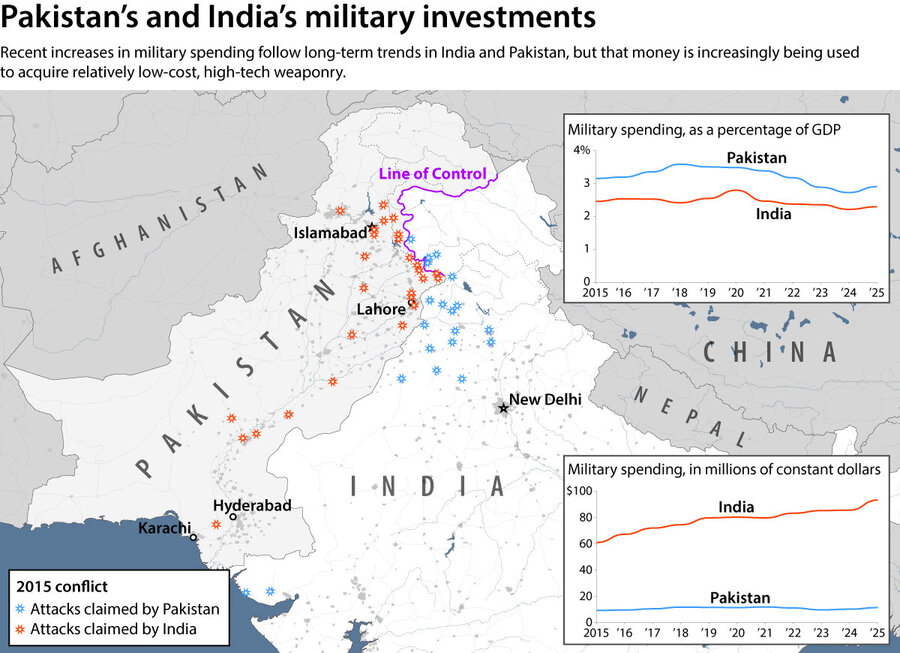

SOURCE:

Stockholm International Peace Research Institute, New York Times

|

Jacob Turcotte/Staff

India, meanwhile, has expanded defense cooperation with Israel, France, and Russia while also pushing to boost domestic weapons production and reduce dependence on foreign suppliers. In recent months, Delhi moved forward with plans to acquire 114 additional Dassault Rafale fighter jets from France and S-400 air defense systems from Russia – both used during the 2025 conflict – and expanded joint production agreements with Israeli and French firms for drones and precision-guided weapons. 

Officials are also in talks with Israel about developing India’s own Iron Dome, called Mission Sudarshan Chakra, after last year’s strikes exposed the limits of existing air defense systems.

Despite the accelerating arms race, analysts do not believe either country is preparing for total war. Instead, the danger lies in repeated, low-level conflicts gradually becoming the new normal. 

“We are moving into what strategists term ‘hybrid warfare,’” says Mr. Misra, in which rapidly evolving technology is used in formal military operations and unconventional attacks, like disinformation campaigns. 

Hybrid warfare doesn’t fit neatly into the existing rules of war, and is inherently unpredictable. Yet the 2025 conflict added merit to a growing belief that such wars can be fought and contained under the nuclear threshold. 

Analysts warn this assumption – more so than any one kind of weapon – could lay the foundation for a more volatile phase of India-Pakistan relations.


Source link

Related Posts

Intel’s US$3.3b India Plant Raises Questions On Growth And Valuation

May 30, 2026

US War Secretary Pete Hegseth Calls India a ‘Critical Anchor’ in Indo-Pacific, Hails Military Modernisation and Defence Co-Production With US

May 30, 2026

Migrants try to flee to Bangladesh fearing India crackdown

May 30, 2026
Add A Comment
Leave A Reply Cancel Reply

Top Posts

Abandoned malls, whispers of nuclear war and young foreigners detained. This is what’s REALLY going on in Dubai… and the chilling warning one taxi driver gave to the Mail’s IAN BIRRELL

April 11, 2026

Dubai food conglomerate IFFCO set to go into provisional liquidation – Financial Times

May 3, 2026

Asian Angle | Why Japan-China ties can benefit from promoting people-to-people exchanges

May 3, 2026
Don't Miss

Official Draw for ASEAN Club Championship Shopee Cup™ 2026/27 To Be Held on 5 June in Jakarta

By IslaMay 30, 2026

SINGAPORE (30 May 2026) – The ASEAN Club Championship Shopee Cup™, Southeast Asia’s premier club…

China’s space station lands new batch of samples for experiments

May 30, 2026

Kremlin-Backed Disinformation Unit Tied To Zelenskyy Dubai Apartment Hoax

May 30, 2026

Tourism offers a lifeline to Hong Kong’s dwindling open-air food stalls

May 30, 2026
SUBSCRIBE TO OUR NEWSLETTER

Get our latest downloads and information first. Complete the form below to subscribe to our weekly newsletter.


I consent to being contacted via telephone and/or email and I consent to my data being stored in accordance with European GDPR regulations and agree to the terms of use and privacy policy.

Stay In Touch
  • Facebook
  • YouTube
  • TikTok
  • WhatsApp
  • Twitter
  • Instagram
Top Trending

This Jersey Oil and Gas Insider Increased Their Holding In The Last Year

By IslaMay 30, 2026

Hong Kong to curb flavoured tobacco in next phase of controls: health chief

By IslaMay 30, 2026

Summer-like heat hits much of Japan as severe tropical storm approaches

By IslaMay 30, 2026
Most Popular

May Fourth Movement remembered

May 4, 2026

Juventus Summer Tour powered by Jeep: the Hong Kong Football Festival 2026 

April 21, 2026

Power demand defies forecasts, officials say consumption likely to surge further | India News

April 26, 2026
Our Picks

Guangzhou Yuexiu Capital Q1 net profit up 97.7% y/y

April 29, 2026

Ethan Brown makes dream start to Hong Kong stint with Happy Valley win on Shooting To Top | HK Racing

April 22, 2026

Iran Refutes UAE’s Groundless Accusations

April 21, 2026
SUBSCRIBE TO OUR NEWSLETTER

Get our latest downloads and information first. Complete the form below to subscribe to our weekly newsletter.


I consent to being contacted via telephone and/or email and I consent to my data being stored in accordance with European GDPR regulations and agree to the terms of use and privacy policy.

© 2026 Simply Invest Asia.
  • Get In Touch
  • Cookie Policy
  • Privacy policy
  • Terms & Conditions

Type above and press Enter to search. Press Esc to cancel.

SUBSCRIBE TO OUR NEWSLETTER

Get our latest downloads and information first.

Complete the form below to subscribe to our weekly newsletter.


I consent to being contacted via telephone and/or email and I consent to my data being stored in accordance with European GDPR regulations and agree to the terms of use and privacy policy.