
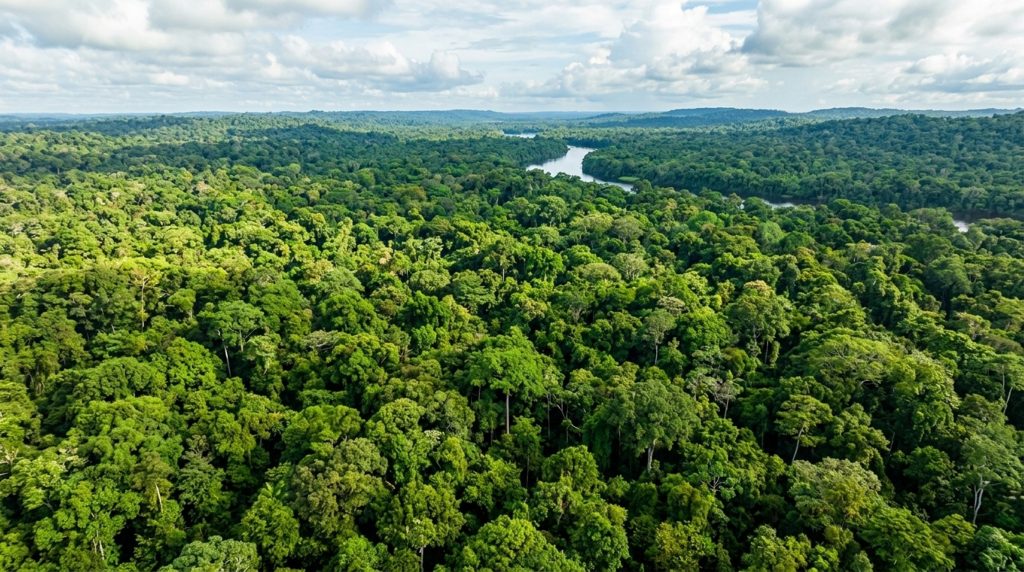
The air above the Amazon smells the way it does because of chemicals the trees are constantly releasing.
Researchers have been measuring those compounds for years, and most of the time the mix is predictable enough that any big departure reads like a distress signal.

During and after the record-shattering drought of 2023 and 2024, the readings showed something no one had seen there before.
Molecules that had never been detected in the rainforest’s air appeared above the canopy – and they kept appearing long after the rains came back.
Trees send distress signals
Plants give off a whole family of airborne compounds. The lightest, isoprene, makes the blue haze over forested mountains.
Heavier and far rarer are the sesquiterpenes, larger molecules trees release when something is wrong.
One of them, caryophyllene, gives cloves and black pepper their warm bite. Trees release sesquiterpenes as distress signals and protective chemicals, guarding their tissues when heat, drought, or pests push them past a safe limit.
These molecules are faint and break down within minutes, so few measurements of them exist over any tropical forest.
Dr. Joseph Byron of the Max Planck Institute for Chemistry (MPIC) in Mainz, Germany, led a team to catch them during a real climate extreme.
Measuring the Amazon’s breath
The team works at the Amazon Tall Tower Observatory, a German-Brazilian site about 93 miles northeast of Manaus, Brazil.
Steel towers rise out of the canopy, letting researchers sample the air right where the trees release it.
From about 75 feet up, just above the treetops, an automatic sampler drew in air every hour and a half to three hours.
It trapped the compounds on cartridges that later traveled to a German lab for sorting molecule by molecule.
They sampled four times over two years, timing each visit to the drought’s arc – before the El Niño took hold, near its peak, as it eased, and after recovery.
That lets them watch the chemistry move with the climate, not guess from one snapshot.
Heat and drought intensify
By October 2023, the forest was hotter and drier than the records had ever shown.
Canopy temperatures that normally sit near 79°F climbed toward 88°F, humidity near 90 percent dropped into the low 60s, and the soil dried to match.
Through all of it, isoprene and monoterpenes – lighter relatives of the sesquiterpenes that many trees release – barely reacted to the drought, rising and falling with the ordinary swing of wet and dry seasons.
The sesquiterpenes behaved nothing like them.
Across the El Niño, their levels more than doubled. The team confirmed this was a real increase, not just molecules lingering because less ozone was around to destroy them.
The forest appeared to be spending scarce carbon to build them exactly when water and energy were hardest to come by.
Stress signals outlast drought
None of that compared to what came after the drought peaked. The same team had shown in an earlier study that the forest leaves chemical traces of its own stress.
This time the trace was new. As the rains returned in spring 2024, the forest began releasing heavier, stickier molecules that had never registered in its air – a group of sesquiterpene alcohols led by beta-eudesmol.
Until this study, no one had reported these compounds in any rainforest’s air.
Instruments had read flat zero for them on earlier visits; now they appeared at levels rivaling the main stress compounds. Stranger still, they peaked after the drought, not during it, and lingered for weeks.
The team measured the air, not the inside of the trees, so the metabolism behind it stays an inference. Still, the new molecules shared the same underlying structure.
They rose and fell in step – a sign that one stress-triggered pathway had switched on and kept running well past the emergency.
How trees manage stress
Drought and heat damage trees partly by flooding their cells with reactive oxygen species – unstable molecules that tear at tissue from within.
Plants survive by mopping them up, and other research suggests Amazon trees coordinate such emissions to endure stress.
There is a clue from human medicine. Beta-eudesmol, the molecule the forest started releasing, is known from essential oils as an anti-inflammatory and antioxidant, and in human cells it switches on genes that clear away those same destructive molecules.
Whether it does the same job inside a tree is still a hypothesis.
The researchers caution that plant and human cells handle oxidative stress – the damage from those unstable molecules – differently, and no one has watched these compounds at work in Amazon leaves.
Drought may reshape emissions
These reactive molecules clump into tiny particles that seed clouds and scatter sunlight. A lasting change in what the forest emits could ripple into the weather and climate over the whole basin.
For now, the forest recovers between droughts and its chemistry returns to normal.
Project leader Jonathan Williams, an atmospheric chemist at the institute, expects that reset to weaken as the planet warms and El Niños grow stronger.
“These emissions may become a permanent feature of the region,” said Williams.
Before this work, the alcohols the forest makes under stress had never been recorded in its air. Now they have names and a clear pattern.
The related sesquiterpenes more than double during extreme drought, and the defensive chemistry lingers into the recovery season before fading.
Scientists can track them as live stress markers. A recent study treats the basin’s hot droughts as a preview of a hotter future – one where tree emissions may not match anything measured before.
The study is published in the journal Communications Earth & Environment.
—–
Like what you read? Subscribe to our newsletter for engaging articles, exclusive content, and the latest updates.
Check us out on EarthSnap, a free app brought to you by Eric Ralls and Earth.com.
—–