
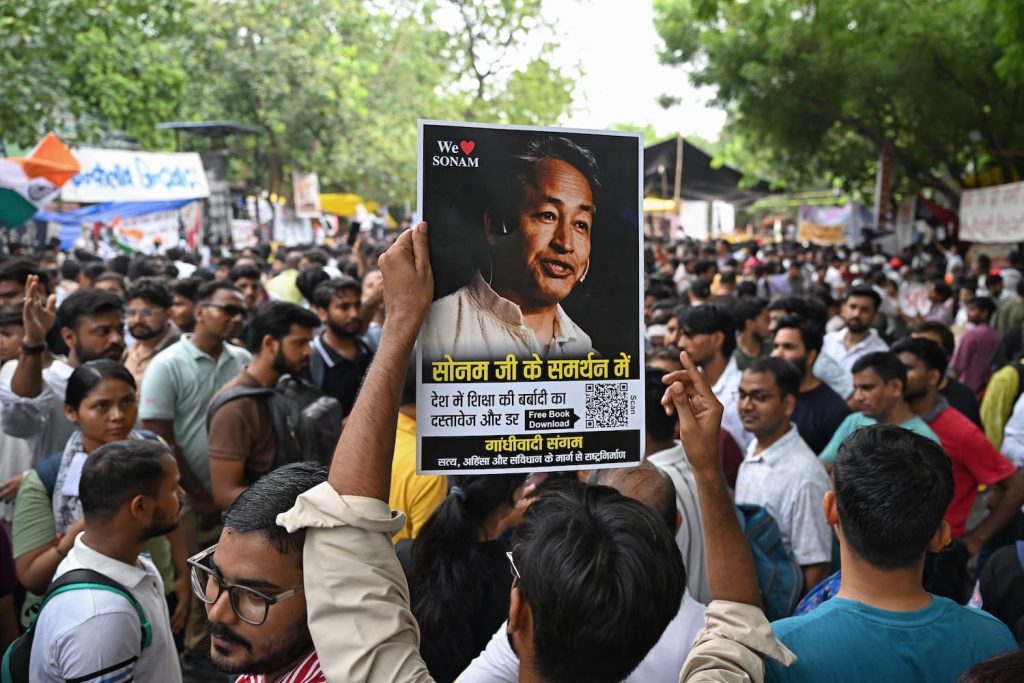
On July 18, the award-winning Indian activist Sonam Wangchuk was picked up by the Delhi Police and taken to a state-run hospital against his will 20 days into a hunger strike. His fast is aimed at demanding accountability from the government after medical school entrance exam papers were leaked in May—supporting a nascent movement of young Indians fed up with unfairness in India’s hypercompetitive education system and high unemployment.
The scene at the hospital was familiar: a frail man surrounded by men in uniform, with a government insisting that it had acted out of medical concern and his family insisting that the state had no business intervening. Wangchuk’s condition remains stable, and on Tuesday, the Delhi High Court allowed him to be moved to a private hospital. India has watched similar situations play out many times—the fast is one of the oldest protest mechanisms in its political repertoire.
Wangchuk, 59, is an engineer and education reformer best known for water conservation work in the Himalayas. He began his hunger strike at New Delhi’s Jantar Mantar observatory on June 28, shortly after India’s medical school entrance exams—sat by roughly 2.2 million aspiring doctors—were conducted twice within weeks because of the leak. The controversy caused mass frustration and uncertainty; it was followed by a wave of reported suicides among students.
Out of that grief, the Cockroach Janta Party emerged. The protest movement began online as satire, defiantly naming itself after the Indian Supreme Court chief justice dismissed unemployed young people as “parasites” and “cockroaches.” However, its focus on exam integrity has struck a chord among aspirant youth, who face bleak job prospects and believe that the best way to climb the ladder of success is through education. If that system is rigged, what are the young to do?
The Cockroach Janta Party also made its base camp at the Jantar Mantar, long New Delhi’s designated site for dissent, thus asserting that the movement belonged in the lineage of legitimate protest. On Monday, thousands of demonstrators marching toward Parliament on the opening day of its session and were met with tear gas and batons. The only real government engagement—a single round of talks with a senior minister—failed to defuse the standoff. Some students have joined Wangchuk’s hunger strike in solidarity.
On Tuesday, protesters said they would stand their ground at Jantar Mantar, though they would not attempt another march, while political opposition leaders staged a sit-in outside Indian Prime Minister Narendra Modi’s residence.
Wangchuk understood the frustration of the youth, undertook an indefinite fast, and became a rallying point for the movement. He demands the resignation of Education Minister Dharmendra Pradhan and an overhaul of the exam system that has betrayed the students who trust it. Hours before the police picked up Wangchuk, he wrote online that “Smaller Movements have brought down many governments in India.”
Why fast? Why not march, or strike, or sue? The answer lies in a moral logic that runs deep in Indian political history, in which the only violence permitted against a more powerful adversary is violence against oneself.
Mohandas Gandhi did not invent the political fast, but he made it a national instrument, undertaking at least 17 hunger strikes during his life. His target was not necessarily the British Empire. Most of the fasts were directed inward at Hindu society and at his own followers; Gandhi wanted to remove caste hierarchies and discrimination, end Hindu-Muslim violence, and impose moral discipline in his ashrams.
Gandhi’s most consequential fast, in September 1932, was fought against the colonial government granting a separate electorate to the Dalits—led by B.R. Ambedkar, later one of the main authors of India’s constitution. The fast produced the Poona Pact, which replaced the British-proposed separate electorates with reserved seats in a joint electorate. Ambedkar would later describe the hunger strike as coercion dressed up as principle, pushing him to sign the pact under the threat of Gandhi’s death.
Only a handful of Gandhi’s fasts focused on British or communal power. In other words, the technique was less a weapon against the colonizer than a tool for disciplining Gandhi’s own side—a distinction that Wangchuk’s fast, aimed at his own government, echoes directly.
This raises the question of whether such “coercion” is fair politics in a democracy. Governments assert that hunger strikes are a form of blackmail, while fasting activists would argue that they are driven to the extreme measure precisely because the government would not listen. Repeated pleas by students for the overhaul of how examinations are conducted or for the education minister’s resignation have gone ignored in India.
The most dramatic proof of the power of the fast in independent India belongs not to Gandhi but to a little-known Indian National Congress party worker, Potti Sriramulu. In 1952, Sriramulu began an indefinite fast in Madras (now known as Chennai) demanding a separate, Telugu-speaking state of Andhra Pradesh. Indian Prime Minister Jawaharlal Nehru was at first dismissive of the protest, writing privately that he was “totally unmoved.”
Sriramulu fasted for 58 days and died on Dec. 15, 1952. His death set off riots across the Telugu-speaking districts of Madras province. Within two weeks, Nehru announced that Andhra Pradesh would be created. Sriramulu’s death is usually credited as the spark for the wider linguistic reorganization of Indian states in 1956.
The fast has also challenged India in its most militarized form. In 2000, 28-year-old Irom Sharmila began fasting in the state of Manipur after paramilitary troops shot and killed 10 civilians at a bus stop; she was protesting the Armed Forces Special Powers Act (AFSPA), which shields security forces in “disturbed areas” from ordinary prosecution. Sharmila was regularly jailed and force-fed for 16 years—one of the longest hunger strikes ever recorded. Sharmila ended her fast in 2016, turning instead to electoral politics. The AFSPA remains in force.
To be sure, the hunger strike as a weapon against the state has a long history outside India. In July 1909, a Scottish suffragette named Marion Wallace Dunlop, jailed in London’s Holloway Prison for stenciling a message on a wall of the House of Commons, refused all food until she was treated as a political prisoner rather than a common criminal. Other suffragettes quickly copied her, and Gandhi himself was aware of their example.
Ireland supplied perhaps the most famous fast in the Western world. On March 1, 1981, Bobby Sands, a Provisional Irish Republican Army inmate in the Maze Prison near Belfast, stopped eating to demand that republican inmates be treated as political prisoners. While starving, he was elected to the British Parliament. The U.K. government refused to yield, and Sands died on the 66th day of his strike; nine more prisoners would die before the protest ended in October 1981.
More recent examples reflect similar standoffs, from the 106 Guantánamo Bay detainees force-fed at the height of their protest in 2013 to Palestinian prisoners in Israeli jails who have used prolonged hunger strikes against administrative detention for more than a decade.
The most recent proof that a fast can still reshape Indian politics came in 2011, when 73-year-old Anna Hazare sat down at the Jantar Mantar to demand a stronger anti-corruption ombudsman during Prime Minister Manmohan Singh’s second term. His five-day hunger strike forced the government to agree to jointly draft a bill with civil society activists that would incorporate some of Hazare’s demands. When the process collapsed, Hazare was arrested preemptively, then refused to leave jail until he was allowed to protest without conditions.
Hazare then fasted for 12 days at a large public ground, Ramlila Maidan, and tens of thousands of people gathered there daily. Parliament eventually passed a resolution accepting his core demands in principle. The legislation that followed in 2013 was watered down, but the hunger strike’s real consequence was political, not legislative: It crystallized the public mood of disgust with allegations of corruption that tainted the Congress party’s rule.
This last protest set in motion two very different political juggernauts. Former Indian Revenue Service bureaucrat Arvind Kejriwal founded the Aam Aadmi Party and rode the same anti-corruption energy to power in the capital territory of Delhi within two years. Meanwhile, the Bharatiya Janata Party—then in the national opposition—absorbed this broader anger and took it all the way to India’s center of power. Modi became prime minister in 2014 promising the clean government that Hazare had demanded of his predecessor.
Against this backdrop, Wangchuk’s hunger strike looks less like an isolated tactic than a last resort. Student protesters have demanded resignation and an overhaul of the exam system since the cancellation of the University Grants Commission-National Eligibility Test two years ago. The satirical Cockroach Janta Party lacked what Wangchuk has supplied: a body, a name, and a moral biography. He was already associated with sacrifice for a cause, and already fluent in the choreography of the fast.
In that sense, Wangchuk has done for the Cockroach movement what Sriramulu did for the Telugu-speaking districts of Madras and what Hazare did for the anti-corruption campaign. He gave a diffuse, generational anger a clock ticking down, and a question that the state could not indefinitely dodge: Would it let him die?
Whether that gamble pays off is harder to say. As Hazare’s protest shows, what Wangchuk’s fast wins may matter less than which political actor capitalizes on that anger.
The hunger strike retains something that ordinary political blackmail or sabotage does not: The only person at risk is the one making the demand. A hunger strike is not a bombing, a terrorist attack, a blockade, or a riot. No one is taken hostage but the faster themself. Whether that makes it more honorable is a question that India has never fully settled.
Aside from the forced hospitalization, Modi’s government has met Wangchuk’s fast largely with silence. This is not unprecedented: When a government cannot silence a demand, it tries to silence the method, declaring the faster’s body a medical emergency. In 2018, environmentalist G.D. Agarwal (later known as Swami Sanand) fasted for 111 days while demanding action to save the River Ganga, writing repeatedly to Modi and receiving no substantive reply. He died in October 2018, hours after being forcibly moved to the hospital.
Modi, who rarely misses an opportunity to praise India’s youth, has also disregarded the protest movement. This aligns with how the prime minister operates domestically. Responding to critics and changing tactics is not in his DNA. However legitimate the students’ demands might be, Modi will not accede. A few months from now, he might find a face-saving way to remove Pradhan and offer him another position, but for now, he will stand firm.
There are two common readings of the Indian government’s silence toward Wangchuk. One is simple indifference. New Delhi has learned that a fast rarely commands the kind of electoral consequence that Sriramulu’s death did in 1952 or Hazare’s protest did in 2011. The other is more calculating—the idea that Modi, whose political identity rests on an image of unbending strength, treats any visible concession to protest as an admission of weakness, including being moved by a hunger strike.
That second explanation is more persuasive. Here is a prime minister who has built his brand on never appearing to bend to anyone. Conceding to Wangchuk now, with a youth movement watching closely, would not just be a policy reversal. It would be a defeat in the terms that Modi has always most cared about.