
The Capital recorded 107.8mm of rainfall between Monday morning and Tuesday 8.30pm, taking the total monsoon rainfall to653mm—past the June-September average of 640.4mm, with over a month before the monsoon ends, according to the India Meteorological Department (IMD).

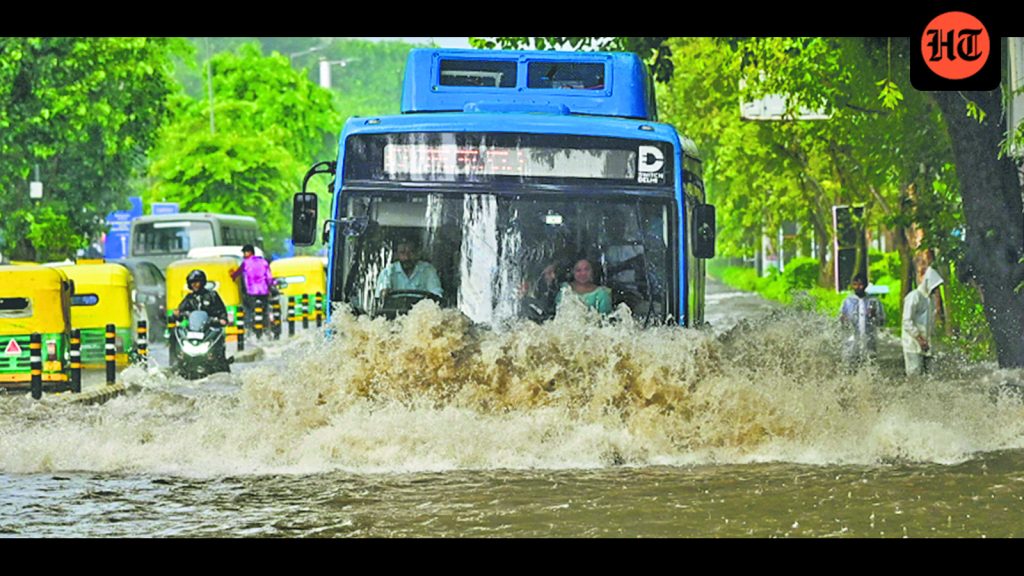
The spell of rainfall on Tuesday left several key roads waterlogged, throwing traffic out of gear in central and south Delhi.
Chief minister Rekha Gupta said that drainage, sewerage and waterlogging remained among the key issues the government is working on. “We are working on long-term solutions. We are laying new sewer lines and approving projects worth crores of rupees to find long-term solutions to the issue,” Gupta said.
Public Works Department (PWD) minister Parvesh Verma said that the number of waterlogging-prone spots has been brought down from 308 in 2023 to 115, at present.
Verma said long-term measures are being taken at 21 spots, while short-term interventions are being made at several other points. “There is no patchwork. We are constructing huge drains,” he said, citing requirements for the next 50 years.
Throughout the day, water accumulation was reported on Ashoka Road, Raisina Road, Parliament Street, Baba Kharak Singh Marg, around Connaught Place and RML Hospital. Areas near the Supreme Court and AIIMS were also affected, along with ITO, Moti Bagh, Kamla Nagar, Karol Bagh and Deramandi Road.
In southern Delhi, the entire Chirag Dilli flyover stretch and roads in Savitri area, GK 1 and 2, CR Park, Okhla Mandi, New Friends Colony, Munirka and Kishangarh were gridlocked.
Rajeev Kaul, a resident of GK 1’s W Block, said, “I have an electronic store in Connaught Place, but I have not been able to go to my shop because of the incessant rains. The problem was not just waterlogging but the roads near our house are damaged. The Lala Lajpat Rai road is filled with huge potholes. During rains, one can’t see them and anyone can fall. There’s also severe waterlogging on the Defence Colony flyover and traffic is bad there. No traffic police personnel are even seen there.”
Shiv Kumar, a shopkeeper at Pratap Market, said, “People say this is one of the biggest markets of Delhi but look at us. We are all suffering. There has been knee-deep water inside Sadar Bazar since Monday morning. I saw three carts carrying stationery submerged in water. There’s random electricity cuts. We are all scared that many workers, who are still working in rains, may get electric shock due to naked wires.”
The continued rainfall, meanwhile, brought down the mercury levels across the city.
The minimum temperatures remained below normal at all five major IMD stations. The Ridge station recorded the lowest minimum, at 20.8°C, which was 4.7 degrees below normal, followed by Palam station at 21.8°C, 4.3 degrees below normal. Delhi’s base station at Safdarjung recorded 23.5°C, which was 2.9 degrees below normal. The maximum temperature at the Safdarjung station was 33.4°C, which was slightly below normal.
Weather expert Navdeep Dahiya said that the rainfall total had exceeded expectations despite earlier concerns over the possible impact of El Niño. While the monsoon is expected to weaken later this week, he said that the remaining 36 days of the season could further add to Delhi’s surplus.
A day after 14 private school buses with nearly 300 schoolchildren were stranded for hours because of waterlogging caused by heavy rain across Gurugram, the district administration on Tuesday issued a comprehensive set of measures to ensure the safe movement of school buses during the monsoon. These measures included route status reports on days with adverse weather, real-time updates on waterlogging, and a staff escort, among others.
“The objective is to ensure that decisions regarding school bus movement and student dispersal are taken proactively,” said deputy commissioner Uttam Singh.