
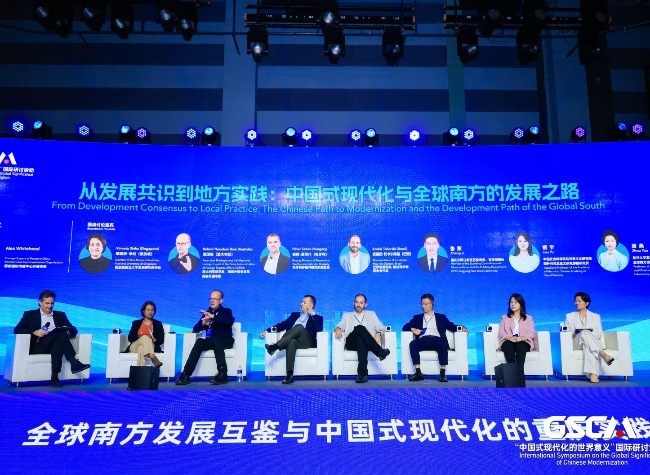
Chongqing- Experts from China, Singapore, Hungary, Brazil, and Australia said Chongqing’s experience in infrastructure, industrial development, urban renewal, and grassroots governance offers a reference for Global South cities, while emphasizing that no development model can be copied without local adaptation.
The remarks were made during a roundtable session held as part of the International Symposium on the Global Significance of Chinese Modernization in Chongqing on June 18.

Experts participate in a roundtable session themed “From Development Consensus to Local Practice: Chinese Modernization and the Development Path of the Global South” during the International Symposium on the Global Significance of Chinese Modernization in Chongqing on June 18, 2026. (Photo/WCICO)
Alex Whitehead from the Western China International Communication Organization moderated the session, framing the discussion around how development consensus can move into local practice. He said the roundtable would examine Chongqing’s experience in infrastructure, digital governance, inland opening-up, industrial upgrading, and urban resilience, and explore its relevance for Global South countries.
Vineeta Sinha, Director of the Asia Research Institute at the National University of Singapore, said China’s infrastructure and digital economy have produced visible results, but their application in Southeast Asia requires local adjustment.

Vineeta Sinha, Director of the Asia Research Institute at the National University of Singapore. (Photo/WCICO)
She cited logistics centers, digital hubs, and e-commerce networks as areas where Chinese companies have been active in Southeast Asia, including Alibaba’s logistics presence and digital hub development in Thailand’s Eastern Economic Corridor. But she said Southeast Asian countries still face challenges in regulation, legal systems, privacy, and data localization.

Vineeta Sinha, Director of Asia Research Institute, National University of Singapore. (Poster/Liu Dan, Li Jiao)
Sinha also pointed to Chongqing’s infrastructure financing and urban development experience, saying the city had built world-class infrastructure and transformed its landscape into a futuristic metropolis without draining the city’s budget. She said Southeast Asian countries could study the way Chongqing combined corporate mechanisms, land development, financing tools, and industrial policy.
Zhou Yan, Professor at Fudan Development Institute and Director of the Global South Field Research Laboratory at Fudan University, drew on her field research in Brazil to explain why local conditions matter.

Zhou Yan, Professor at Fudan Development Institute and Director of the Global South Field Research Laboratory at Fudan University. (Photo/WCICO)
She said China’s poverty reduction experience is development-driven, supported by industrial development, infrastructure, public services, and job creation. In Brazil, she cited BYD’s electric vehicle manufacturing base in Bahia as a successful case that created more than 20,000 direct and indirect local jobs and supported a shift from fuel vehicles to electric vehicles.

Zhou Yan, Professor at Fudan Development Institute and Director of Global South Field Research Laboratory at Fudan University. (Poster/Liu Dan, Li Jiao)
But Zhou also cited a suspended Chinese-backed urban rail project in Brazil, saying it was halted in 2023 due to high cost estimates, pandemic impacts, and technical limitations. She said the case showed that “Chinese experience cannot be directly copied,” and that success depends on local conditions and adaptive transformation.
Roland Theodore Boer, an Australian sinologist and high-end foreign expert of the State Administration of Foreign Experts Affairs, said Chinese modernization should be understood through both universal and particular dimensions. He said modernization broadly means improving people’s well-being, but each country has different historical backgrounds, political structures, resources, and cultural traditions.

Roland Theodore Boer, Australian Sinologist and a High-end Foreign Expert of the State Administration of Foreign Experts Affairs. (Photo/WCICO)
Boer said one feature of Chinese modernization is the integration of representative democracy and consultative democracy. Referring to local budgeting and investment projects, he said comprehensive consultation and planning are needed before a project moves forward, along with public supervision during implementation.

Roland Theodore Boer, Australian Sinologist and a High-end Foreign Expert of the State Administration of Foreign Experts Affairs. (Poster/Liu Dan, Li Jiao)
André Tokarski, representative of Fundação Maurício Grabois in Brazil, said Brazilian policymakers are interested in China’s digital governance, including digital government, data-based planning, smart cities, platforms, and public service accessibility. He said such experience should be studied while respecting each country’s legal, social, and policy norms.

André Tokarski, representative of Fundação Maurício Grabois in Brazil. (Photo/WCICO)
On urban renewal, Tokarski said Brazil and China can exchange experience on delivering smaller-scale, faster urban improvements through social participation, public planning and urban quality improvement.

Andre Tokarski, Representative of Fundacao Mauricio Grabois, Brazil. (Poster/Liu Dan, Li Jiao)
Turning to inland opening-up, Zhang Li, Member of the Standing Committee and Director-General of the Publicity Department of the CPC Liangjiang New Area Committee, said Chongqing and many Global South cities share the condition of not being coastal or border cities.

Zhang Li, Member of the Standing Committee and Director-General of the Publicity Department of the CPC Liangjiang New Area Committee. (Photo/WCICO)
Zhang said Liangjiang New Area’s opening-up experience can be summarized through three keywords: channels, industry, and innovation. Chongqing has built routes westward through the China-Europe Railway Express, eastward through the Yangtze River waterway, southward through the New International Land-Sea Trade Corridor, and northward through rail links connecting Eurasia.

Zhang Li, Member of the Standing Committee and Director-General of the Publicity Department, CPC Liangjiang New Area Committee. (Poster/Liu Dan, Li Jiao)
He said channels bring logistics, but industry is the key to opening up. Liangjiang New Area has focused on three major industrial clusters: intelligent connected new energy vehicles, electronics, and software and information services. It has attracted major companies, including Chang’an, SERES, BOE, and OPPO, and built an industrial ecosystem through leading enterprises and global suppliers.
Péter Szitás, Deputy Director of Research at the Danube Institute in Hungary, said Hungary has welcomed Chinese investment and plays an important role as a gateway to the European market. He cited Chinese companies, including CATL and BYD, as examples of firms using Hungary as a base to enter the EU market.

Péter Szitás, Deputy Director of Research at the Danube Institute in Hungary. (Photo/WCICO)
“The economic cooperation has reached a level of no turning back,” Szitás said. “The Belt and Road Initiative is the future, and no normal decision-maker would turn their back on the future.”

Péter Szitás, Deputy Director of Research at the Danube Institute, Hungary. (Poster/Liu Dan, Li Jiao)
He said Hungary, like Chongqing, is not coastal, making Chongqing’s transformation from an inland hinterland to an opening-up hub relevant to Hungary’s own development thinking.
Lou Yu, Associate Professor of the Academy of Marxism at the Chinese Academy of Social Sciences, said Chongqing is an important reference for inland regions in Latin America. She said the city’s experience shows that inland cities can turn geographical disadvantages into industrial advantages.

Lou Yu, Associate Professor of the Academy of Marxism at the Chinese Academy of Social Sciences. (Photo/WCICO)
Lou cited Chongqing’s automobile and motorcycle industries, noting that motorcycles developed for Chongqing’s mountainous terrain have also found markets in Latin American cities with similar topography.

Lou Yu, Associate Professor of the Academy of Marxism at the Chinese Academy of Social Sciences. (Poster/Liu Dan, Li Jiao)
“Chongqing’s experience shows that geographical constraints are neither a barrier to development nor a barrier to modernization,” Lou said.