
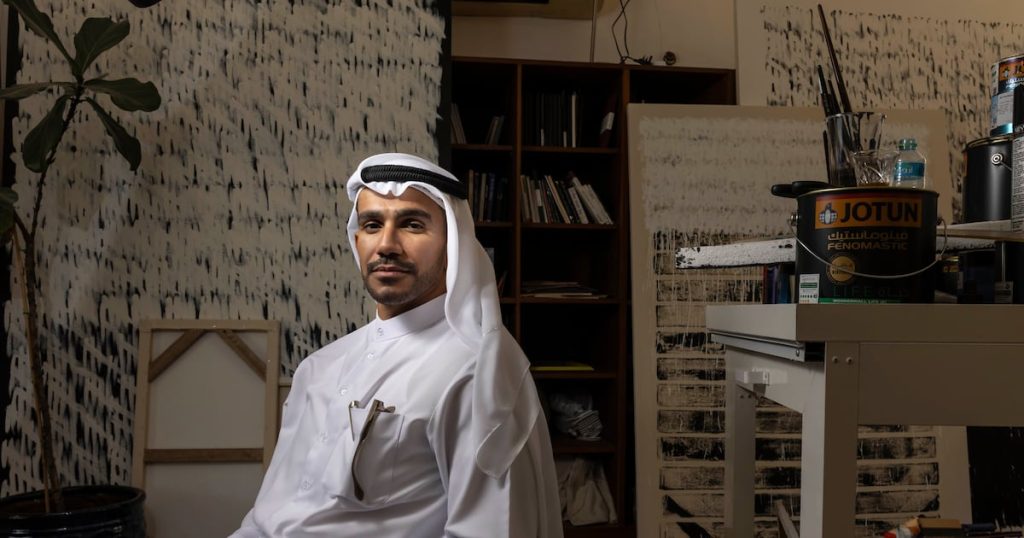
A bold red line cuts through the largest painting in Juma Al Haj’s new exhibition at Iris Projects. Underneath are the abstract, calligraphic strokes that have become characteristic of his work. The strokes are methodically applied, amassing as steady rivulets of white.
The part above the red line, however, is unlike anything the Emirati artist has done before.
Long black bars criss-cross against a storm of wiry scrawls. Dissimilar to previous works, where Al Haj meticulously keeps his forms contained within themselves, this disorder of black paint drips down the canvas, running past the red line and into the white.
The painting, like all the other works in the exhibition, has been created in the months since the Iranian missile attacks on the UAE began. Titled Black Cloud, Red Line, it is easy to see the work as a reflection of recent geopolitical anxieties. It can be interpreted literally, with the red line acting as a skyline – turmoil above and daily life carrying on below.
“We think of the UAE as one of the safest place to be, and that’s an emotional state,” he tells The National. When the country came under attack, when that sovereign red line was crossed, “that safe space that we have is also crossed. Our mental sovereignty is also under attack.”
As such, Black Cloud, Red Line can be explained in more introspective terms that extend beyond regional tensions. “It could be about struggling with internal anxieties,” Al Haj says. “About grappling with issues that are happening within you.”
The paintings within Interoception can all be read in a similar light. The exhibition, running at Iris Projects until August 6, is curated by Shamma Al Mheiri and examines how moments of crisis are internalised and expressed.
The siren-like emergency alerts, warning the population to seek shelter, has been abstracted into blocks of a bold yellow, the colour reminiscent of the caution symbol that, in the first few days of the missile attacks, incessantly popped on mobile screens. In one piece, Al Haj superimposes the feverish yellow forms atop the neat and ordered streams of abstracted writing.
In another, the yellow takes over the entire canvas. The missile attacks may be the reflective source of Al Haj’s new body of work, but they also depict a more primeval scuffle, that between order and chaos. Again, the delight is that they can be read in all sorts of ways, from the internal to the geopolitical, from the environmental to the cosmic.
Al Haj says his meticulous methodology was also challenged in these new works. The artist often has a clear idea of what his paintings are going to end up looking like even before he starts them. With these, he had to let go, to allow his acrylics (he uses diluted house paints) to run and drip at will.
He used water guns in a few pieces, spattering against his scrupulous brushstrokes. In others, he applied paint using slabs of Styrofoam he cut from a large block just outside the door to his studio in Sharjah.
Yet, despite these newfound methods, it would be wrong to assume that Al Haj has given his impulses free reign in his art. Stringent conceptualisation and journalling precedes most of the works, and even when he has an idea for a new piece or tool, he almost almost-compulsively tries to ensure that it lends itself to his core concept. Sometimes this process takes weeks.
But there is one work, which he says materialised in a matter of hours. He had been at home in the first week of Ramadan when, right before suhoor, “the windows started shaking. I heard a blast. It was night, pitch black. I went to the studio, to try and make sense of the situation. That entire experience was put into this piece.”
The painting is one of the most monochromatic of the new works. It features his textual abstraction in a ghostly white against a black background, with slight dabs of golden-beige in the margins. The scene is a reflection of what Al Haj saw outside the windows that day, the darkness outside the trembling glass.
Abstraction is often a means for Al Haj to explore his inner states and, perhaps counter-intuitively, it is how he brings himself into focus, reifies himself. His signature forms, in fact, come from a very private place.
Al Haj spent his childhood years in the United States and, “going to an English school, with not many Arab friends or families around”, often felt remote from his culture. To put things into context, this was in the years around 9/11, when anti-Arab sentiments were especially potent in the US.
“I had an Arabic tutor,” Al Haj says. “He passed away last December, unfortunately, but I kept in contact with him because he had a big impact on me and how I saw the world. During class one day, he looked at my handwriting and said I needed to improve it.”
Al Haj sought help from the artist-in-residence at his school, who happened to be of Lebanese origin. “He didn’t know how to write in Arabic, but he gave me these exercises to loosen my wrist. They were these abstract forms of the Arabic letters. I’d go fast and go slow. But interestingly enough, Arabic goes right to left, but I did it from left to right.”
Those exercises became a therapeutic past-time for Al Haj, and when he couldn’t figure out how to express himself in writing, he would resort to the abstract lettering, a sort of asemic expression that slowly developed into his own unique style.
But that style did not immediately translate into his paintings. It was during a moment of grief when he turned again to those abstract letters, to try and express the ineffable. On July 1, 2019, Sheikh Khalid bin Sultan Al Qasimi, son of Sheikh Dr Sultan bin Muhammad Al Qasimi, Ruler of Sharjah, died in London. Al Haj was in Abu Dhabi at the time.
“He was a friend of mine, more like an elder brother,” Al Haj says. “We met in London several times, and I was still trying to find my way. He was exactly 10 years older than me. I woke up to hear that and I didn’t know what to do, what was going to happen. The first thing I could think about was not even to write, because I couldn’t really think about what I wanted to write. So I just did this.”
The piece is still in his studio, and while an early iteration of his gestural forms are depicted, the piece clearly begins with a date – July 1, 2019 – much like a journal entry. It is signed at the bottom with the artist’s initials.
“It took all of 15 minutes, but it was powerful. I realised that putting grief on canvas, putting emotions on canvas helped me through a lot of the grieving process.”
It was one of Al Haj’s first expressions as an artist. While writing and note-taking has long been a reflective process for Al Haj, painting as a way of parsing his thoughts is a somewhat recent undertaking.
He only began focusing on his art career in 2020 and has since exhibited in group and solo shows, while also taking part in residencies at the Cultural Foundation Abu Dhabi and 421 Arts Campus.
His works are also featured in several esteemed institutions, including that of the Barjeel Art Foundation, the UAE Ministry of Culture, the Bvlgari Art Collection, as well as the private collection of UAE President Sheikh Mohamed.
Al Haj is now preparing for another stride in his artistic career. He has resigned from his day job as the director of marketing at the Sharjah Research, Technology and Innovation Park and is now taking his chances as a full-time artist, pursing an MFA at the Paris College of Art.
Despite his accomplishments of the last few years, Al Haj is eager to see how his art will measure outside the UAE. Much like how he was driven to return to the country after growing up in the US, to be amidst his compatriots and community, he says he now feels he must leave it for some time, propelled by as much restlessness as ambition.
“I need to get that credibility within myself,” he says. “I want to go where the opportunities are much harder. Will I still be successful? That’s the journey I am going on.”
Juma Al Haj’s solo show Interoception is on display at Iris Projects in Abu Dhabi until August 6