
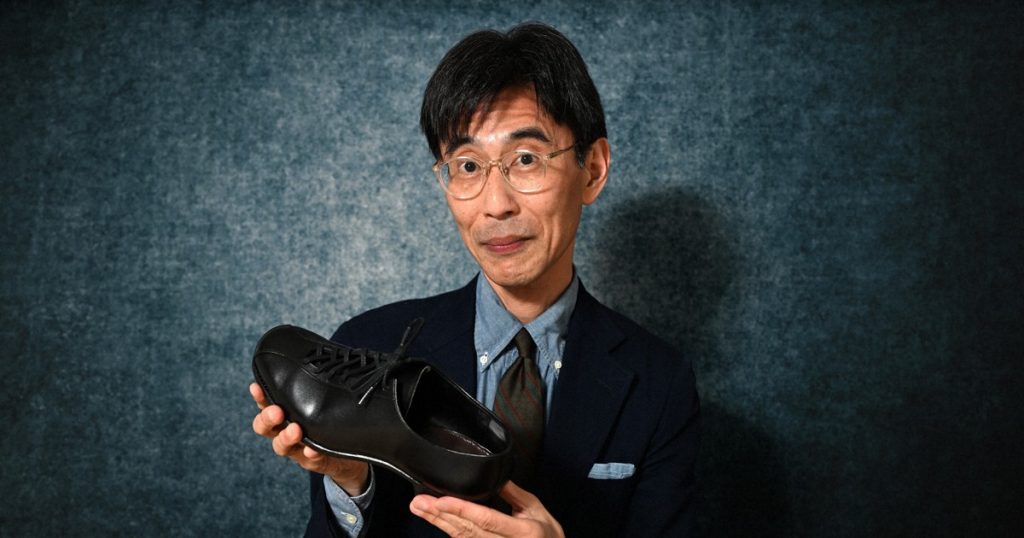
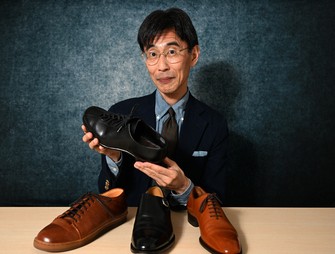
TOKYO — Japan’s consumers are moving away from leather shoes. Or so it is said. Office attire is becoming more casual, and the industry faces strong headwinds from the weak yen and rising prices. Yet across the industry there is a willingness to try new things, to fail and try again, and leather shoes still hold deep appeal. So what is it that makes leather shoes, protectors of human feet for millennia, feel so good to wear?
In February, Regal Corporation, known for leather shoes popular with young people, announced that it would seek voluntary retirements and close a manufacturing subsidiary. It was a stark illustration of the industry’s struggle amid the retreat from leather shoes.
With remote work now entrenched, demand may seem to be shrinking. But that is not exactly true. According to estimates by Yano Research Institute Ltd., the domestic market for men’s shoes has been rising steadily from the 119.1 billion yen (about $729 million at current exchange rates) posted in fiscal 2020. The forecast for fiscal 2026 is 137.3 billion yen (around $840 million). The research firm sees a similar rise for women’s shoes, from 185.9 billion yen (roughly $1.13 billion) to 199 billion yen (approx. $1.22 billion) over the same span. Models that emphasize functionality are winning customers, and the recovery trend appears clear. So is this really a move away from leather shoes?
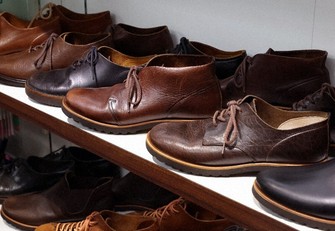
The Mainichi Shimbun asked Michiya Suzuki, 64, who long served as president of the Japanese arm of the popular U.S. brand Red Wing.
“Even among leather shoes, boots and other styles that go with casual clothes are still doing well,” he said. A look around the women’s shoe floors of department stores does indeed reveal new products aiming to combine refinement with freedom from pain.
At the same time, he said, “As things stand, market shrinkage for men’s business shoes will be hard to avoid.” He continued, “The industry bears some blame, too. It has focused almost entirely on foot length, without making shoes that truly fit different widths and shapes. As a result, consumers have come to see leather shoes as hard to wear.”
Making leather shoes requires many parts, as well as sewing machines and specialized tools. Manufacturing and repairs are handled mainly by small workshops. “If the market keeps shrinking like this, the industry’s ecosystem will collapse,” Suzuki said.
Is there no way out? Takahiro Iino, 58, a clothing researcher who lives surrounded by 180 pairs of famous shoes and published a book whose title roughly translates to “Appreciating Gentlemen’s Shoes” 16 years ago, brought along part of a collection that he says lets him “feel the future of leather shoes.”
The items included shoes made with hand-sewn construction, in which the sole is attached by hand, giving them a good fit and making them easier to break in; shoes that achieve low prices and high quality through the work of skilled Chinese artisans; and shoes that look like sneakers but are constructed as full-fledged leather shoes. None are famous brands.
“Inbound tourism is key after all. Japanese sneakers are hugely popular, and stores have lines outside them,” he said. There is even a Japanese brand whose popularity in Thailand took off after an image of the country’s king wearing its shoes spread on social media. “High-quality Japanese leather shoes could break through too, if given the right spark,” he said hopefully.
“Sneakers can aim for the greatest happiness of the greatest number. But a good pair of leather shoes can make one individual far happier,” Iino said. “If you take proper care of a pair that fits your feet, it will develop beyond what it was when new. I want people to experience the pleasure of the process by which they become your shoes.”
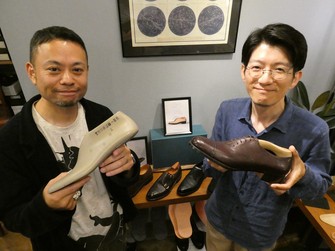
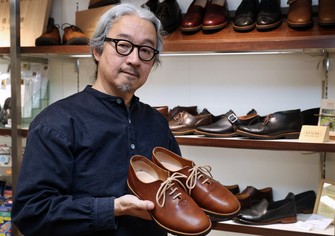
What about the craftspeople? Japanese bespoke shoes are said to be highly regarded and are popular with wealthy clients from overseas as well. This reporter visited Tatsuya Noguchi, 46, a prosthetist and orthotist, and Hirokazu Sotobayashi, 40, a shoemaker. In 2023, the two launched “Lightbulb,” a shop specializing in custom shoes.
Noguchi, with his deep knowledge of feet, mainly handles the lasts — the foot form model used to shape shoes — while Sotobayashi is chiefly responsible for making the shoes. Their focus is comfort, but even semi-custom pairs for which they combine existing lasts and leather choices start at 130,000 yen (some $800). That is hardly everyday pricing.
Even so, Sotobayashi said with hope, “Leather excels at absorbing and releasing moisture, and even as it ages it continues to support the foot well without losing functionality. I almost feel it exists for the sake of making shoes. I hope people will make informed choices after learning about the materials and processes involved.” In the long run, there is still plenty to expect from Japanese-made leather shoes.
Suzuki, mentioned at the start, is also trying a new approach. In 2020, together with seven shoe manufacturers in Yamatokoriyama, Nara Prefecture, one of Japan’s leading shoe-producing areas but one that struggles with name recognition, he launched “Kotoka.” It is a shared brand whose name evokes “koto,” meaning ancient capital, and aims to create distinctly Japanese leather shoes. The shoes minimize linings and reinforcements to pursue comfort and lightness, and the seven companies divide up the production of more than 20 styles, including slip-ons.
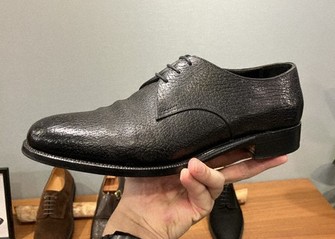
The cowhide used is sourced from highly regarded domestic leather suppliers, and features that had traditionally been seen as flaws are deliberately highlighted as part of each shoe’s individuality. Thick leather approaching 3 millimeters is used, and natural markings such as grain wrinkles and vein traces are left intact. The idea is to let wearers enjoy changes in texture over time. Prices are in the 20,000- to 30,000-yen range (somewhere between $122 and $184). In addition to online sales, the shoes have also been well received as return gifts under the city’s “hometown tax” donation program.
Japan, with its tradition of zori sandals and geta wooden clogs, still labors under “the spell that the true home of leather shoes is Europe and America,” Suzuki said. Can that spell be broken with bold Japanese-style leather shoes, and can Japan then set its sights on the world?
(Japanese original by Norikazu Chiba, Opinion Editorial Department)