
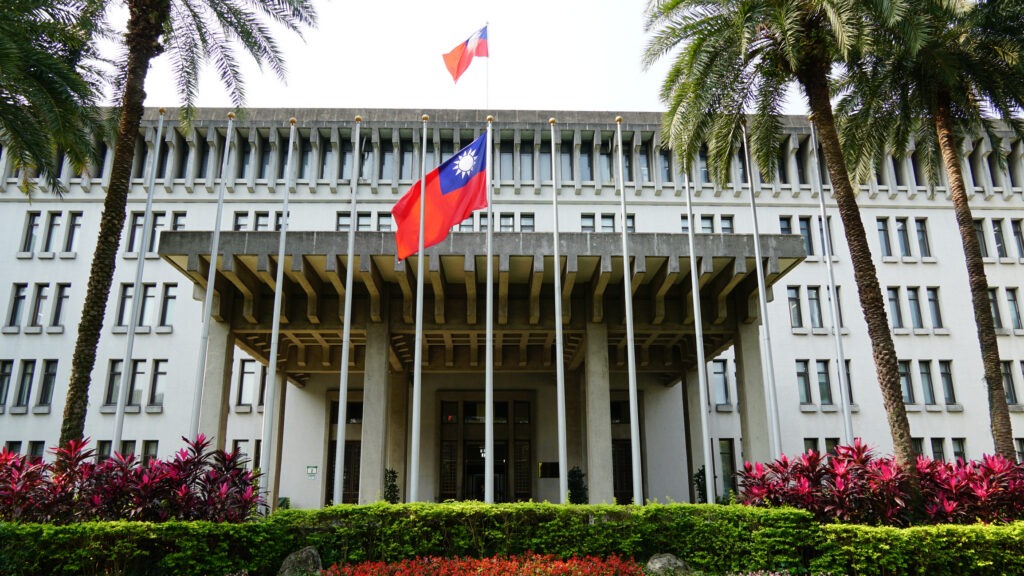

After enjoying great success in eliminating Taiwan’s formal diplomatic ties, it has turned its attention to the island’s quasi-embassies, called representative offices. One reason is that persuading Taiwan’s last 12 diplomatic partners to switch recognition to Beijing is increasingly difficult.
Where China succeeds in closing representative offices, it significantly constrains Taiwan’s ability to communicate directly with governments that do not formally recognise it. This is particularly significant in regions such as the South Pacific where China wields considerable influence.
Under the influence of the People’s Republic of China, the number of countries that formally recognise the Republic of China (Taiwan) has fallen sharply from 22 in 2016 to 12 today. Although Beijing has continued to make diplomatic gains over the past decade, Taiwan’s remaining diplomatic partners are more difficult to sway through economic incentives alone. This is because of their long-standing government-to-government ties with Taiwan, institutionalised development cooperation and broader social connections. This has made efforts to undermine Taiwan’s formal diplomatic relationships increasingly difficult and has contributed to a shift in Beijing’s targets of pressure.
The shift in China’s diplomatic pressure began during the Taiwanese administration of President Lai Ching-te. In 2024, South Africa demanded that Taiwan relocate its representative office from Pretoria, and in July 2026, Papua New Guinea unilaterally announced the closure of Taiwan’s representative office. Compared with Taiwan’s previous administration, led by Tsai Ing-wen, these cases show a clear shift in the China’s diplomatic pressure.
China’s targeting of Taiwanese representative offices is hardly new. As early as 2017, Beijing pressured countries including Nigeria, the United Arab Emirates, Bahrain, Ecuador and Jordan to rename or relocate Taiwan’s representative offices. This has had much less success than the campaign to persuade Taiwan’s diplomatic partners to switch recognition to Beijing. Still, as Taiwan has concentrated its resources on maintaining ties with its remaining diplomatic partners – those with which it exchanges formal embassies – Beijing has had greater reason to weaken Taiwan’s the informal ones, the representative offices.
The shift in China’s diplomatic pressure has already begun to threaten Taiwan’s diplomatic position in the South Pacific. Apart from Australia and New Zealand, Taiwan has only two representative offices in the region, in PNG and Fiji. Its diplomatic and trade engagement with Pacific Island countries has long relied heavily on these two offices, particularly the one in Fiji. In addition to handling diplomatic affairs with eight Pacific island countries that do not formally recognise Taiwan, the Fiji office also manages Taiwan’s engagement with the Pacific Islands Forum Secretariat, underscoring its importance to Taiwan’s regional diplomacy.
Taiwan continues to urge PNG to allow its representative office to remain open. However, if Taiwan is ultimately forced to close the office, China is sure to put greater efforts into achieving closure of the multi-role Fijian office and thereby greatly undermine Taiwan’s diplomatic influence throughout the South Pacific. For communicating with South Pacific governments, Taiwan would have to rely on its Australian and New Zealand representative offices and its embassies elsewhere in the Pacific.
The main reason for the shift in China’s diplomatic pressure is the growing difficulty of persuading Taiwan’s remaining diplomatic partners to switch recognition. Beijing has therefore increasingly turned to targeting Taiwan’s representative offices to enforce its One China principle. For Taiwan, this will constrain international engagement, particularly in the South Pacific, where individual offices with regional responsibilities are likely to face growing pressure.