
Sabeena Ibrahim examines India’s youth uprising and its impact on the opposition to Modi’s rule
For more than a decade, Indian Prime Minister Narendra Modi of the BJP has been marketed as invincible: a leader without a credible rival, backed by a nation united behind him. His government has out-manoeuvred every opponent put in front of it, dominated the country’s media narrative almost at will, and steadily narrowed the room available for dissent in what is still nominally the world’s largest democracy.
In May 2026, the Chief Justice of India, Surya Kant, was hearing a routine case when he reached for an unfortunate turn of phrase. Unemployed young people who turn to journalism, social media or Right to Information activism, he told the court, behave ‘like cockroaches’, ‘parasites’ with no proper place in a profession. Within seventy-eight hours, a satirical social media page built around the insult had gathered three million followers. Three months later, that page had become a mass movement that forced a sitting Union Cabinet minister out of office, something no opposition party had managed to do to Narendra Modi’s government in twelve years of BJP rule.
From 3 million cockroach followers to material grievance
It would be a mistake to read the Cockroach Janta Party Party (CJP) as merely a viral joke that got out of hand. The meme took hold because it landed on a raw and specific wound: the National Eligibility cum Entrance Test (NEET-UG), India’s single medical school admissions exam, sat this year by roughly two million students competing for around 130,000 seats. The 2026 exam was engulfed by allegations of a leaked paper and other irregularities serious enough that authorities were forced to cancel and re-run it. Families across the country had sunk years of preparation and lakhs of rupees into coaching for a single sitting. In the weeks that followed, at least 21 students took their own lives in the fear of having to go through the pressure of exams again.
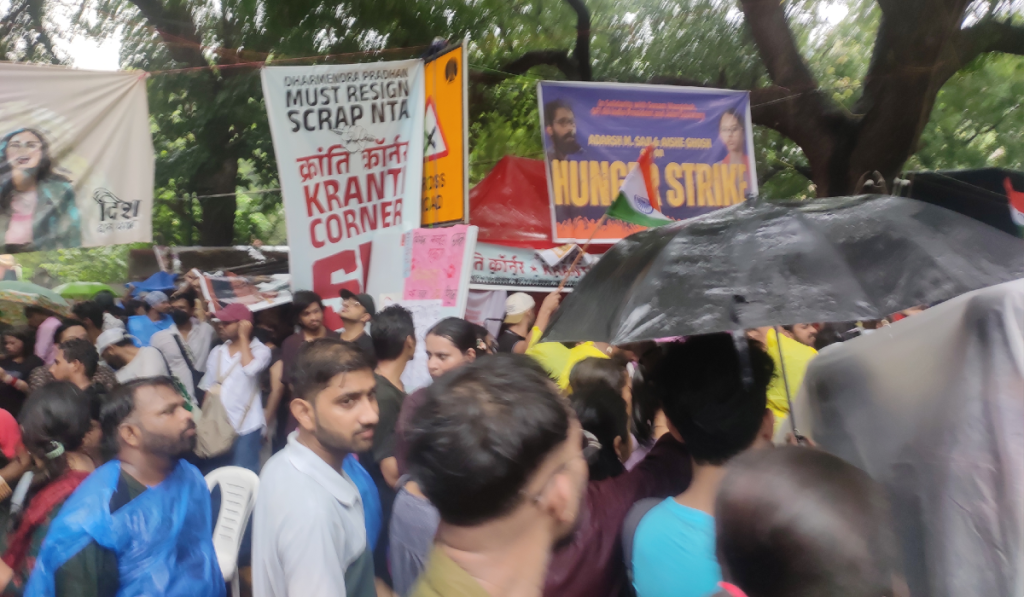
The movement refused to stay contained as a niche education-policy grievance. Left-wing student organisations, including the All India Students’ Federation, the All India Students’ Association and the Students’ Federation of India, joined the CJP at Jantar Mantar, giving the protests organisational ballast alongside its viral appeal. However, the movement’s turning point came when education activist Sonam Wangchuk joined.
Wangchuk and the weight of an older tradition
Sonam Wangchuk, the Ladakhi engineer and Magsaysay laureate, had walked free from Jodhpur Central Jail only months earlier. In March 2026, he was detained for 170 days under the National Security Act over his role in Ladakh’s statehood movement following protests in which four people were killed by police. At Jantar Mantar, he began an indefinite hunger strike alongside six students from the All India Students’ Association. After roughly twenty days without food, the police forcibly removed him to Safdarjung Hospital, which only widened public outrage. Wangchuk broke his fast after twenty-six days, once the government provided written assurances: compensation for the families of students who had died by suicide, the withdrawal of cases against non-violent protesters, and talks on preventing future paper leaks.
Wangchuk’s fast linked a Gen Z digital insurgency to an older, Gandhian idiom of civil resistance that Indian state power still finds hard to dismiss outright.
The trick the BJP couldn’t play twice
To understand why this movement rattled the government more than most, it is worth recalling how Hindutva politics has typically handled dissent. The 2019-20 protests against the Citizenship Amendment Act were cast by the ruling party and its allied media as a Muslim grievance, allowing the state to reach for its most dependable weapon: communal division. The 2020-21 farmers’ movement was painted as a sectional Punjab-and-Haryana interest, its leaders smeared with the language of Khalistani separatism, a slander that only lost its grip once farmers built alliances with trade unions and workers’ organisations nationally.
The Cockroach movement offered the state no comparable fault line. A leaked exam paper does not check anyone’s religion. Ministers and pro-government commentators tried anyway, gesturing at the usual claims of foreign funding; the Ministry of External Affairs was ultimately forced to publicly deny that the CJP had received money from abroad. It did not land, because too much of the crowd was somebody’s suburban, temple-going, exam-cramming nephew or niece. The genius of the CJP was landing on a grievance broad enough that the BJP’s usual playbook of communal and regional division had nothing to grip.
What worried the BJP more than the protest numbers themselves is who else was radicalised by proxy: parents. India’s aspirational middle class, and in particular its upper-caste, Hindu-belt, urban middle class, has been the single most loyal constituency of Modi’s political project. It is one thing for a government to absorb criticism from activists and minorities its base has long been trained to distrust. It is another to watch that same base’s own children occupying Jantar Mantar.
Resignation as symbolic defeat
The BJP has spent over a decade contrasting itself with the Congress-led governments of the 2000s and early 2010s, presenting itself as a government that does not fall to street pressure. Pradhan’s resignation broke with that record. Announcing his exit, he wrote that he held deep respect for the aspirations of India’s youth and that realising their dreams remained his life’s political purpose, words that arrived only after seven weeks of confrontation had made his position untenable. The message received by every young protester watching was blunt: sustained pressure works. That is worth more to a movement than any single policy concession, and for exactly that reason, it is the precedent the state will be most determined not to let repeat.
Repression, once the mask slips
None of this was won without violence. On 20 July, tens of thousands of protesters attempting to march on Parliament were met with baton charges and tear gas from the Rapid Action Force, in clashes that left dozens injured. Two days later, the Supreme Court declined to hear an urgent petition alleging police brutality against the students, with the Chief Justice’s own bench refusing to intervene.
For readers used to encountering Indian state violence through the lens of Kashmir, of Adivasi land defenders, of Muslims targeted under anti-conversion laws, or of Dalits attacked for entering temples, the mechanism on display at Jantar Mantar was not new. What was new was its target: a constituency the government had always claimed as its own future. The students did not discover repression. They discovered what it feels like when repression is turned, for once, against people the state usually calls “our” future.
An opposition that arrived late and unevenly
The parliamentary opposition’s relationship to the CJP was neither absent nor straightforwardly supportive. It was cautious, uneven, and revealing of its own anxieties. Congress, India’s main opposition party, was notably slow and ambivalent about formally endorsing the movement. Party insiders were candid about their reasons: CJP founder Abhijeet Dipke’s past association with the Aam Aadmi Party made some Congress figures wary of lending the movement legitimacy, for fear of building a rival political force rather than their own; the party had also launched its own youth campaign, Chhatron Ki Goonj, on related grievances, and did not want to share a stage that might blur its ownership of the issue. Congress remained the only major opposition party that never formally endorsed the CJP as an organisation.
That institutional caution, however, did not stop individual opposition leaders from acting. Rahul Gandhi and his sister Priyanka Gandhi Vadra were briefly detained by police during a sit-in outside the Prime Minister’s residence; opposition MPs, many dressed in black, disrupted both houses of Parliament in solidarity, forcing repeated suspensions of proceedings. Gandhi publicly condemned the police crackdown on protesters as incompatible with democracy and called on the government to meet the movement’s demands. Smaller parties moved more readily: a spokesperson for the NCP (Sharadchandra Pawar faction) joined the protest camp directly, and figures from the Trinamool Congress and Dravidian parties voiced support from their respective states.
The movement offered young Indians a vehicle for political anger that did not require trusting a political class many of them already distrust. That is a warning for Congress as much as it is a defeat for the BJP: a large, mobilisable, anti-government sentiment now exists that no party currently owns.
What has actually changed for the BJP, and for India?
Modi and the BJP had remained broadly popular; only months before the protests began;, they posted strong results in state elections in regions they once struggled to win.
Ten days after Pradhan’s resignation, the BJP lost a by-election in Bankipur, a Bihar constituency the party had held for three decades, to the newly formed Jan Suraaj Party, a defeat commentators linked, at least in part, to the mood the CJP protests had crystallised among younger voters. Analysts described Pradhan’s exit itself as a serious setback that further dented the image of invincibility Modi had cultivated for over a decade.
For ordinary people, and young people especially, the change is less about any single policy and more about a demonstrated fact: that sustained, disciplined, cross-communal pressure can move this government, something the preceding decade of Modi’s rule had made to feel almost unimaginable. The CJP itself has chosen, deliberately, not to convert that momentum into a political party. Its leadership announced it would remain a “pressure group,” broadening its focus beyond education to jobs and government accountability more generally, rather than contest elections.
In the weeks since the Jantar Mantar sit-in was cleared, smaller, decentralised protests invoking the Cockroach name and its methods have continued to surface in cities across the country, a diffusion that may prove harder for the state to isolate and outlast than a single encampment ever was.
The question this movement leaves open
Indian social movements have shown they can win discrete victories before. The farmers defeated the three farm laws largely because they built alliances across caste and occupation rather than remaining an isolated sectional interest. The anti-CAA movement ,against the racist Citizenship Amendment Act, for all the communal framing thrown at it, mobilised millions. What has not yet happened is the fusing of these separate constituencies (students, farmers, workers, Dalits, Adivasis, religious minorities, the unemployed) into a shared analysis of what actually produces their grievances, rather than a series of parallel, disconnected fights that the state can isolate and outlast one at a time.
The Cockroach Janta Party proved something the BJP would rather nobody had proven: that there remains, in India, a constituency that Hindutva’s usual machinery of division cannot easily split, because its anger is rooted not in religion or region but in the increasingly precarious promise of a decent life, and that the machinery of ‘”anti-national’ ” smears, deployed so reliably against every other constituency of dissent, does not work when the people in the crowd are recognisably the ruling party’s own base.
Whether that double discovery becomes the seed of broader working-class politics or is absorbed back into business as usual once the next exam calendar resets is the argument that matters far more than one minister’s signature on a resignation letter.
Before you go
The ongoing genocide in Gaza, Starmer’s austerity and the danger of a resurgent far right demonstrate the urgent need for socialist organisation and ideas. Counterfire has been central to the Palestine revolt and we are committed to building mass, united movements of resistance. Become a member today and join the fightback.