
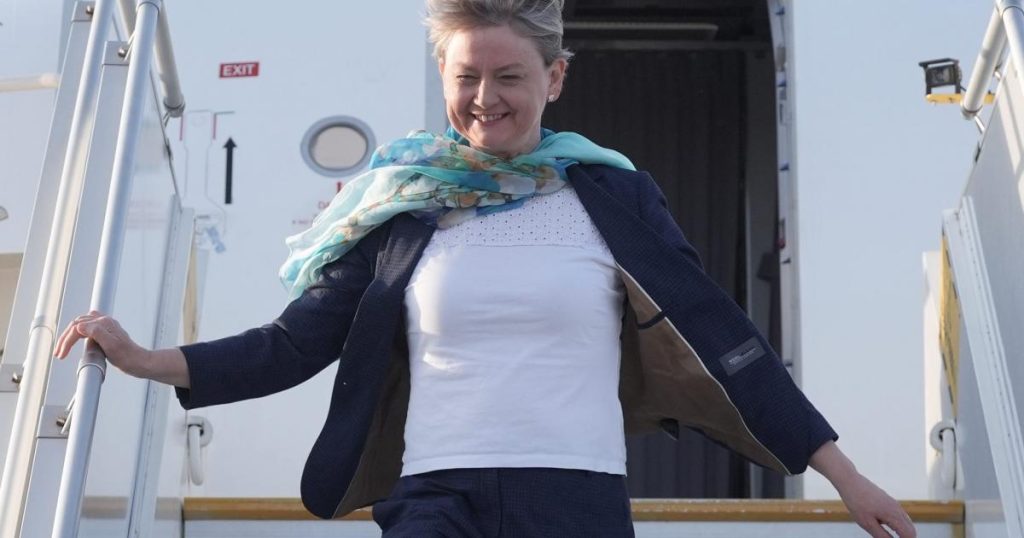
The Foreign Secretary will meet Chinese vice-president Han Zheng and her counterpart Wang Yi for bilateral discussions that are expected to last several hours on Tuesday.
Talks are expected to focus on the series of major crises around the world, including wars in Iran and Ukraine and the outbreak of Ebola in the Democratic Republic of the Congo.
China’s relationship with Russia, with which it has shared enduring strategic ties since Moscow’s full-scale invasion of its neighbour in 2022, is also expected to be discussed.
Critics have pressured Labour to take a harder line on Beijing, including over issues like the treatment of its Uighur population and the imprisonment of British citizen and pro-democracy campaigner Jimmy Lai, which Ms Cooper is likely to raise during her visit.
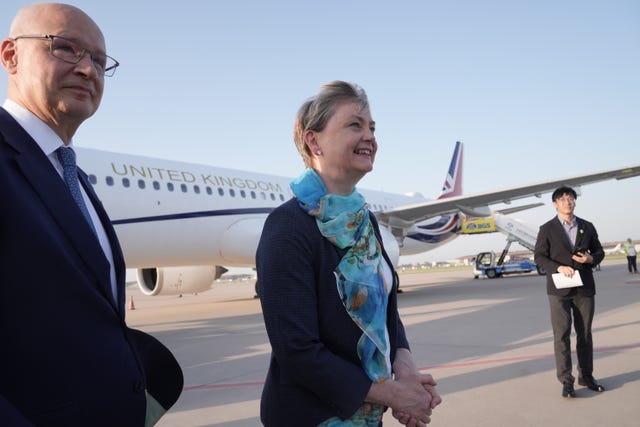
But the Government sees engagement with major economies including China as key to Britain’s security at a time of heightened global instability, and insists it will cooperate where it can and challenge where it must.
Former foreign secretary David Lammy previously travelled to Beijing as part of initial efforts to thaw what Sir Keir Starmer dubbed a diplomatic “ice age” between the two countries, and the Prime Minister flew to China earlier this year for a heavily trade-focused visit.
Despite warming relations, the Foreign Office delegation are understood to be carrying “burner” phones throughout the trip in a sign of ongoing concerns over espionage.
Ms Cooper’s trip is understood to be aimed at building on previous Government visits with the most extensive senior foreign policy discussions since Labour came to power.
After meeting Mr Han in Beijing’s Great Hall of the People and foreign minister Mr Wang at Diaoyutai State Guest House, the Foreign Secretary will fly on to the southern city of Shenzhen, a major technology hub near Hong Kong after talks in Beijing.
She will then travel to Delhi to meet her Indian counterpart Subrahmanyam Jaishankar on Thursday along with businesspeople and academics.
That bilateral meeting is also expected to include discussion of the Middle East, with a focus on maritime security as Iran maintains its chokehold on the Strait of Hormuz amid ongoing escalation around the key global shipping route.