
The resignation and criminal designation of former Attorney General’s Office Special Crimes chief (JAMPIDSUS) Febrie Adriansyah has thrust Indonesia’s law enforcement institutions into an unprecedented test of accountability, as prosecutors prepare to handle a case involving one of their own.
A raid that became one of Indonesia’s biggest law enforcement stories
Indonesia’s legal establishment has entered uncharted territory after the National Police’s Corruption Crime Corps (Kortastipidkor) officially named former Attorney General’s Office Special Crimes chief (JAMPIDSUS) Febrie Adriansyah a suspect in alleged corruption and money laundering (TPPU).
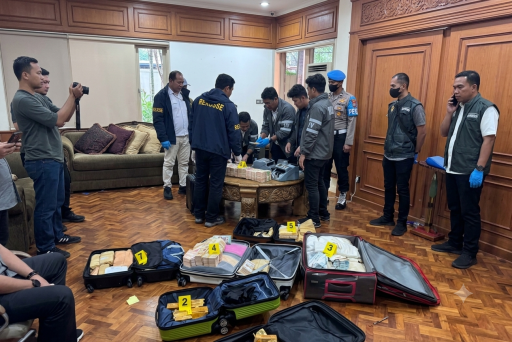
The designation comes days after investigators raided Febrie’s house in Sentul, Bogor, where they seized 74 kilograms of gold bullion, US$4.77 million (around Rp77.5 billion), SGD14.08 million (around Rp179 billion) and Rp100 million in cash. Police also confiscated documents and electronic devices, with the total value of the seized assets estimated at around Rp476 billion (approximately US$29 million).
Febrie has acknowledged ownership of the Sentul property but denied owning the seized gold and cash, maintaining that the assets belong to identifiable third parties whose claims should be verified through the legal process. His designation as a suspect does not constitute a finding of guilt, and the allegations remain subject to judicial proceedings.
The developments have immediately drawn nationwide attention because Febrie was one of Indonesia’s most influential prosecutors, overseeing many of the country’s largest corruption investigations before becoming the subject of one himself.
Resignation formalizes an extraordinary fall
Hours before police publicly announced Febrie as a suspect, Attorney General ST Burhanuddin officially accepted his resignation as head of the Special Crimes Division.
The Attorney General’s Office said the resignation was accepted to preserve the integrity, objectivity and neutrality of the legal process while the police investigation proceeds. It also stressed that the leadership change would not disrupt ongoing prosecutions handled by the Special Crimes Division.
The announcement transformed what had previously been media speculation into an official institutional response, marking one of the highest-profile departures of a senior law enforcement official in recent years.
On Monday, the Directorate General of Immigration confirmed that Febrie had been placed under a 20-day travel ban at the request of the Jakarta Metro Police’s Special Criminal Investigation Directorate (Ditreskrimsus), preventing him from leaving Indonesia while the investigation continues.
The system investigates itself
The case is exceptional because it does not involve a politician or business executive.
Instead, it centers on the official who until days ago led many of Indonesia’s largest corruption investigations.
According to police investigators, the allegations stem from Febrie’s alleged conduct while overseeing three major corruption cases during his tenure as JAMPIDSUS:
- Alleged irregularities in PLN’s coal procurement, which investigators allege contributed to electricity disruptions in several regions;
- The multitrillion-rupiah PT Asabri corruption case involving the state-owned military insurance company; and
- The Rp6.9 trillion blast furnace project at PT Krakatau Steel.
For many observers, the investigation has therefore become more than a dispute over ownership of seized assets. It has evolved into a test of whether Indonesia’s law enforcement institutions are willing, and able, to subject their own senior officials to the same legal scrutiny applied to public officials, business executives and other corruption suspects.
Questions over undeclared assets
The investigation has also intensified scrutiny of Febrie’s asset declarations.
One of the latest developments is investigators’ focus on the ownership structure of the Sentul property, which reportedly does not appear in Febrie’s official State Officials’ Wealth Report (LHKPN). The omission has prompted investigators to examine whether the property may have been held through a nominee or another third-party ownership arrangement, although authorities have not publicly concluded that such a structure existed.
Authorities are continuing to trace the ownership of the seized assets as part of the money laundering investigation, with the ownership structure becoming one of the central aspects of the case.
Accountability or institutional rivalry?
The sequence of events has also fueled speculation about broader institutional dynamics between the National Police and the Attorney General’s Office.
Yet the latest developments have created an even more extraordinary legal situation.
Following Febrie’s resignation, the case is expected to move through Indonesia’s prosecution process, placing the Attorney General’s Office in the unusual position of handling criminal proceedings involving its own recently resigned Special Crimes chief.
The prospect of prosecutors handling a case involving one of their former top officials has placed the independence and credibility of Indonesia’s legal institutions under intense public scrutiny.
So far, authorities have not characterized the investigation as an institutional conflict, nor has any public evidence linked the case to the government’s Forest Area Enforcement Task Force or other strategic enforcement operations. Nevertheless, the timing of the investigation and the unprecedented nature of the case have fueled debate over whether it represents solely a criminal investigation or also reflects deeper institutional tensions within Indonesia’s law enforcement establishment.
A defining test for Indonesia’s justice system
Whatever the courts ultimately decide, the investigation has become one of the most consequential tests of Indonesia’s justice system in recent years.
Public confidence will depend not only on whether investigators can establish the ownership and source of the seized assets, but also on whether the investigation and any subsequent prosecution are conducted transparently, professionally and free from political or institutional interference.
President Prabowo Subianto has repeatedly pledged to strengthen law enforcement and intensify Indonesia’s fight against corruption. The case against Febrie Adriansyah has now become an early measure of that commitment, not because it involves another corruption suspect, but because it tests whether the country’s legal institutions are prepared to pursue accountability at the highest levels, even when one of their own stands accused.
Beyond the legal proceedings themselves, the case is likely to become a benchmark for whether Indonesia’s anti-corruption institutions can investigate senior officials within their own ranks with the same rigor applied to politicians, business leaders and other public officials. The coming weeks will therefore be watched not only for the evidence presented against Febrie, but also for how Indonesia’s law enforcement institutions navigate one of the most sensitive corruption cases in their recent history. The outcome is likely to shape public confidence in the government’s anti-corruption agenda and the credibility of the justice system itself.