
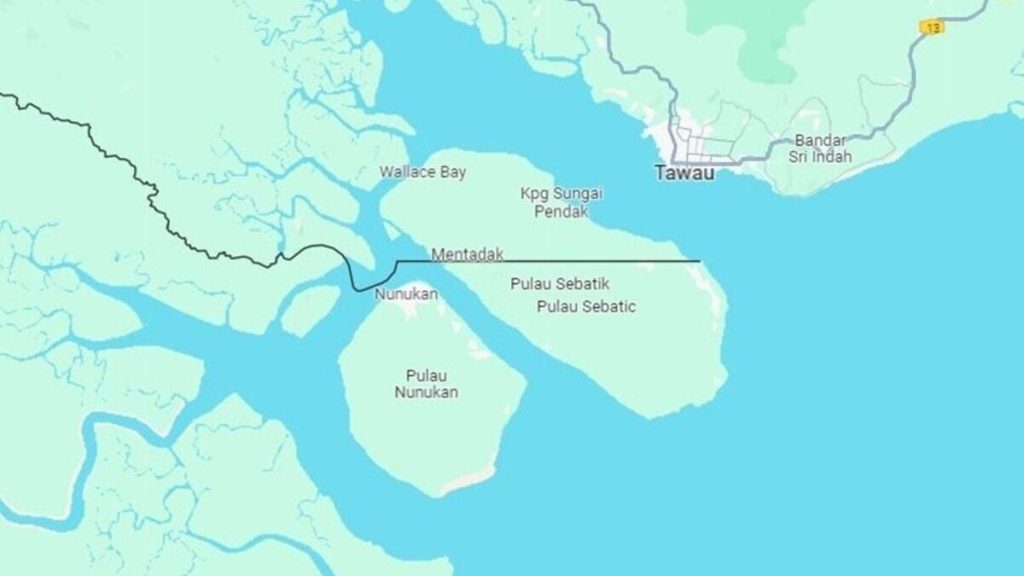
The government of Indonesia has reaffirmed its territorial sovereignty following the completion of a land boundary demarcation agreement with Malaysia on Sebatik Island, located in North Kalimantan.
Officials said in a press conference on 15 April that the agreement results in a net territorial gain for Indonesia, with 127.3 hectares of land now formally recognised as part of its sovereign territory.
Boundary adjustment and territorial changes
Head of the Presidential Staff Office, Muhammad Qodari, said the demarcation marks the conclusion of a diplomatic process conducted through peaceful means.
“The completion of the boundary demarcation on Sebatik Island is a tangible manifestation of successful peaceful diplomacy that strengthens Indonesia’s territorial sovereignty,” he said at a press briefing in Jakarta.
Under the revised boundary, an area of 127.3 hectares that previously fell within Malaysian territory has now been incorporated into Indonesia. At the same time, a smaller portion—approximately 4.9 hectares—has shifted from Indonesia to Malaysia as part of the agreed adjustment.
Qodari described the outcome as evidence of strengthened sovereignty in the border region, while noting that the government is addressing the impact on affected communities.
Support for affected residents
Authorities said a special team has been established by the Ministry of Home Affairs to assess compensation for residents whose land or property is affected by the new boundary line.
The government stated that measures are being taken to ensure that administrative and legal transitions for local communities are handled in an orderly manner.
Strengthening border governance
The boundary agreement forms part of broader efforts by Indonesia to reinforce governance and development in its frontier regions.
For 2026, the government has allocated a budget ceiling of Rp86 billion to support the operation of 15 State Border Crossing Posts, known as Pos Lintas Batas Negara (PLBN), managed by the National Border Management Agency.
Between December 2016 and October 2024, Indonesia constructed and inaugurated 15 such posts out of a planned total of 18 across the country. Operational sites include Entikong, Motaain, Skouw and Sebatik.
Economic role of border posts
According to the Presidential Staff Office, the PLBNs have evolved beyond their primary function as border checkpoints, becoming centres of economic activity in frontier regions.
More than 2.4 million people have passed through the 15 posts, with total recorded trade reaching Rp13.5 trillion.
Strategic locations such as Motaain in East Nusa Tenggara and Skouw in Papua have contributed to increased cross-border tourism and the export of local goods.
Ongoing coordination
The Presidential Staff Office said it continues to monitor the implementation of border policies, including field verification and coordination on the ratification of Border Crossing Agreements with Malaysia and Timor-Leste.
Officials added that the government aims to develop border areas into secure, well-managed and economically competitive regions, while maintaining clear and mutually recognised territorial boundaries.