
There is a view in Washington that the U.S. operation against Iran has been a dramatic setback for China. This perspective stems from a belief that in launching Operation Epic Fury, the U.S. has not only degraded the Iranian regime but also diminished China’s standing in the region and beyond. A corollary to this argument is the idea that the U.S. has sent a message of deterrence to Beijing with this operation, and thus the war fits into a broader China strategy.
These claims rest on several faulty assumptions, namely that Iran is China’s most important partner in the Middle East, that China is entirely dependent on the region for its own energy, and that this show of American combat power will give pause to Beijing’s own aspirations to seize Taiwan.
But these beliefs misunderstand China’s priorities in the Middle East and beyond. On top of that, they fail to account for President Donald Trump’s own inconsistent approach to the country.
Iran is not China’s most important relationship in the region. It is historic, of course, and may in fact be one of the oldest in the world. It also shares an ideological bent against the Western-led international order. But it is neither remarkably close nor even symmetric in its current iteration. Beijing has yet to fulfill much of its $400 billion in commitments under a 25-year strategic partnership signed in 2021. And while China’s purchases of Iranian oil are indeed crucial for Iran’s survival, they are driven more by bottom lines than any sense of Chinese altruism, as a large swath of sales proceeds is funneled back from Iran to Chinese companies.
Meanwhile, the conventional armed support that China provides to Iran is modest and almost always done with a measure of deniability, such as the transfer of dual-use sodium perchlorate propellant for Iran’s ballistic missiles. For a country with an increasingly self-sufficient defense industrial base and a desire to become a top-tier global arms exporter, China’s reluctance to offer more conventional weaponry to a partner like the Islamic Republic—which is constantly seeking access to advanced weaponry—speaks volumes.
Today, China’s most important regional relationships instead lie across the Strait of Hormuz. A vast majority of China’s regional investments, engagements, and arms flow to the Arab Gulf states. Almost two-thirds of China’s overall commercial exports to the region, Europe, and Africa flow through Emirati ports alone. While China’s crude oil imports from Iran may comprise more than 90 percent of Tehran’s total exports, they made up only 11 percent of Beijing’s total imports in 2024. That same year, China imported 14 percent of its crude oil from Saudi Arabia, 11 percent from Iraq, 7 percent from Oman, and 6 percent from the United Arab Emirates. Saudi Arabia and the UAE are China’s top trading partners in the region. The UAE, in particular, hosts more than 15,000 Chinese companies and, according to Beijing itself, is the No. 1 destination for Chinese foreign investment in the Middle East. There is nothing in the China-Iran relationship that approaches the level of collaboration and investment Beijing has with the Arab Gulf states in the AI, digital economy, and green energy sectors, all of which are crucial parts of the Gulf states’ aspirations to diversify their economies.
This isn’t to say Iran has no value to China. China’s relationship with the country affords Beijing a unique diplomatic standing in the region (as evidenced by the China-facilitated Iran-Saudi Arabia agreement) and buys it leverage over Iran’s proxies (which proved useful for Chinese companies navigating the Houthi blockade in the Red Sea). To maintain this relationship, China offers Iran a largely sanctions-resistant path to sell oil and a modest level of military and intelligence support. Yet China has built up its energy reserves to increase its resiliency and prevent its relationship with Iran from becoming a liability. And while Chinese support to Iran during this conflict is indeed troubling, it pales in comparison to what Iran’s other partner, Russia, has offered.
Thus, it is understandable that some analysts may want to see Operation Epic Fury as part of a grander Trump administration strategy to counter China around the world. Unfortunately, the reality of China’s priorities in the region, coupled with the administration’s own rhetoric and actions toward this great power competition, paints a more pessimistic picture.
The president’s approach to China is marked simultaneously by competition and cooperation. On the one hand, the administration is expeditiously decoupling critical supply chains from exposure to China, particularly when it comes to critical minerals. This work is praiseworthy and long overdue. Trump has also prioritized holding the Chinese Communist Party (CCP) accountable for its role in America’s opioid crisis, specifically the shipments of Chinese-made fentanyl precursors to North America. Nested under both efforts is a desire to eliminate America’s trade deficit with Beijing.
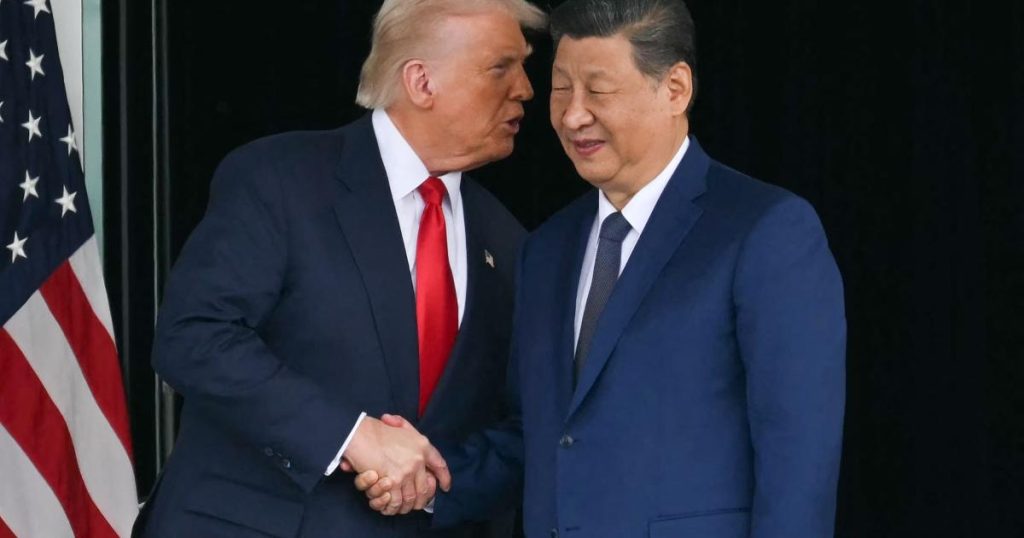
On the other hand, Trump has also described his approach to China as fundamentally cooperative. He has said publicly that America and China can “solve all of the problems of the world” if they work together and called on Beijing to join U.S. efforts to open the Strait of Hormuz. Even tariffs, Trump’s signature China policy, are an instrument to securing what he has long sought: a trade deal with Beijing. Moreover, Trump has issued tariff threats to deter China from equipping Iran militarily, only to back down when Beijing apparently dismissed his warning.
Trump’s blend of competition and cooperation matches his emphasis on dealmaking, but comes at a strategic cost. Last year, the administration approved the sale of advanced AI chips to Chinese companies that partner with the People’s Liberation Army. As national security experts have warned, these chips will support AI model training for combat scenarios against U.S. forces. Trump also approved a deal that has left TikTok’s powerful algorithm under the ownership of ByteDance, a Chinese company, and subject to continued political manipulation by the CCP.
The administration has also reportedly pressured Japan to tamp down its public criticism of Beijing’s belligerence toward Taiwan. The irony is unavoidable: U.S. officials have asked allies and partners for years to take the China threat more seriously. When one of Washington’s closest partners did just that, it received public silence and private scolding from the United States.
As it stands now, the administration’s denial of trade-offs is producing an internally inconsistent approach to America’s most important relationship in the 21st century. Eliminating supply chain dependencies on Beijing while allowing companies like Nvidia to sell advanced AI chips to CCP-controlled companies is akin to pulling weeds from a garden one day and then planting new weeds the next morning. Holding China accountable for its role in America’s fentanyl crisis while leaving TikTok’s algorithm under continued ByteDance ownership is trading synthetic opioids for digital drugs. Silencing allies from speaking out about Taiwan sends a dangerous signal to Xi Jinping that Washington may care more about trade deals than the political future of Taiwan.
A coherent approach to China would more strictly enforce the boundaries between competition and cooperation. It would contest China on bilateral issues of strategic importance—supply chains, critical minerals, AI export controls, fentanyl, TikTok—and beef up deterrent efforts in theaters crucially important to China, namely the Indo-Pacific. And it would find a way to pursue its interests in the Middle East without draining America’s own standing and deterrent capabilities, while also exacting an economic cost on China. Unfortunately, none of that appears to be happening at the moment.
Absent this type of strategic logic, Trump could inadvertently end up weakening America’s hand against the CCP. If the war persists, critical weapons stockpiles needed to deter China in the Indo-Pacific are likely to become further depleted. The U.S. ability to counter CCP propaganda about the war will continue to be limited due to the administration’s foreign broadcasting cuts, as will its ability to counter Chinese initiatives like the Belt and Road Initiative due to the dismantling of USAID.
The longer the crisis in the region endures, the more time and resources the U.S. spends in the Middle East, the more exposed American interests in China’s primary theater of competition—the Indo-Pacific—become. This risk doesn’t invalidate the president’s rationale in the Middle East, but rather highlights the reality of high-stakes strategic trade-offs. The conflict has undoubtedly had negative effects on China’s economy, but the costs to the U.S. strategic position have been far greater thus far. Analysts who insist that weakening Iran is some clever gambit in countering China are missing the forest for the trees.