
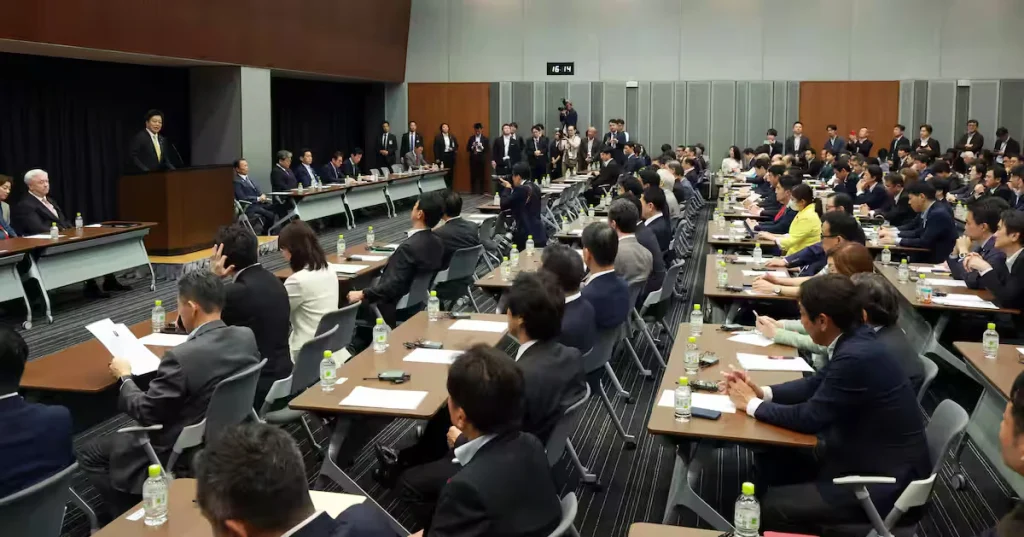
A group of Liberal Democratic Party (LDP) lawmakers aligned with Prime Minister Sanae Takaichi, the party’s president, launched a new parliamentary group, the National Power Research Group, on May 21.
Media outlets have largely framed the move as political maneuvering ahead of next autumn’s LDP presidential election. Political calculation is undoubtedly part of the picture. Yet Koichi Hagiuda, the party’s acting secretary-general and secretary-general of the new group, described its purpose this way:
Hagiuda said Japan now stands at “a truly major turning point” and must confront unresolved postwar questions head-on. He pointed in particular to constitutional revision, stable imperial succession, and national defense, stressing the principle that “we must defend our own country ourselves.”
He said the new study group was launched by lawmakers who share those convictions and want the government and LDP to work together on the medium- and long-term challenges facing the Takaichi administration. The group, he added, will seek to maintain a shared sense of purpose through regular study sessions and cooperation “in a spirit of unity” to meet public expectations.
New Forum After the Factions
As Hagiuda said, Takaichi is now set to take up the challenges of constitutional revision, stable imperial succession, and strengthening of Japan’s defense capabilities head-on. And among them, constitutional revision and stable imperial succession are especially difficult tasks. Even former Prime Minister Shinzo Abe, whom Takaichi regards as her political mentor, was unable to accomplish them.
Historically, the LDP’s factions competed with one another and sharpened each other through that rivalry. Except for the Aso faction, those factions are now dissolved.
One mid-ranking lawmaker from the former Abe faction recalled, “When people talk about factions, the negative image of ‘money politics’ tends to dominate.”
In reality, “the place where we studied the Constitution and imperial succession most seriously was at faction study sessions,” he said.
The LDP has many divisions under its Policy Research Council, as well as numerous parliamentary leagues. Yet the same former Abe faction lawmaker said, “Policy divisions and parliamentary leagues are not places where lawmakers can really debate one another. With the dissolution of the factions, we lost venues for discussing major issues such as constitutional revision.”
“I hope the Research Group on National Strength will fill that role,” he added.
The Coming Backlash
Approval rating for the Takaichi Cabinet remains high. But if the administration moves to tackle constitutional revision and other such issues, opposition forces can be expected to step up their activities.
Anti-revision campaigns are already taking shape online, often with their partisan coloring kept deliberately muted. One example is Demo Calendar, a website that gathers information on demonstrations across Japan under slogans such as “No to war! Protect Article 9” and “Protect the Constitution! Penlight Rally.”
For each event, the site provides the time, address, and a map, and lets users indicate interest with buttons such as “I’m going” or “I support this!” It also encourages visitors to share the listings on X to help broaden their reach.
In its April 6 online edition, Shimbun Akahata, the Japanese Communist Party’s official newspaper, interviewed the site’s operator, identified as Lucy, a 38-year-old resident of Kyushu.
“When reports emerged that the LDP had won a sweeping victory in the general election, I was frightened and felt hopeless,” she said in the interview. “I feared that proposals to revise the Constitution might soon take concrete shape, and that my husband, I, and ordinary citizens could be drafted.”
“But nothing has happened yet,” she continued. “I realized that if we did nothing, it really would be over. Then I saw a post on X noting that there had been a website compiling protest information during the 2015 movement against the security legislation. That prompted me to act, and with the help of AI, I completed and published the site within a few hours.”

Preparing for the Fight Ahead
To be clear, even if the Constitution is revised, no one will be drafted.
Still, it is easy to see how such opposition movements could gain traction online, especially if liberal media outlets pick them up and help amplify their message.
Abe once recalled that enacting the 2015 security legislation amounted to “a de facto constitutional revision,” which he said explained the intensity of the resistance. If Takaichi takes on Article 9 of the Constitution, she will have to brace for an even fiercer backlash than Abe faced at the time.
Nor would such opposition be confined to Japan. In a joint statement issued after the China-Russia summit on May 20, the two countries singled out Japan for criticism, saying that its rapid “remilitarization” now poses a serious threat to regional peace and stability and has drawn strong vigilance from the international community and countries in the region.
The two countries will likely intensify their cognitive warfare campaigns against any move by Japan to revise its Constitution. The LDP must do everything in its power to push back against such opposition efforts, both at home and abroad.
Constitutional revision is part of the LDP’s founding mission. The party should now rally behind that goal, not waste time entertaining claims that the new group backing Takaichi resembles a wartime political mobilization body.
RELATED:
Author: Takashi Arimoto, The Sankei Shimbun
(Read this article in Japanese)