
Leading Japan’s tech and industrial corporations are joining forces to accelerate domestic artificial intelligence development, as the country moves to close the gap with U.S. and Chinese firms amid a broader surge in AI adoption across society, and a push by Tokyo to assert cybernetic sovereignty.
SoftBank Corp., NEC Corp., Honda Motor Co., Sony Group Corp. among others have established a new company dedicated to building large-scale AI models for domestic use, according to sources familiar with the matter cited by Kyodo News on April 6. The initiative is expected to receive government backing and reflects growing concern over Japan’s competitiveness in next-generation technologies.
The new firm will initially employ around 100 AI engineers and be led by a SoftBank executive. In addition to the core group, major industrial and financial players — including Nippon Steel Corp., Kobe Steel Ltd., MUFG Bank, Sumitomo Mitsui Banking Corp., and Mizuho Bank — have invested in the venture, signaling broad cross-sector support.
Coordinated push to build domestic AI capacity
SoftBank and NEC are expected to spearhead development efforts, with Tokyo-based AI developer Preferred Networks Inc. set to join at a later stage. The company aims to create a large-scale AI model that can be shared among Japanese firms, with future applications potentially extending to factory automation, including AI systems capable of operating industrial robots.
The consortium is also planning to apply for funding from Japan’s New Energy and Industrial Technology Development Organization (NEDO), which has earmarked up to 1 trillion yen ($6.3 billion) to support domestic AI development.
Success
You are now signed up for our newsletter
Success
Check your email to complete sign up
The initiative reflects a coordinated attempt to build what is being described as “data sovereignty” — ensuring that critical digital infrastructure and data processing capabilities remain under national control.
That priority was underscored days earlier when Microsoft announced a major expansion of its own AI footprint in Japan.
Microsoft investment highlights global competition
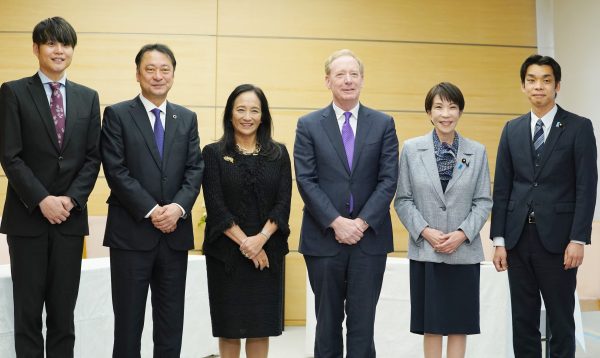
On April 4, Microsoft Vice Chair and President Brad Smith said the company would invest 1.6 trillion yen (US$10 billion) in Japan through 2029 to strengthen AI and cloud infrastructure. Speaking during a meeting with Prime Minister Sanae Takaichi in Tokyo, Smith described the move as the company’s “biggest investment decision in Japan.”
“We can provide the support that the Japanese economy needs for the future,” Smith said at the outset of the meeting, which was open to the media.
The investment will include partnerships with SoftBank Group Corp. and Osaka-based Sakura Internet Inc., and will focus not only on infrastructure but also on workforce development and cybersecurity.
Takaichi welcomed the initiative, calling it “very meaningful” for Japan’s data sovereignty efforts—a concept that has gained prominence as governments seek to ensure that domestically generated data remains subject to national laws and regulations.
Microsoft had previously announced a $2.9 billion investment plan in 2024 to upgrade data centers in Japan, highlighting the accelerating pace of competition in the AI sector.
AI adoption surges across Japanese society
The urgency behind these investments is reinforced by the rapid spread of AI tools among younger generations in Japan.
A survey conducted by the Gakken Research Institute for Learning and Education in November 2025 found that 73.7 percent of Japanese high school students are already using conversational AI tools such as ChatGPT. The figures were also significant among younger students, with 43.2 percent of junior high students and 36.6 percent of elementary school students reporting AI use.
Among high school users, 42.3 percent said they use AI “to help with studying and homework,” while 26.0 percent use it “to find information,” according to the survey of 2,400 students.
Hiroyuki Masukawa, a professor of cognitive science at Aoyama Gakuin University, said the findings highlights a need to address the growing presence of AI in ordinary life.
“It is essential to foster AI literacy and make sure that children can use the technology as an assistant to help improve their thinking ability,” he told Kyodo.