
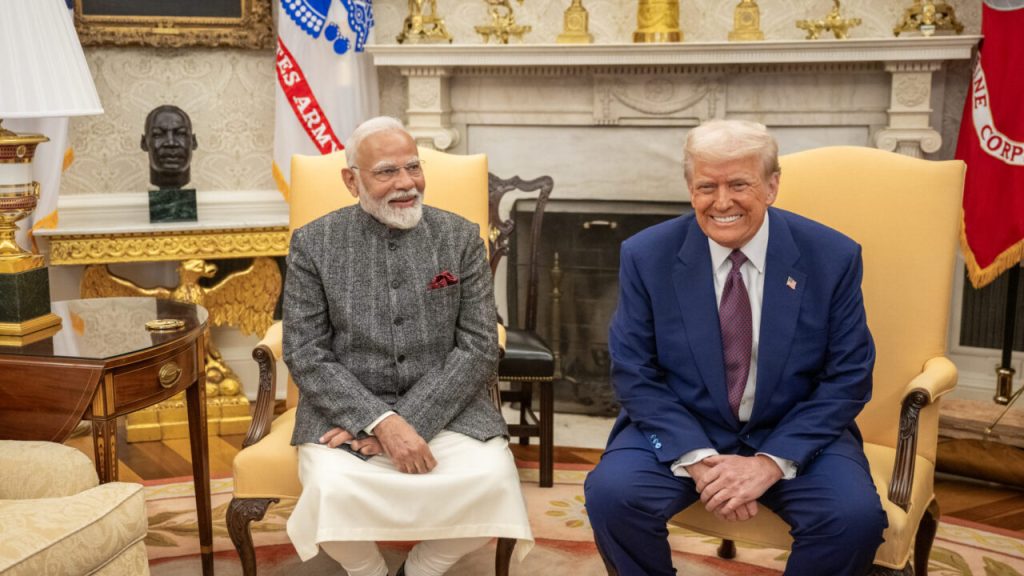
Despite deep defense and economic ties, religion and identity have become major fault lines in the relationship between Washington and New Delhi.
The deterioration of US-India relations under the second Trump administration is often viewed through the lenses of friction over trade, the shifting US positions on China and Pakistan, or the deprioritization of the Indo-Pacific in American national security strategy. But an invisible strain lies in the growing cultural tensions shaping political discourse in both countries. The fault lines between the United States and India are extending beyond traditional instruments of statecraft into issues of religion and identity.
On May 23, Secretary of State Marco Rubio began his four-day visit to India by touring the headquarters of Missionaries of Charity in Kolkata, a Catholic institution established by Mother Teresa. Hindu nationalist groups have accused the charity of prioritizing religious conversion over service to the poor. Two days earlier, Rep. Chris Smith (R-NJ) published a column arguing that India’s domestic legislation regulating the assets of organizations receiving foreign funding risks inflicting “lasting damage” on bilateral relations. Notably, Mother Teresa’s Mission has been under scrutiny under this legislation.
For some time now, developments in India have reinforced perceptions of American interference in domestic affairs.
First, the US Commission on International Religious Freedom (USCIRF) has repeatedly designated India a “country of particular concern” on religious freedom, a characterization New Delhi rejects as biased and politically motivated.
Second, concerns about US-based networks working against India have been addressed in the Indian Parliament and by the prime minister himself in 2024.
Covert actions and intelligence-linked controversies between the two countries have further deepened mistrust. The assassination plot against Gurpatwant Singh Pannun, a US citizen and Khalistani separatist, involving an Indian national reportedly linked to Indian intelligence (a charge the Indian government denies), alongside the arrest of American private military contractorMatthew van Dyke in Kolkata on charges of facilitating illegal border crossings, has further deepened mutual suspicion. Set against the backdrop of diaspora advocacy of Sikh separatism in the state of Punjab and Hindu-Christian ethnic violence in Manipur, such developments give the impression that American and Indian intelligence agencies are engaging in subversive operations on each other’s soil.
On the other side, many in the United States believe that Indians have exploited loopholes in the immigration system to keep Americans away from high-paying jobs. Last month, Rep. Eli Crane (R-AZ) introduced a bill proposing a three-year pause on H-1B visa issuance, alongside reforms that would filter out many Indian employees working in the United States, amid accusations that Indians have gamed the H-1B system. The economic frustrations have manifested in cultural outbursts, evident through targeting Indian-Americans in hate crimes, trolling Indian-origin government officials, and rising anti-Indian sentiment on social media platforms such as X.
With socio-cultural anxieties on both sides, a bipartisan consensus has finally emerged, ironically, in the opposite direction. Beyond a handful of diaspora lobbies, it is difficult to identify a politically salient constituency willing to advocate for warmer US-India relations consistently. Across the political spectrum in both countries, pessimism toward the other is steadily deepening.
For liberals in America, India is becoming a difficult democratic partner because of Prime Minister Narendra Modi’s perceived assaults on religious freedom and democratic institutions. The MAGA-Right views Indian immigrants as beneficiaries of a broken immigration system that has displaced American workers from high-paying jobs. Christian conservatives often see the beliefs of Hindu-Americans as incompatible with Christian values.
On the other side, Hindu nationalists find both religious intolerance of the Christian Right and progressive values of the Left as fertile ground for domestic subversion through missionary activities and global civil society networks, respectively. The liberals in India view the United States as an imperial power and the principal underminer of the rules-based order. The strategic autonomy school of Indian foreign policy has come to realize that Washington does not see India as an equal partner. Meanwhile, New Delhi’s hawks suspect that the United States remains uncomfortable with India’s rise, shaped in part by Washington’s experience with Beijing.
The political scientist Samuel Huntington, in his famous Clash of Civilizations thesis, argued that the dominant source of conflict in the post-Cold War world would be cultural. Huntington classified India as a “swing civilization,” capable of aligning with either the West or other powers depending on strategic interests. Though both countries belong to different civilizations, the scope for conflict between them would have remained limited as long as economic and strategic interests overpowered their cultural differences.
Critics of The Clash of Civilizations thesis note that it treats civilizations as monolithic actors, underplaying economic and strategic variables, and paying insufficient attention to the interaction between civilizations and domestic politics in a globalized world. For much of the post–Cold War period, it did not explain the US-India relations, as complementary economic and strategic interests bound the two countries. Current trends suggest that the conditions limiting its applicability may be steadily weakening in US-India relations.
First, while India appears to be moving toward a more cohesive Hindu civilizational identity, the United States has struggled to accommodate Hindus within its emerging societal undercurrents.
Second, the geopolitical and economic foundations of partnership stand weakened, and strategic priorities show clear signs of divergence.
Third, the interactions between Hindus and Christians in both the United States and India have grown more confrontational than in the past.
The long-celebrated “oldest-and-largest democracies” narrative, which once glorified US-India ties, has lost its persuasive force. In India, notwithstanding the temporary setback of the 2024 general elections, the decisive victories of Prime Minister Modi’s Bharatiya Janata Party (BJP) in successive state elections, West Bengal being the latest, suggest that the Indian electorate will continue to vote for the Hindu nationalists. In the United States, meanwhile, political polarization has deepened, yet neither side of the ideological divide appears receptive to Hindu identity. The Christian right often views Hinduism through a hostile theological lens, while segments of the radical left struggle to situate them within the familiar oppressor-oppressed framework, given that Hindu-Americans, like Jews, are not marginalized and among the highest-earning minorities in the United States.
For much of the post-Cold War decades, these cultural divergences remained politically manageable. They were overshadowed first by economic interdependence generated through the post-1990s information technology boom and later by the mutual strategic interests in balancing China. But the glue that once held a cracked vase has dried up. Trade and immigration have emerged as a principal source of friction under the second Trump administration, while the prospects of détente following President Donald Trump’s visit to Beijing weaken the strategic rationale that underpinned US-India ties for nearly two decades. If these trends persist, the bilateral relationship risks being reduced to the kind of animosity that Huntington once envisioned.
If history is any guide, the cultural fault lines between the United States and India can only be contained by converging material interests. At present, however, such prospects appear meager. Over the past year, Washington and Islamabad have moved toward a renewed strategic accommodation, driven in part by instability in West Asia. At the same time, both India and the United States have sought to stabilize their respective ties with China. Should these trends persist, the foundations of the bilateral relationship will continue to erode.
In the near term, India’s drift toward Hindu nationalism is unlikely to reverse course. A more culturally cohesive India will remain increasingly sensitive to questions of religion, sovereignty, and external involvement in domestic affairs. Meanwhile, the economic foundations of the relationship are under strain. Under the second Trump administration, there appears to be little appetite for restoring the earlier consensus on immigration and free trade.
In this environment, both countries will have to construct new forms of interdependence. For instance, expanding cooperation in energy and technological innovation may provide one avenue. Reforming immigration frameworks to cultivate human capital, while reserving skilled jobs for Americans and plugging India’s brain drain, may offer another solution. Unless new strategic and economic complementarities emerge, it may be difficult for both countries to prove Samuel Huntington wrong.
About the Author: Ambuj Sahu
Ambuj Sahu is a PhD candidate at Indiana University Bloomington and writes about India’s foreign policy interests in the Indo-Pacific. He is also pursuing an MS in Applied Statistics. He originally studied electrical engineering at the Indian Institute of Technology Delhi. Follow him on X at@DarthThunderous.