
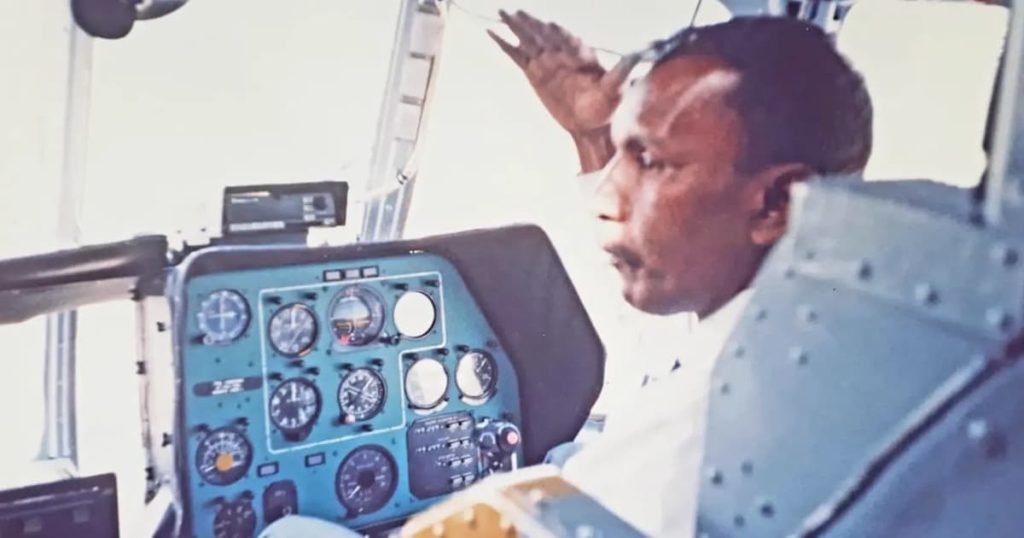

When Munisamy Arumugam climbed into the cockpit of a Russian-built Mi-171 helicopter in Siberia nearly three decades ago, he wasn’t there as a trainee or tourist.
The retired Royal Malaysian Air Force (RMAF) lieutenant-colonel had been entrusted with a far more important task: to determine whether the aircraft was suitable for Malaysia.
For a pilot who had already logged more than 5,500 flying hours across an extraordinary range of aircraft during a 31-year military career, it was a responsibility unlike any he had undertaken before.
Today, the soft-spoken 80-year-old still describes the experience as “the icing on the cake”.
“It was shortly after my retirement from the RMAF in 1998 at age 52, after 31 years of service.
“That year, Aerospace Industries Malaysia roped me in as project manager to evaluate the suitability of the Mi-171 as a search-and-rescue helicopter for the fire and rescue department.
“The following year, I spent months shuttling between Kuala Lumpur and Ulan Ude for a thorough analysis on the capabilities of the heavy-lift helicopter.”
Sam, as he is affectionately known among former colleagues, became the first Malaysian to test-fly the aircraft at the Ulan Ude Aviation Plant in Buryatia, deep in Siberia.

The assignment came during a period when Malaysia was looking increasingly towards Russia to diversify its defence procurement.
Impressed by Russia’s aviation capabilities after the 1991 Langkawi International Maritime and Aerospace Exhibition, then prime minister Mahathir Mohamad later oversaw the purchase of MiG-29N fighter jets in 1995, followed by Sukhoi Su-30MKM fighters in 2003.
Against that backdrop, Sam’s evaluation formed part of Malaysia’s efforts to assess Russian-built aircraft for civilian search-and-rescue duties.
His verdict was positive. “I found the Mi-171 practical, user-friendly, cost-effective and highly manoeuvrable,” he said.
Three years later, during Mahathir’s visit to Ulan Ude in March 2002, Sam once again took to the controls – this time with the prime minister on board during a demonstration flight.
Malaysia eventually acquired two Mi-171 helicopters for the fire and rescue department’s air division in 2004.

Sam had already built an impressive flying career long before Siberia.
After joining the RMAF in 1967, he was among four young officers selected for 18 months of flight training in India, where they progressed through several aircraft before returning home.
“Our basic flying course at the India air force base in Bidar saw us training on the Hindustan Trainer-2,” he recalled.
“Then we moved to Jodhpur to train on the Harvard T-6G before completing our stint at Hakimpet on the de Havilland Vampire.”
Back in Malaysia, Sam flew an equally diverse fleet that included the Bell 47G, Alouette III, Nuri and Percival Provost. He later travelled to Britain for instructor training on the Aérospatiale Gazelle.
His versatility, he believes, made him a better pilot. “My exposure to both rotary and fixed-wing aircraft sharpened my knowledge and honed my flying skills.”

Those skills would prove invaluable during some of the RMAF’s most demanding years.
Throughout the communist insurgency, Sam flew countless Nuri helicopter sorties into the jungles of peninsular Malaysia, Sabah and Sarawak, transporting troops and supporting security operations in difficult terrain.
His duties also included VIP missions. As a young flying officer stationed in East Malaysia, he frequently flew Sarawak’s second Yang di-Pertua Negeri, Tuanku Bujang Tuanku Othman, on visits to remote Iban longhouses, including Rumah Jawi Abu in Sungai Gemuan near Bintangor in 1971.
Not every mission ended in celebration. On Jan 16, 1991, Sam was the first rescue pilot dispatched after an RMAF Nuri helicopter crashed into a rubber plantation in Kampung Parit Zin, Muar.
Miraculously, all 12 people on board survived.
Fifteen years earlier, he had also been among the first pilots to respond after another Nuri was shot down by communist insurgents in Gubir, Kedah, killing all 11 personnel aboard.

For a man whose career spanned more than three decades, countless aircraft and thousands of flying hours, those missions remain deeply etched in his memory.
Yet it is that flight over Siberia – at the controls of a helicopter few Malaysians had ever seen – that still stands above the rest: “It was the icing on the cake.”